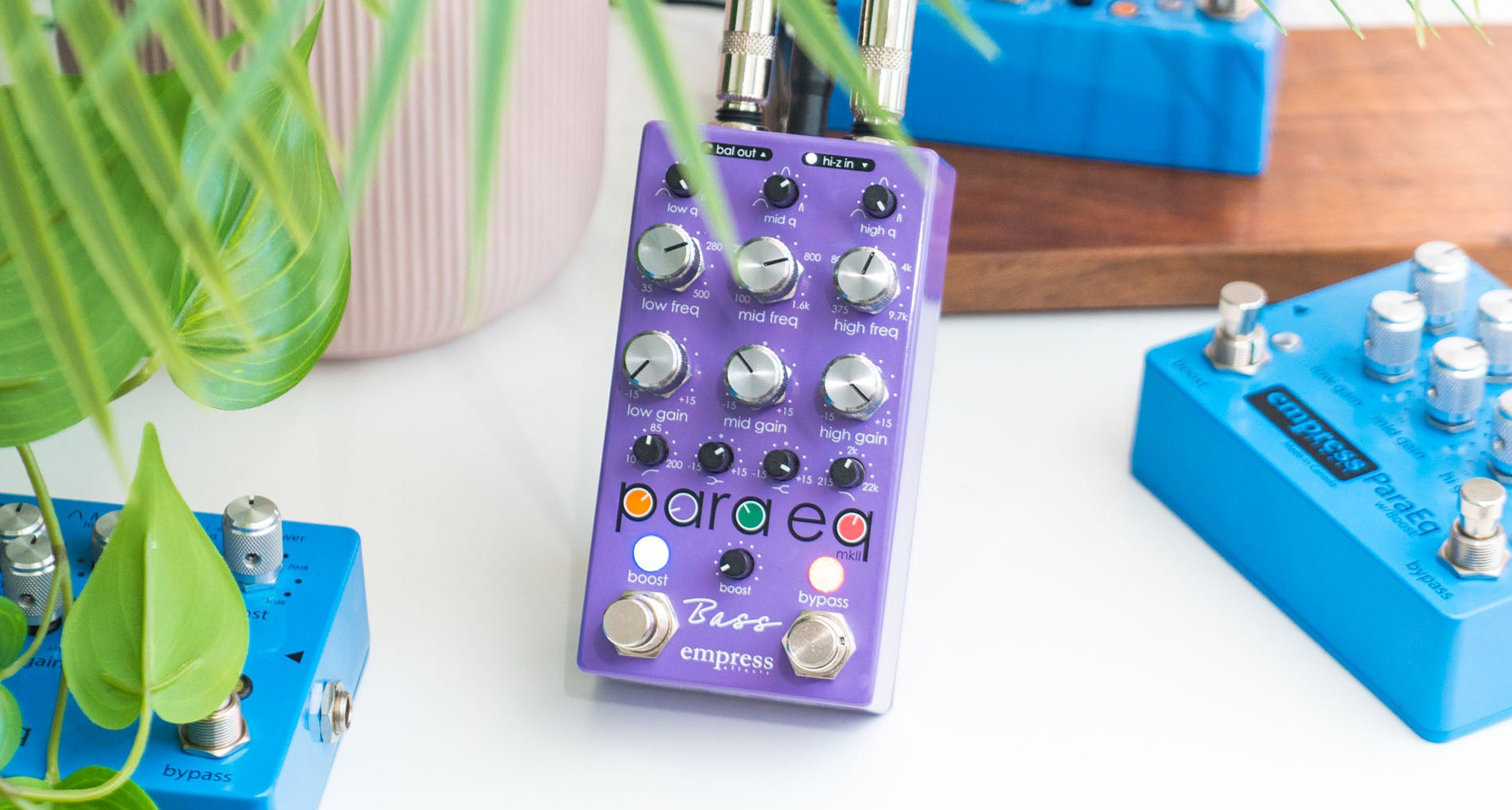
Empress Effects Bass ParaEQ Deep Dive: Pedal Review
A studio-grade tone shaping tool for bass players EQ pedals are among the most overlooked tools on a bass pedalboard. Many players rely entirely on the EQ built into their amplifier or instrument, which usually provides only broad tonal shaping. While that works in many situations, it lacks the precision needed to solve common bass problems such as muddiness, feedback, or lack of definition in a dense mix. The Empress Effects Bass ParaEQ was designed to solve exactly those problems. Based on the company’s highly respected ParaEQ MKII Deluxe, the Bass ParaEQ adapts the design specifically for bass instruments. The result is a pedal that offers the kind of precise, studio-style tone shaping normally found in rack gear or mixing consoles, but in a compact stompbox format. The pedal combines three fully parametric EQ bands, shelving filters, and high-pass and low-pass filters, giving bass players and producers an exceptional control over their sound. More importantly, those controls are tailored specifically to bass frequencies, which makes the pedal far more intuitive in real-world playing situations. Disclaimer: This pedal was kindly provided by Empress Effects for the purpose of this review. However, this does not influence our opinions or the content of our reviews. We strive to provide honest, unbiased, and accurate assessments to ensure that our readers receive truthful and helpful information. Designed specifically for bass According to Empress Effects, the Bass ParaEQ grew out of conversations with bass players who were already using the company’s ParaEQ MKII Deluxe. That pedal had become popular among musicians who needed powerful tone shaping both on stage and in the studio. However, bass players pointed out that the original design could be refined further to better suit low-frequency instruments. The Bass ParaEQ keeps the core architecture of the original pedal but adds several features that specifically benefit bass players. The frequency ranges of the parametric bands were optimized for bass, allowing the pedal to target common tonal problem areas more effectively. The pedal also includes a high-impedance input option for piezo pickups, which is especially useful for upright bass players, and an auto-detecting balanced output for improved signal compatibility. One of the most important design choices is the pedal’s 27-volt internal operation. Even though the pedal runs from a standard 9-volt power supply, the internal circuitry boosts the operating voltage to 27 volts. This dramatically increases headroom, allowing the pedal to handle large EQ boosts without distorting the signal. In practice, this means the Bass ParaEQ remains clean, dynamic, and noise-free even when making aggressive tone adjustments. The philosophy behind the pedal is simple: it should make your bass sound like itself—only bigger, clearer, and more defined. Understanding parametric EQ Parametric EQ is not something that everyone knows about, but to appreciate what makes the Bass ParaEQ so powerful, it helps to understand how it differs from the tone controls found on most bass amps. Traditional EQ sections typically provide fixed bands such as bass, mid, and treble. These controls adjust predetermined frequency ranges, which makes them easy to use but somewhat limited. A parametric EQ adds two additional layers of control. Instead of adjusting a fixed frequency band, each EQ section lets you choose the exact frequency you want to boost or cut, as well as the bandwidth of that adjustment. This allows the user to perform both broad tone shaping and extremely precise corrective EQ. The Bass ParaEQ includes three parametric bands, each capable of boosting or cutting frequencies by up to 15 dB. In addition to selecting the frequency and gain, each band includes a Q control, which determines how wide or narrow the adjustment is. A narrow Q setting focuses the EQ on a very small range of frequencies. This is particularly useful when trying to eliminate specific problem areas, such as feedback or resonant notes that jump out in certain rooms. A wider Q setting affects a larger portion of the spectrum and tends to sound more natural, making it ideal for general tone shaping. Many players will find that medium or wide Q settings are perfect for sculpting their overall sound, while narrow Q becomes useful for surgical fixes. Filters that shape the extremes While the parametric bands provide detailed control over specific frequencies, the Bass ParaEQ also includes high-pass and low-pass filters that help shape the extremes of the frequency spectrum. The high-pass filter removes frequencies below a selected cutoff point, with a range from 10 Hz to 200 Hz and a slope of 12 dB per octave. Although bass players sometimes hesitate to remove low frequencies, extremely deep sub-bass often contributes more rumble than usable tone. Rolling off these frequencies can clean up the sound dramatically, especially in live settings where uncontrolled low end can overwhelm a mix. At the other end of the spectrum, the low-pass filter attenuates frequencies above the cutoff point, which can be adjusted between 215 Hz and 22 kHz. This filter is useful for smoothing harsh high-frequency content such as string noise or aggressive pick attack. It can also be used creatively to create darker or more vintage-style tones by gently rolling off the upper harmonics. Together, these filters allow the Bass ParaEQ to function not only as a corrective EQ but also as a powerful tone-shaping tool. Musical shelving filters In addition to the parametric bands and filters, the Bass ParaEQ incorporates Baxandall shelving filters for shaping the overall low and high end of the instrument. Baxandall circuits are widely respected in audio design because of their smooth, musical response curves, which tend to sound more natural than aggressive parametric boosts. The low shelf in the Bass ParaEQ uses a modified Baxandall design that behaves somewhat differently from traditional shelving EQs. Instead of operating at a fixed break frequency, the transition point shifts dynamically depending on how much boost or cut is applied. Smaller adjustments affect a narrower range of frequencies, while larger boosts extend further up the low-mid spectrum. For example, moderate boosts primarily target frequencies below roughly 75 Hz, while