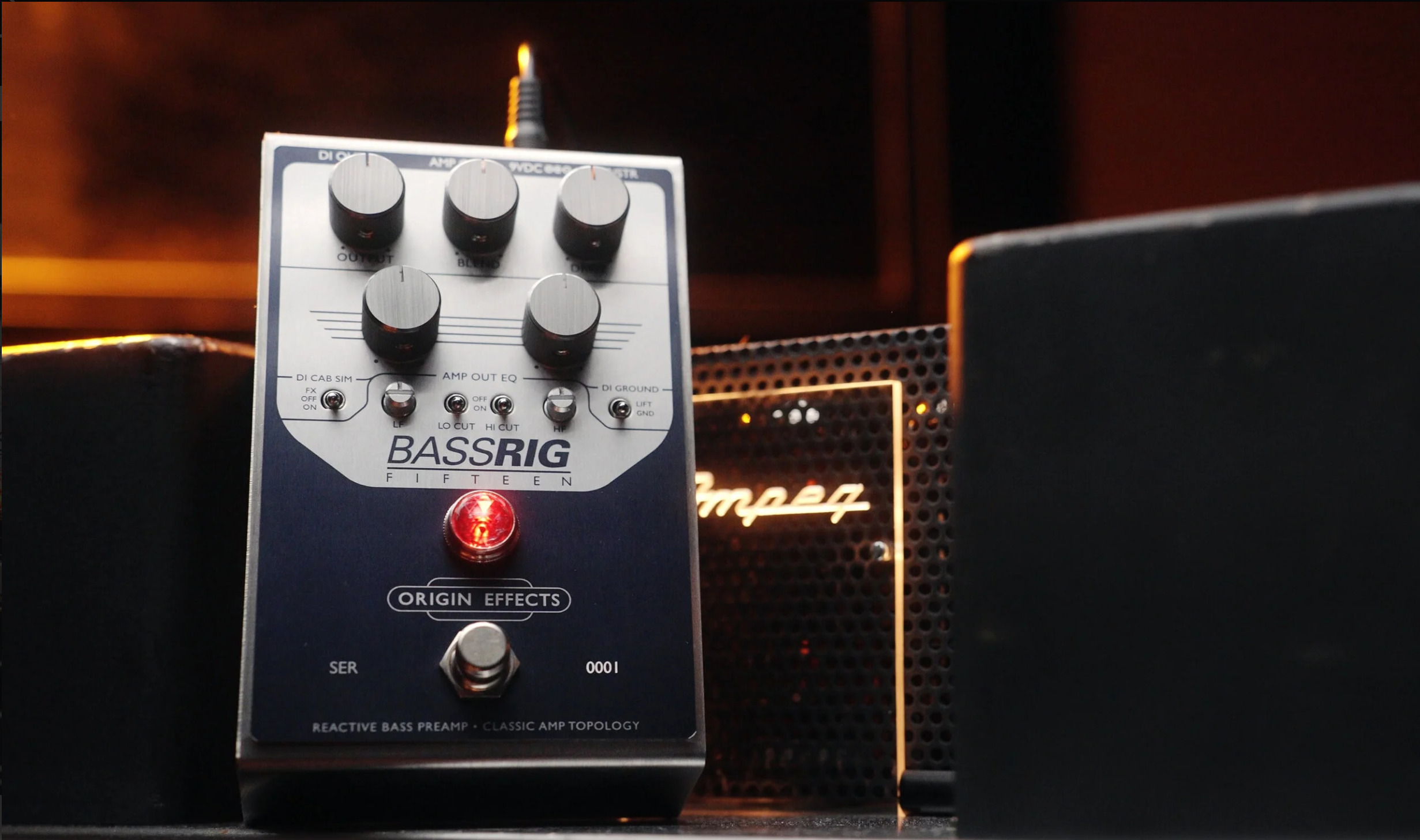
Origin Effects BASSRIG Fifteen: Pedal Review
The Sound of Restraint Done Right When it comes to effects pedals, there are a wide range of brands on the market. Some focus on affordability, others on value for money; some operate in the boutique, hard-to-find space, while others have become industry staples. And then there’s Origin Effects. Origin Effects is one of those brands that delivers exactly what it promises: hand-built, individually tested, industry-leading compressors and groundbreaking, amp-inspired overdrive/preamp pedals. I’m no stranger to Origin Effects pedals—and chances are, neither are you. I’ve been using their Cali76 compressor for the past four years, and I can say without a shadow of a doubt that very few pedals on the market reach that same level of quality and attention to detail. So when they offered to send me their newest bass pedal, the BassRig Fifteen, I wasn’t just excited—I was genuinely blown away. And having said that, here’s our disclaimer: Disclaimer: This pedal was kindly provided by Origin Effects for the purpose of this review. However, this does not influence our opinions or the content of our reviews. We strive to provide honest, unbiased, and accurate assessments to ensure that our readers receive truthful and helpful information. You see, I’ve always been the kind of player who gravitates toward a flatwounds-into-P-Bass-into-B-15 setup. So getting my hands on an Origin Effects B-15–inspired pedal—especially considering the work they’ve done with the other BassRig models (the Black Panel and the Super Vintage)—meant my expectations were about as high as they could be. Spoiler alert: I wasn’t disappointed. Check the BASSRIG Fifteen price on Amazon –> Controls, Features and Connectivity At its core, the BassRig Fifteen is exactly what the name suggests: an all-analogue amp recreation and DI pedal based on the legendary Ampeg B-15 Portaflex. It’s important to be clear here—this is not designed to be a drive pedal. The overdrive is part of the picture, but the real goal is to recreate the response, feel, and tonal behaviour of a classic studio bass amp. The control layout reflects that philosophy. Origin Effects has divided the pedal into three main sections: the core amp controls, the amp output EQ section, and the DI section. Starting with the main controls, you get Drive, Blend, and Output. The Drive control behaves like the gain stage of a real amp. Turning it up increases saturation and harmonic richness, while backing it off delivers clean, warm tones with just a hint of breakup. It’s less about “adding distortion” and more about how hard you’re pushing the virtual amp. The Blend control is essential for bass. It lets you mix your clean signal back in, preserving low-end clarity and note definition—especially useful as you increase the gain. The Output simply sets the overall level of the pedal without affecting the character of the sound, making it easy to integrate into any setup. Before the gain stage, there’s a two-band pre-drive EQ consisting of Bass and Treble controls. This is a key part of how the pedal behaves. The Treble control shapes how much high-end hits the drive stage. Increasing it gives you a brighter, more aggressive response, while rolling it back smooths things out considerably. The Bass control adjusts the low-end going into the circuit. Turning it up adds depth and weight, while reducing it tightens the response and makes the sound more focused. Notably, lower bass settings can really help maintain definition when pushing the pedal harder. The Amp Out EQ section is designed for those running into a real amp or power amp. Here you’ll find HF and LF controls for shaping high and low frequencies, allowing you to adapt the pedal to different cabinets and environments. Two additional switches refine this further. The Hi Cut trims top-end frequencies—particularly useful with modern tweeter-equipped cabinets—helping recreate the warmer character of a vintage B-15 cab. The Lo Cut reduces low-end buildup, tightening the response of full-range cabinets and making them behave more like a classic ported 1×15. Then there’s the DI section, which is one of the standout features of the BassRig platform. The balanced XLR DI output provides an all-analogue cabinet simulation of a B-15-style 1×15 enclosure, making it ideal for going straight into a PA or recording interface. A Cab Sim switch determines how and when that simulation is applied. In FX mode, the cab sim is only active when the pedal is engaged, allowing it to behave like a traditional effect. In ON mode, the cab sim remains active at all times, effectively turning the pedal into a standalone cabinet simulator for your entire signal chain. And if you prefer to use external IRs or process your tone later, you can switch it OFF entirely. To round things out, there’s a ground lift switch to eliminate hum when using the DI alongside other outputs—a small but crucial detail for real-world use. Build Quality & Design As expected from Origin Effects, the build quality is exceptional. The enclosure feels incredibly robust, the switches are solid, and the knobs have a smooth, precise resistance that makes fine adjustments easy. This is clearly a pedal built to withstand both studio work and life on the road. One thing worth mentioning is the weight. This is not a lightweight pedal by any means—it has a reassuring heft to it. While that might be noticeable on smaller pedalboards, it also reinforces the sense that you’re dealing with a premium, no-compromise piece of gear. Despite the number of controls, the layout remains clean and intuitive. Each section is clearly defined, and once you understand the signal flow, dialing in tones becomes second nature. Visually, it keeps things understated and professional—very much in line with the rest of the Origin Effects lineup. Sound & Real-World Performance The moment you plug in, it becomes obvious what this pedal is about. Rather than feeling like a traditional effects unit, the BassRig Fifteen responds like an actual amp. There’s a depth, a softness to the attack, and a dynamic response that makes it incredibly