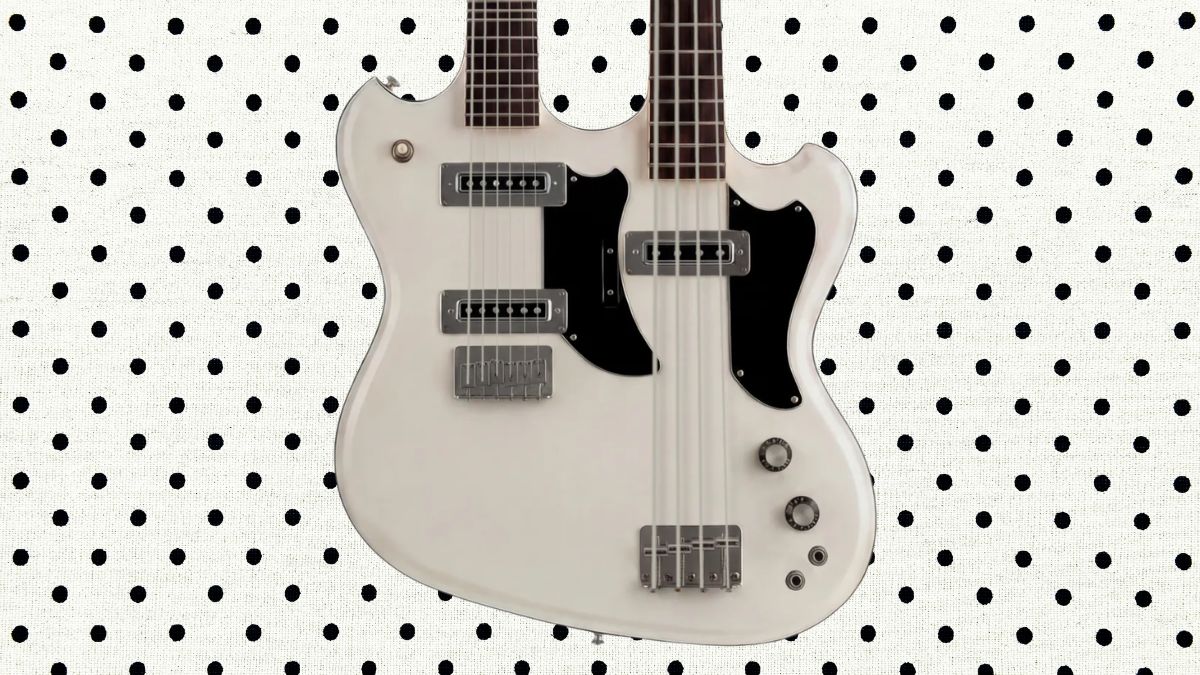
Eastwood Releases Microtonal Doubleneck
Is this the Weirdest Bass/Guitar Hybrid I’ve Seen This Year? There are plenty of strange instruments floating around the internet these days, but every once in a while something comes along that genuinely stops musicians in their tracks. Eastwood Guitars’ new Microtonal Doubleneck 4/6 Electric Guitar/Bass is one of those instruments. If you’ve spent any time on YouTube, Instagram, or musician forums over the last few months, chances are you’ve already seen the band Angine de Poitrine. The Quebec experimental duo exploded online after a now-viral KEXP performance that introduced a much wider audience to their bizarre mix of math rock, Zeuhl, avant-garde prog, absurdist stage design, and microtonal harmony. The visual presentation certainly helped. Giant papier-mâché masks. Matching polka-dot outfits. Completely deadpan stage presence. But honestly? The thing most musicians couldn’t stop talking about was the instrument. At the center of the band’s sound is a custom-built doubleneck featuring both a bass neck and a guitar neck, each outfitted with microtonal frets that allow for quarter-tone intervals and harmonic textures you simply cannot achieve on a standard instrument. The sound is disorienting at first, but also strangely addictive. Now Eastwood Guitars has decided to bring that concept into production. Not Quite a Signature Model One of the more interesting parts of this story is that Eastwood’s instrument is not technically an official signature model. According to the company, the original custom instrument used by Angine de Poitrine was built by Quebec luthier Raphaël Le Breton. After the band suddenly went viral, there was understandable interest in creating a production version of the instrument. However, Eastwood says the musicians themselves were not interested in simply recreating the exact custom build as a commercial signature instrument. Instead, the company revisited an older concept discussion they had apparently had years earlier with Khn de Poitrine regarding a white microtonal version of Eastwood’s existing 4/6 doubleneck platform. That distinction matters. Rather than presenting this as a direct copy of the band’s instrument, Eastwood is positioning it more as a realization of an earlier collaborative idea that now happens to align perfectly with the current explosion of interest in microtonal music. And honestly, that probably makes more sense creatively. The original custom instrument feels deeply tied to the identity of the band itself. Trying to duplicate it exactly would likely have felt a little too safe — or worse, a little too corporate. So What Exactly Is This Thing? From a technical perspective, the instrument is pretty fascinating. The upper neck is a six-string microtonal guitar neck, while the lower neck is a four-string microtonal bass neck. Both use modified fret spacing designed to accommodate quarter-tone playing. If you’ve never experimented with microtonality before, the easiest way to think about it is this: traditional Western instruments divide an octave into twelve equal notes. Microtonal systems introduce additional notes between those pitches. The result is a very different harmonic language. Notes bend against each other differently. Chords feel unstable in unusual ways. Melodies suddenly take on an almost vocal quality because of the extra tonal movement available between standard semitones. For progressive musicians, experimental composers, and players who enjoy alternative tuning systems, it opens up an entirely different creative world. Construction-wise, Eastwood appears to have stayed fairly practical here. The body is alder, while both bolt-on necks are maple with rosewood fingerboards. Hardware is standard chrome/nickel Gotoh-style equipment, which should help keep maintenance relatively straightforward despite the instrument’s unconventional layout. Electronics are also more sensible than you might expect. The guitar section includes three Eastwood single-coil pickups paired with a three-way selector switch, along with dedicated tone and volume controls. Separate outputs allow the bass and guitar sides to run independently into different amps or signal chains. That last detail is especially important. Players experimenting with this type of instrument are almost certainly going to want independent processing paths for the bass and guitar sections. Running the bass through octave effects, synth processing, or heavy compression while keeping the guitar side more atmospheric could produce some genuinely wild soundscapes. Surprisingly Affordable — At Least Relatively Speaking Custom instruments like this are usually financially terrifying. A fully custom-built microtonal doubleneck from an independent luthier could easily climb into boutique pricing territory very quickly, especially once custom fretwork and specialized setup work enter the picture. That’s why the projected price here is honestly one of the biggest surprises. Eastwood is currently listing the instrument at around $1,299 USD through its Guitstarter platform. That is obviously not inexpensive, but in the context of boutique experimental instruments, it’s actually fairly accessible. For comparison, many high-end extended-range basses, custom multiscale instruments, or boutique microtonal builds can easily cost double or triple that amount. Whether the average player will actually commit to learning microtonal phrasing is another question entirely. But for adventurous musicians, soundtrack composers, progressive players, and experimental bassists, this suddenly becomes a realistic option instead of a distant fantasy. Why Microtonal Instruments Suddenly Matter Again What’s particularly interesting about this release is that it arrives during a moment when microtonal music is slowly moving from niche curiosity into mainstream awareness. For decades, microtonality mostly existed on the fringes of experimental composition, jazz fusion, avant-garde classical music, and various regional musical traditions around the world. But over the last several years, artists like King Gizzard & The Lizard Wizard helped expose younger rock audiences to alternative tuning systems in a much more approachable way. Angine de Poitrine pushed things even further. Their music doesn’t simply use microtonality as an occasional texture. It feels completely built around it. The dissonance, instability, and strange melodic movement are fundamental to the emotional impact of the music itself. That’s part of why their performances generated such strong reactions online. Even people who didn’t fully understand what they were hearing immediately recognized that it sounded different. Final Thoughts I genuinely don’t know how many of these Eastwood will ultimately sell. Microtonal instruments are still extremely niche, and doubleneck instruments have always occupied a fairly