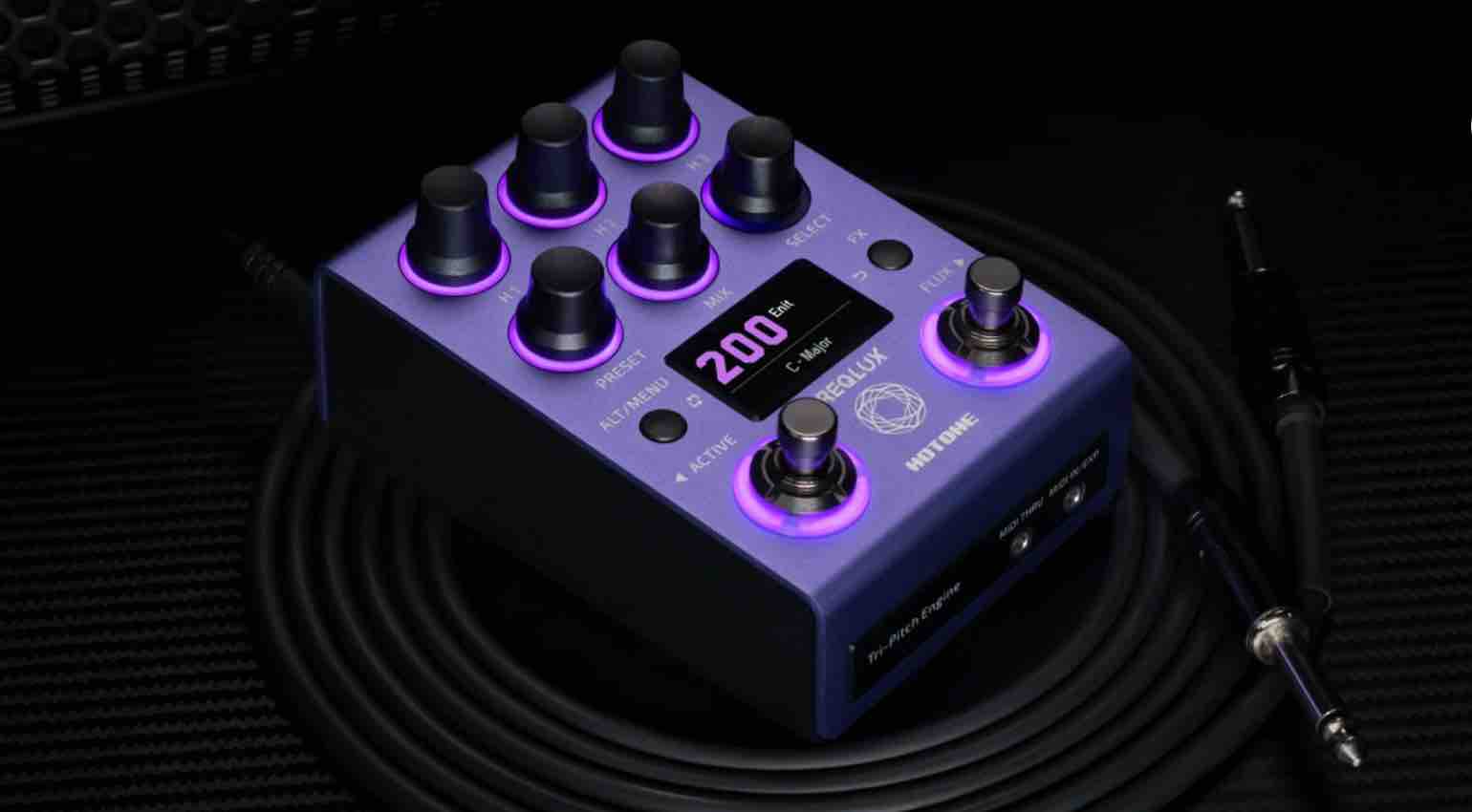
Hotone Freqlux Pitch Shifter: Pedal Review
Beyond Octaves and Into Sound Design Disclaimer: This pedal was kindly provided by Hotone for the purpose of this review. However, this does not influence our opinions or the content of our reviews. We strive to provide honest, unbiased, and accurate assessments to ensure that our readers receive truthful and helpful information. Every now and then a pedal lands on my desk that completely changes direction after the first hour of playing. The Hotone Freqlux was one of those pedals. My initial expectation was fairly simple: another high-end pitch processor with plenty of intervals, harmonies and presets. After all, that’s become a crowded category. But the more time I spent with the Freqlux, the more I realized that’s not really what Hotone has built here. This is less an octave pedal and more a sound-design platform. Yes, it can deliver convincing sub octaves, harmonies and synth textures, but those are almost by-products of a much deeper engine. The Freqlux rewards experimentation in a way very few pedals do, and for bass players willing to invest a little time, it can become one of the most inspiring pieces of gear on the pedalboard. More Than Three Pitch Voices On paper, the headline feature is simple enough: three completely independent pitch engines that can each be assigned their own interval, operating mode, level, panning, attack and tonal characteristics. In practice, though, those specifications don’t really explain what makes the pedal interesting. Most octave pedals answer one question: “How do I add another note to my bass?” The Freqlux asks something very different: “What kind of instrument do you want your bass to become?” One patch might combine a huge sub octave with a fifth above and a lightly detuned voice that creates an almost studio-like width. Another patch can remove the sub entirely and build evolving organ textures. Another can become a synth pad that barely resembles a bass guitar at all. It’s this flexibility that defines the Freqlux. Rather than stacking effects together, you’re designing voices. Understanding the Different Modes Each voice can operate independently in several different modes, giving you enormous flexibility over how each layer behaves. Poly Mode For many bass players, Poly mode will become the default. Tracking is excellent, even on lower notes where many digital pitch pedals begin to struggle. Fast passages remain articulate and double stops are reproduced surprisingly well. If your goal is adding supportive octaves or harmonies without changing the fundamental character of your bass, this mode delivers exactly that. Key Mode Key mode intelligently generates harmonies within a selected scale. This immediately becomes useful for melodic bass playing, solo arrangements or modern worship music where fixed intervals can easily clash with the underlying harmony. Instead of constantly thinking about what interval will work, you simply play. Detune This ended up becoming one of my favourite modes. Rather than creating obvious harmonies, Detune gently spreads the sound, adding width and richness without drawing attention to itself. It’s subtle enough to leave on for an entire song, making fingerstyle bass feel larger while retaining every ounce of clarity. Arpeggiator Then things start getting interesting. ARP mode transforms sustained notes into evolving musical patterns, pushing the pedal well beyond conventional pitch shifting. Combined with delay and reverb, it becomes surprisingly easy to create ambient passages that sound more like a modular synthesizer than a bass guitar. Mod Removing pitch shifting entirely leaves behind a flexible modulation engine capable of adding movement and texture without fundamentally changing the original tone. Flux Changes Everything The dedicated Flux footswitch deserves special mention because it completely changes how the pedal is played. Rather than simply switching sounds, Flux lets you manipulate pitch movement in real time, creating smooth glides, dramatic octave dives or evolving harmonic transitions. It’s expressive rather than functional. Combined with Auto Flux, which responds dynamically to your playing, the pedal begins reacting almost like another instrument rather than another effect. Surprisingly Easy to Fit Into a Bass Rig Considering everything the Freqlux is capable of, I expected integrating it into a bass rig to be complicated. It wasn’t. Placed after compression, tracking becomes extremely reliable, while the extensive tone and attack controls allow each generated voice to sit exactly where you want it. You can keep your dry bass solidly in the centre while blending harmonies around it, preserving the low-end foundation that every bassist worries about losing when using pitch effects. That attention to detail makes the pedal far more practical than its specification sheet initially suggests. Living With the Freqlux This is where my opinion of the pedal changed. The Freqlux is not a plug-and-play pedal. If you’re expecting to plug it in, scroll through two or three presets and immediately understand everything it can do, you’re probably going to miss the point. Instead, this is a pedal that rewards familiarity. The more time you spend with it, the better it becomes. Some evenings I’d sit down intending to test one feature, only to realise two hours had disappeared while exploring different combinations of voices, modulation and Flux behaviour. That’s partly because the factory presets are genuinely enjoyable. With 95 presets available straight out of the box, there’s an enormous amount to explore, and they’re well designed enough to demonstrate just how broad the pedal’s capabilities really are. You’ll find convincing organ tones, enormous synth basses, beautifully organic sub octaves, shimmering ambient textures and screaming upper-octave effects sitting only a few clicks apart. But as good as those presets are, they’re really just demonstrations. The real magic begins when you stop browsing and start building. Once you understand how the three voices interact, how attack changes the feel of the harmonies, how modulation creates movement and how feedback can transform a static note into something alive, the Freqlux starts feeling less like an effects pedal and more like a musical instrument in its own right. That’s probably the biggest compliment I can give it. It genuinely feels like there’s a lot of music