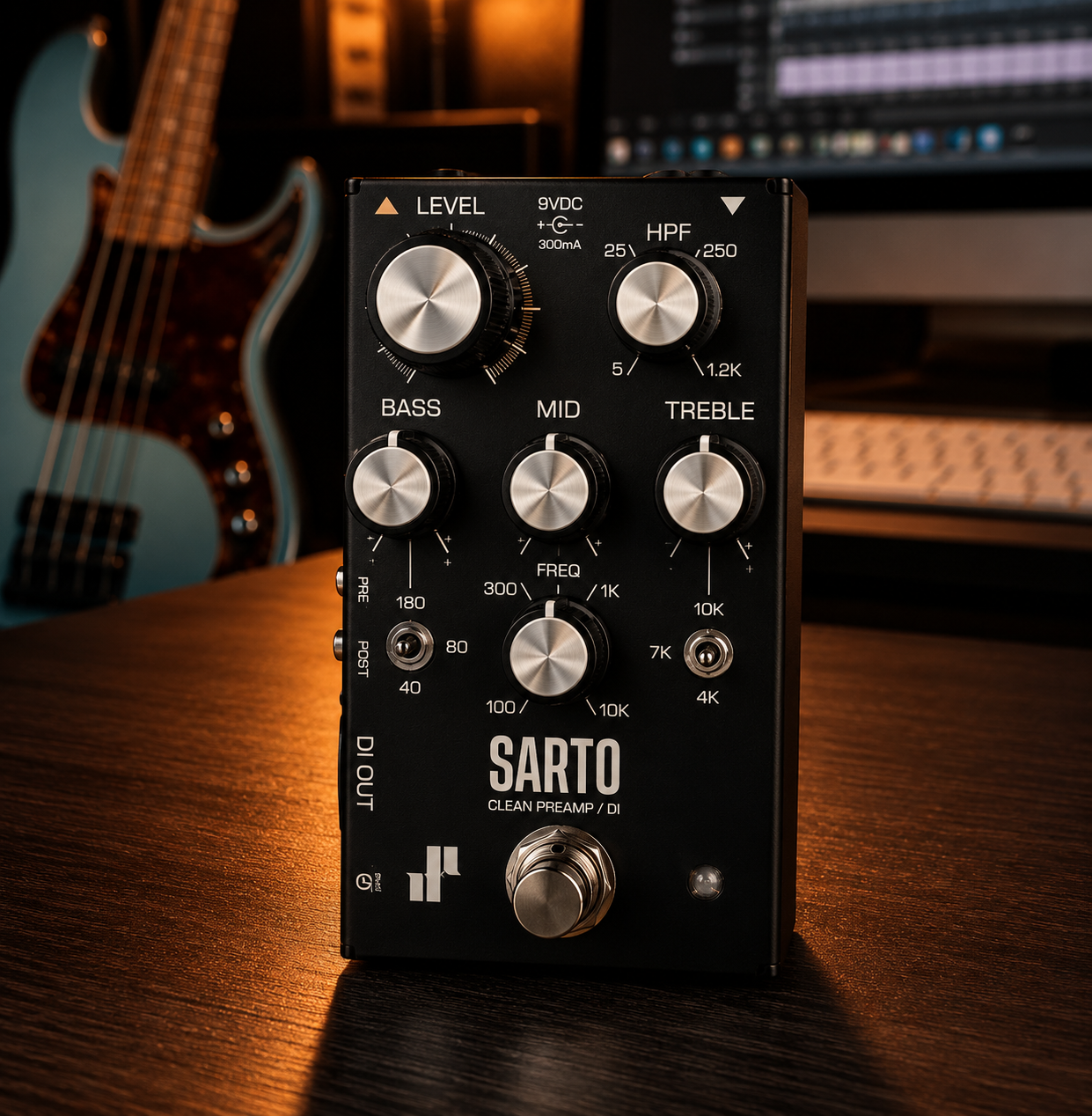
Jad Freer SARTO: Pedal Review
The Art of Getting Out of the Way Disclaimer: This pedal was kindly provided by Jad Freer for the purpose of this review. However, this does not influence our opinions or the content of our reviews. We strive to provide honest, unbiased, and accurate assessments to ensure that our readers receive truthful and helpful information. There are two schools of thought when it comes to bass preamps. The first says a preamp should be part of your sound. Give me tubes. Give me transformers. Give me harmonic saturation, vintage mojo and just enough grit to convince me my Class D amp secretly wishes it were a 300-pound fridge from 1972. The second school says a preamp should simply make your bass sound like your bass! For years, and probably still to this day, I’ve mostly gravitated toward the first camp. I love pedals with personality. I love plugging into something and immediately thinking, “That’s cool!” Whether it’s an Origin BassRig, a tube preamp, or an overdrive that’s always on, I’ve never been shy about adding colour to my sound. So when Jad Freer reached out and asked if I’d like to review the new SARTO, I’ll admit my first reaction was curiosity more than excitement. Not because I doubted the quality—quite the opposite. I’d already spent plenty of time looking at the CAPO and the LUCE and knew Jad Freer had built a reputation for making incredibly well-engineered gear. But the SARTO isn’t selling you “warmth” or “vintage tone.” In fact, it’s barely selling you a tone at all. It’s selling transparency. Does that sound boring to you? I can guarantee you it isn’t. After spending the last few weeks with the SARTO on my pedalboard, I’ve come to appreciate something that most bass players—including myself—don’t spend enough time thinking about. Sometimes the best piece of gear is the one you stop noticing after five minutes. It’s not trying to impress you We’ve all played pedals that impress you in the first thirty seconds. The lows get bigger. The highs get shinier. Everything suddenly sounds more “produced.” It’s exciting, and sometimes that’s exactly what you’re looking for. The SARTO doesn’t do that. Instead, the first thing I noticed was that… nothing really happened. And that’s not criticism, that’s actually the highest compliment I can give it. I plugged in my passive P Bass, set everything flat, adjusted the output to unity and started playing. There wasn’t a dramatic change in EQ. No extra compression. No obvious thickening of the mids. If someone had walked into the room, they probably wouldn’t have known I’d switched anything on. What I did notice after playing for a while was that everything felt slightly more effortless. Notes seemed to speak a little easier. The attack stayed intact. Dynamics remained exactly where my fingers put them. It reminded me less of plugging into a bass pedal and more of plugging into an exceptionally good studio console. Why that matters more than most players realise We spend thousands chasing the perfect instrument. We agonise over pickup height, string gauges, cabinet choices and amplifier voicings. Then we happily run everything through the first buffered pedal we happen to own. That’s not necessarily a problem—modern buffers are generally excellent—but every stage in your signal chain changes something, even if it’s only a little. The challenge for a designer isn’t making a circuit that sounds exciting. It’s making one that disappears. That’s a much harder job. The SARTO starts with a ridiculously high 10 MΩ input impedance, and while that’s a headline feature for upright bassists and anyone using piezo pickups, it’s easy to dismiss if you’re a dyed-in-the-wool electric bassist. I almost did. Then I started swapping instruments. With my passive P Bass, the difference wasn’t dramatic, nor should it be. A good bass into a good amplifier already sounds good. But there was a sense of openness that became more obvious the longer I played. It wasn’t brighter. It wasn’t louder. It simply felt like less of the instrument was being left behind. That’s the thing about transparency. It’s hard to notice. It quietly removes little compromises you didn’t realise you’d accepted. If you’re playing upright, an acoustic bass or anything with a piezo system, the benefits are likely to be far more obvious. Piezos absolutely hate being loaded down by low-impedance inputs, and the SARTO gives them exactly the kind of environment they want to see. That’s clearly one of the reasons Jad Freer designed it this way. But even if you never touch a piezo in your life, the philosophy still makes sense. Start with the cleanest possible foundation, then decide what colour you want to add later. The EQ is smarter than it first appears At first glance, the SARTO’s EQ doesn’t look particularly revolutionary. We’ve all seen that before. The shelving bass control lets you choose whether you’re shaping the extreme lows around 40 Hz, the more familiar punch around 80 Hz or the warmth that lives closer to 160 Hz. The treble section follows the same philosophy, letting you decide whether you’re adjusting presence, string noise or true top-end air. That flexibility means the controls behave differently depending on the bass you’re playing. I found myself reaching for different shelf frequencies with a passive four-string than I did with my five-string, not because one sounded better, but because the pedal lets you decide what you’re actually trying to influence instead of forcing every bass through the same fixed EQ points. Then there’s the midrange. The sweepable mids cover an enormous range, from 100 Hz all the way to 10 kHz, but the clever bit isn’t just the frequency range. It’s the way the filter behaves. The variable-Q design feels remarkably musical. At lower frequencies it lets you make focused corrections without upsetting everything around them, while higher up it becomes broader and more natural. Some parametric EQs feel like surgical instruments. The SARTO was definitely voiced by someone who actually plays and