Darkglass Releases Axioma
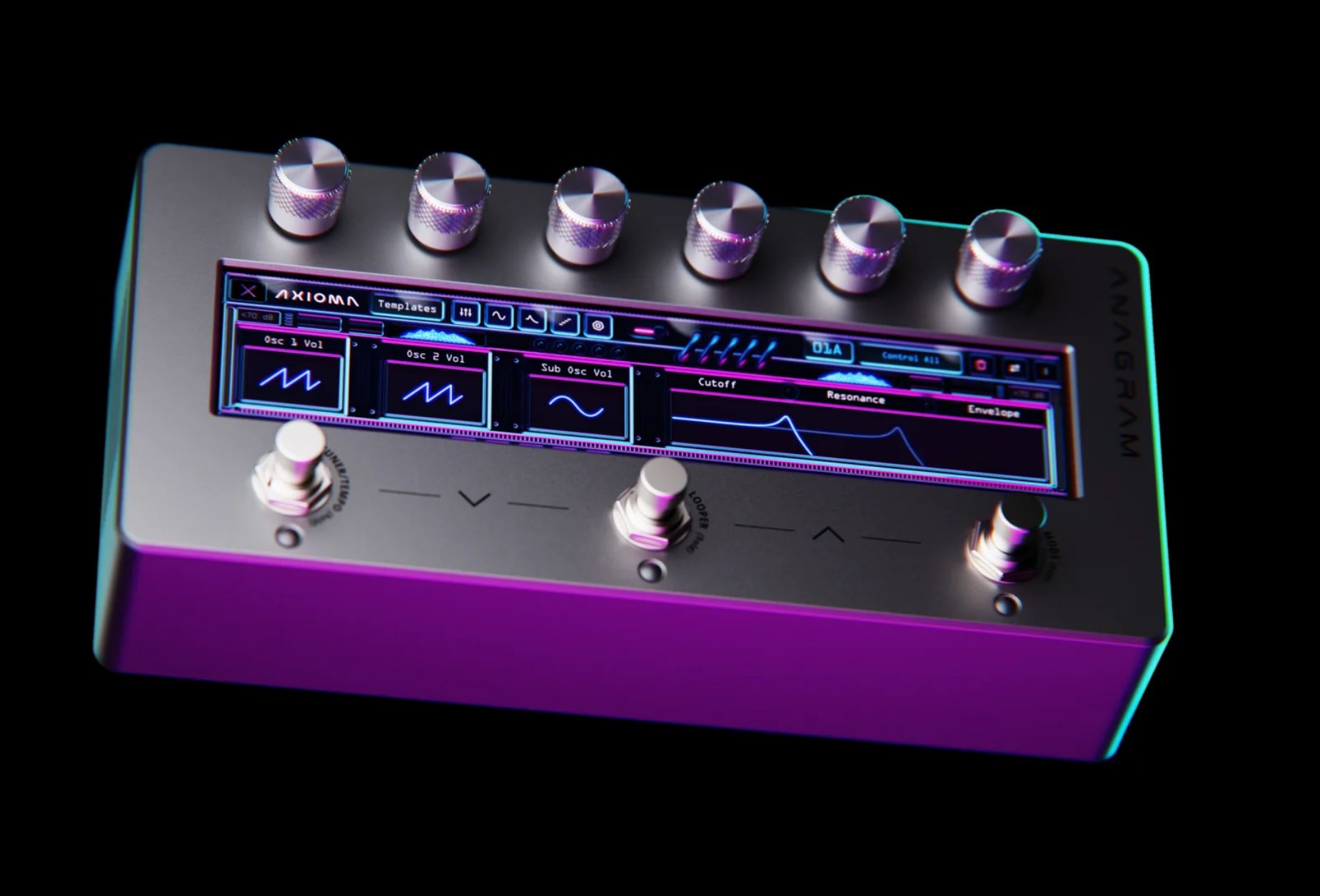
A First Look at the New Synth for Anagram Darkglass has just released Axioma, a new synthesizer for the Anagram, and this is probably one of the more interesting additions to the platform so far. I haven’t had the chance to actually play Axioma yet, so I’m not going to call this a review. I have, however, already heard it in action, and I’ve spent some time going through the manual to see exactly what Darkglass has packed into the new synth. There is quite a lot here. Axioma is a monophonic synthesizer built specifically for the Anagram. It has two oscillators, a dedicated sub oscillator, a filter section, envelopes, dry/synth blending and an arpeggiator. It is also clearly designed with bass in mind (just like everything else Darkglass does!) rather than being a general-purpose synth that happens to be controlled by a bass guitar. And honestly, this is something the Anagram has been missing. So, what exactly is Axioma? At its core, Axioma is a fairly traditional subtractive synth. You get two oscillators, each with saw, square and triangle waveforms. Oscillator 2 can be tuned independently, including fine tuning in cents, so you can detune the two against each other or move the second oscillator to a different interval. Then there is a dedicated sub oscillator sitting an octave below. That combination should already sound familiar to anyone who has spent time with analog synths. Start with a saw wave, add another slightly detuned oscillator, bring in some sub and you have the basic ingredients for a very large sound. The oscillator levels can be mixed independently, and there is also a Blend control that brings the original bass signal back into the sound. Fully wet gives you the synth on its own, while backing the control off lets the dry bass sit underneath it. Pure synth sounds can be great, but on bass they can also get a little disconnected from the instrument. Keeping some of the original signal underneath can make a huge difference, especially in a band where you still need the bass to occupy its normal place in the mix. The filter is where you can start making it your own The synth section itself is relatively straightforward, but the filter gives you plenty of room to move away from the raw oscillator sounds. Axioma has controls for cutoff and resonance, along with an envelope amount and decay. There are also attack and release controls for shaping the note. So you can go from fairly static synth tones to those familiar squelchy, percussive sounds where the filter opens up at the beginning of the note and then closes back down. This is probably where most of the fun will be. The basic oscillator setup isn’t particularly exotic, and it doesn’t need to be. A lot of the classic synth sounds we associate with bass are built from exactly these ingredients. There is an arpeggiator too Axioma has a built-in arpeggiator with four directions: Up, Down, Up-Down and Random. You can choose Major, Minor, Maj7, Min7 or Minor-Major 7 chord types, with one, two or three octaves. It runs in sixteenth notes, and you can set its tempo. What makes it more interesting than a simple automatic pattern generator is how it reacts to what you’re playing. Changing the note restarts the arpeggio, so you can effectively control the progression by moving between notes on the bass. That could be a lot of fun with the right playing style. There is definitely some potential for getting into weird territory here. The big unknown: tracking This is the part I don’t want to pretend I can answer yet. I’ve heard Axioma and the sounds are convincing, but hearing somebody else play a synth is very different from plugging your own bass into one. Darkglass provides quite a bit of information in the manual about getting the best results from it. Axioma is intended to be the first block in the signal chain, and you can select different instrument modes depending on what you’re playing. There are settings for four-string and five-string basses, extended-range instruments, guitar, baritone and other wide-range instruments. There is also a Sensitivity control that needs to be adjusted to the instrument and playing style. And, as you’d expect from a monophonic bass synth, your technique matters. Darkglass recommends muting unused strings and playing individual notes clearly. Harmonics can also trigger the synth, so those need to be controlled if they aren’t intentional. There’s one particularly relevant limitation for extended-range players: Axioma doesn’t track below the open B string of a five-string bass. None of this is unusual for a bass synth. But it does mean that I don’t want to make any claims about how good Axioma’s tracking is until I’ve actually spent time playing it. That’s one of the first things I’ll be looking at when I get the opportunity. The interesting part is what happens after the synth This is where Axioma makes more sense to me than it would as a standalone synth pedal. The Anagram is already capable of some pretty elaborate signal chains, and the synth doesn’t have to be the final stage of the sound. You could run the synth into distortion, compression, modulation, delay or reverb. You could keep some dry bass underneath it. You can also take advantage of the Anagram’s routing options to do more complicated things with the signal. That’s potentially a much bigger deal than the synth itself. A relatively simple synth voice can become something completely different once you start putting it through the rest of the Anagram. Axioma into a filter and distortion, for example, could take you somewhere very different from Axioma into a clean delay and reverb. And because it’s all happening inside the same unit, you don’t need to build a separate pedalboard around the synth. Axioma makes the Anagram feel more like a platform One thing that has become increasingly obvious with the Anagram is that