Joyo Avallon Compressor: Pedal Review
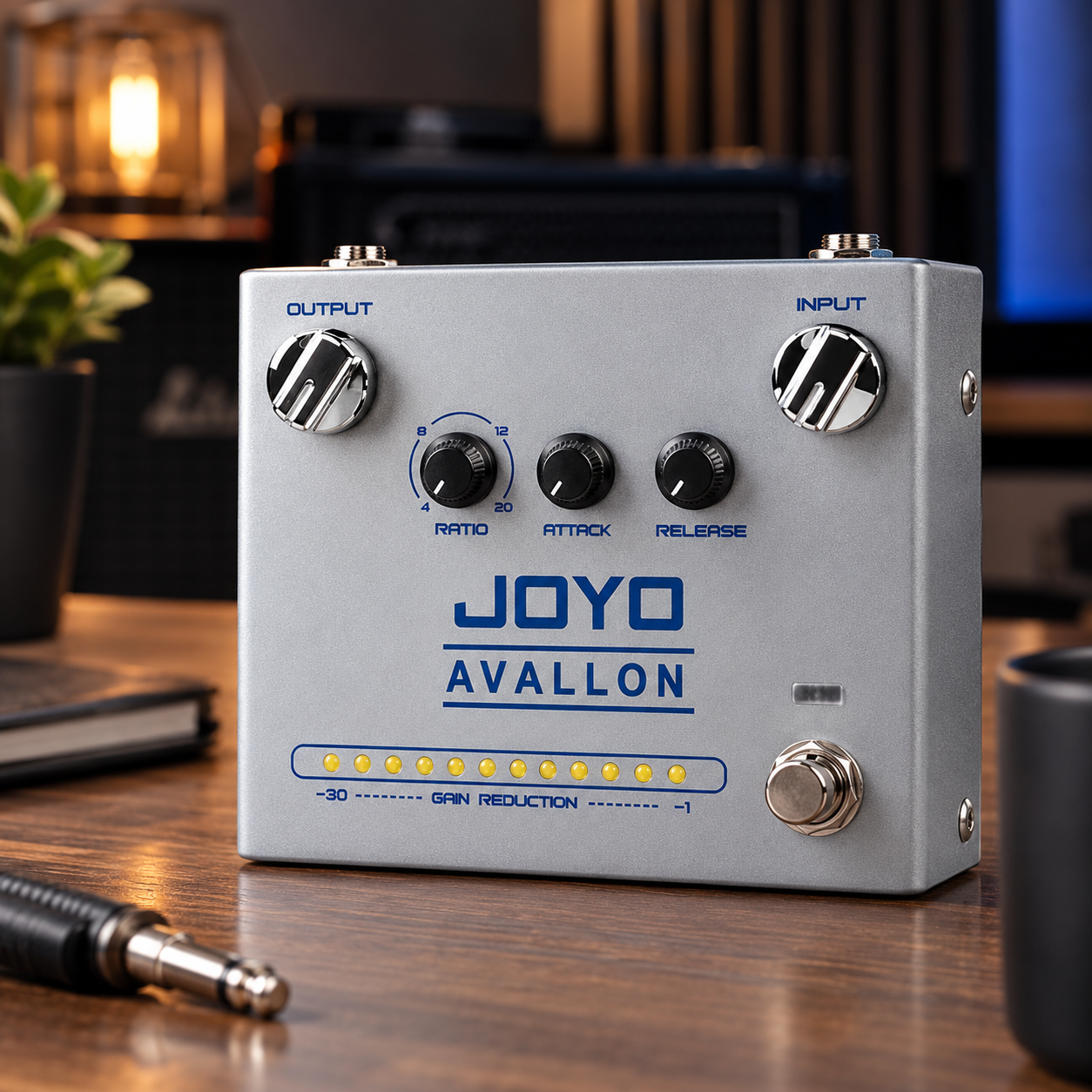
A surprisingly capable compressor for bass When I reviewed the Joyo Scylla compressor back in 2024, I had no idea that the pedal would eventually become such an important part of Bass Gear Reviews. What started as a review of a relatively inexpensive compressor turned into the most visited and best-converting article on the entire website, and it has remained there ever since. So when Joyo got in touch and offered to send me their other compressor, the Avallon, it seemed like a particularly appropriate opportunity to revisit what the company is doing in this part of the market. The Avallon is a very different pedal from the Scylla, though, and that’s worth making clear from the beginning. This isn’t a comparison between the two, and I don’t think it makes much sense to approach it as one. The Avallon has its own design, its own way of approaching compression and, most importantly, its own audience. Where the Scylla puts quite a lot of emphasis on being a flexible bass compressor with a tone control, the Avallon takes a more traditional compressor approach. You get Input, Output, Ratio, Attack and Release, together with a gain-reduction meter that gives you something the Scylla doesn’t: a visual indication of what the compressor is actually doing. That immediately makes the Avallon an interesting proposition for bass players, particularly those who want to understand their compressor rather than simply switch one on and leave it there. A different approach to compression The Avallon is part of Joyo’s R Series, and it is physically larger than many of the company’s compact pedals. The extra space isn’t being used for decoration. Most of the enclosure is taken up by the controls and the row of LEDs that make up the gain-reduction meter. It’s a fairly straightforward layout. Input and Output sit at the top, with Ratio, Attack and Release underneath. There is no dedicated threshold control, so the Input knob is an important part of how you set the amount of compression. Increase the input signal and you’re driving the compressor harder; reduce it and you’re backing away from the point where compression starts to become noticeable. That takes a little getting used to if you’re accustomed to compressors with a separate threshold control, but it makes sense once you start using the pedal. The Output control then gives you a way of bringing the overall level back into line after you’ve established how hard you want to drive the compressor. Ratio determines how much compression is applied once the signal crosses the threshold, while Attack and Release control how quickly the compressor responds and recovers. In practice, those four controls give you quite a lot of room to move between subtle dynamic control and much more obvious compression. That’s really the essence of the Avallon. It isn’t trying to disguise the fact that you’re using a compressor. It gives you the controls and lets you decide how much of it you want to hear. The gain-reduction meter is genuinely useful The feature that immediately separates the Avallon from a lot of inexpensive compressors is the gain-reduction meter. Compression can be surprisingly difficult to set by ear, especially when you’re starting out. It’s very easy to turn on a compressor, hear the resulting signal get louder or more controlled and assume that you’ve improved the sound when you’ve actually just changed the volume. Having some visual feedback makes that process considerably easier. The LEDs show the amount of gain reduction being applied as you play, so you can see when the compressor starts working and how much it is reacting to your playing. That is particularly useful when you’re adjusting Attack and Release because you can actually watch the compressor respond while listening to what those changes are doing to the bass. It’s also useful for an experienced player. With bass, particularly a five-string, there can be a substantial difference in the amount of energy produced by different notes. A low B played aggressively can behave very differently from a higher note played softly, and watching the meter while playing can give you a much better idea of how consistently the compressor is responding. Attack and Release matter more than you might think Attack and Release are the controls that will probably have the biggest effect on how natural or obvious the Avallon feels. A fast attack catches the initial transient of the note quickly. That’s useful when the objective is to control peaks and make the overall performance more even, but too much compression too early can also take some of the character out of your playing. A slower attack allows more of that initial note through before the compressor starts reducing the level. On bass, that can preserve some of the punch and articulation that makes the instrument work in a mix. Release works in the other direction, determining how quickly the compressor stops working after the signal falls back down. A fast release can make the compressor feel more active and responsive, while a slower release produces a smoother and more sustained effect. There isn’t really a correct setting here. It depends on what you’re playing and what you’re trying to achieve. That’s one of the reasons I like the Avallon’s approach. There is enough control to make those decisions yourself rather than having the pedal make all of them for you. Using the Avallon with bass A compressor can help even out fingerstyle playing, control the peaks of slap, give notes more consistency and add sustain without necessarily sounding like you’ve put an obvious effect on the instrument. The Avallon is well suited to that kind of use because you can start with a relatively conservative ratio and a modest amount of gain reduction and gradually increase things until you find the point where the dynamics are controlled without becoming flat. The Input control is important here. Because it effectively determines how hard you’re hitting the compressor, small changes can have