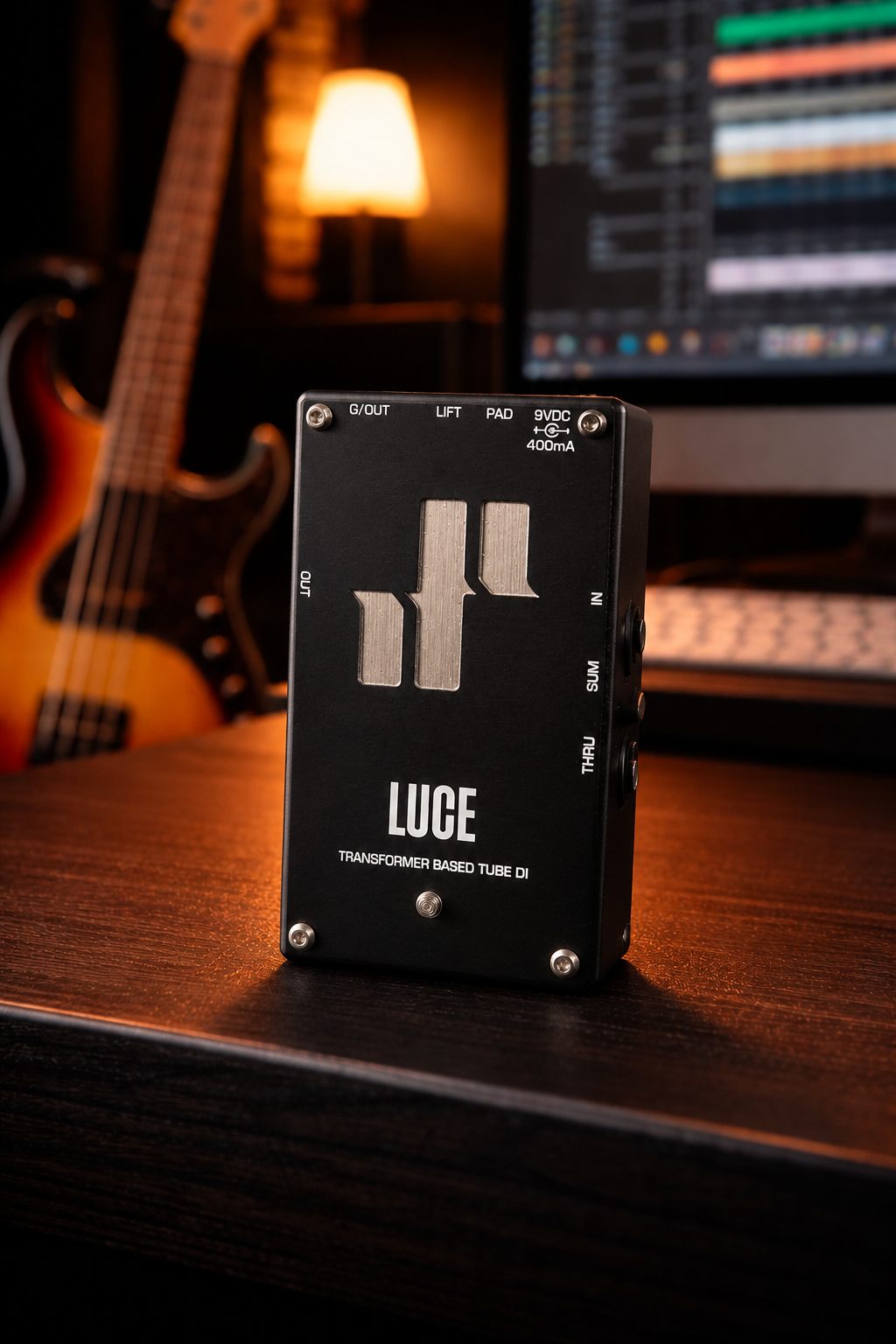
Jad Freer LUCE DI Review
Studio Light in a Pedalboard World Jad Freer Audio didn’t appear out of nowhere. The brand first really came into the spotlight through the Capo DI, a unit that quickly gained traction in the bass community and was pushed into wider visibility by bass players like Tim Lefebvre, Sean Hurley or Chris Chaney. The Capo became known as a kind of “all-in-one modern bass front end”: a highly flexible preamp/DI with serious tone-shaping power, blending clean headroom, drive, EQ, and studio-ready output into a single, carefully designed box. For many players, it represented a new standard in what a pedalboard-friendly studio front end could do—deep, versatile, and unapologetically high-end in both sound and engineering. Disclaimer: This pedal was kindly provided by Jad Freer Audio for the purpose of this review. However, this does not influence our opinions or the content of our reviews. We strive to provide honest, unbiased, and accurate assessments to ensure that our readers receive truthful and helpful information. The LUCE is the latest release from Jad Freer Audio, but it takes a very different philosophical approach. Unlike the Capo, the LUCE is not trying to be an all-in-one solution. It doesn’t offer EQ sections, drive circuits, or complex routing options. Instead, it focuses on one specific job—and does it exceptionally well. You could think of it less as a multi-tool and more as a precision studio instrument: minimal in concept, but deeply refined in execution. And that distinction is important, because everything about the LUCE is built around restraint. It doesn’t try to reshape your sound—it tries to elevate what’s already there. “Luce — light in Italian — is a studio-quality, transformer-based tube DI (Direct Injection) box: a unity gain (1:1) tube preamplifier and active summing unit.” First of all, let’s clear out what all these things actually mean—because this one sentence pretty much tells you everything about what the LUCE is trying to be, even if the terminology isn’t immediately obvious. What is a transformer-based tube DI? Let’s break that into two parts: DI box and transformer + tube. A DI (Direct Injection) box is what lets you send your bass signal straight to a mixing console or audio interface. Instead of relying on a mic’d amp, you’re giving the sound engineer a clean, controlled version of your tone. Now, not all DIs are created equal. The transformer part A transformer is an old-school piece of analog circuitry used in classic studio gear. In practice, for bass players, it does a few subtle but important things: It’s one of those things you don’t hear as an effect—you feel it as authority in your tone. The tube part The LUCE uses a real vacuum tube (not a digital emulation), which introduces: Importantly, this isn’t distortion—it’s the kind of enhancement you associate with high-end studio recordings. Put together, “transformer-based tube DI” basically means:A DI that makes your bass sound like it’s already been through expensive studio gear. Understanding the LUCE’s Unity Gain Design One of the most misunderstood — yet most important — aspects of the Jad Freer Audio LUCE is the fact that it operates at unity gain. On paper, that can sound almost counterintuitive. Most players see the word “preamp” and immediately assume it is there to add volume, push the front of an amp harder, or dramatically reshape the sound. The LUCE approaches the idea differently. Rather than boosting or coloring the signal aggressively, the LUCE is designed to preserve the natural level of your bass while improving the quality and feel of the signal itself. That distinction is important because the pedal is less about imposing a new identity onto your tone and more about refining what is already there. In practice, the effect feels subtle at first, but very noticeable once you spend time with it. Notes become clearer and more dimensional. The low end stays controlled, but feels richer and more connected. Dynamics respond more naturally under the fingers, and there is a sense of consistency across the instrument that can make the entire rig feel more polished without sounding processed. That is ultimately what the LUCE does so well. It does not try to overwhelm your core tone with heavy EQ curves or exaggerated coloration. Instead, it enhances the integrity of the signal in a way that feels organic and musical. If your bass already sounds good, the LUCE tends to make it sound more complete rather than fundamentally different. The Role of the Tube Preamplifier The tube stage is a major part of why the pedal feels the way it does. At its core, a preamplifier is simply the first stage your signal encounters before reaching the rest of the chain — whether that is an amplifier, recording interface, or front-of-house console. In the LUCE, that stage is driven by a tube circuit, and that choice has a very real impact on the playing experience. Unlike many sterile or ultra-clinical solid-state designs, the tube reacts dynamically to touch and articulation. When you dig in harder, the response softens slightly in a pleasing way, creating a subtle compression effect that feels natural rather than obvious. Harmonics become more present, but never harsh, and the attack develops a smoother, more musical character. For bass players, that translates into an instrument that feels more alive beneath the hands. Notes carry a little more depth and dimension, while remaining articulate and controlled. Fingerstyle passages gain warmth and detail, while pick playing retains aggression without becoming brittle. The difference is not necessarily dramatic in the way a distortion pedal or EQ sweep would be. Instead, it is the kind of enhancement that changes the overall feel of the instrument and encourages you to play differently. The signal stops feeling flat or purely functional and starts responding with a sense of movement and elasticity that many players associate with high-end studio gear or vintage tube amplifiers. What is an active summing unit? This is the most technical-sounding part, but it’s actually pretty straightforward. Active summing