Studio Light in a Pedalboard World
Jad Freer Audio didn’t appear out of nowhere.
The brand first really came into the spotlight through the Capo DI, a unit that quickly gained traction in the bass community and was pushed into wider visibility by bass players like Tim Lefebvre, Sean Hurley or Chris Chaney. The Capo became known as a kind of “all-in-one modern bass front end”: a highly flexible preamp/DI with serious tone-shaping power, blending clean headroom, drive, EQ, and studio-ready output into a single, carefully designed box. For many players, it represented a new standard in what a pedalboard-friendly studio front end could do—deep, versatile, and unapologetically high-end in both sound and engineering.
Disclaimer: This pedal was kindly provided by Jad Freer Audio for the purpose of this review. However, this does not influence our opinions or the content of our reviews. We strive to provide honest, unbiased, and accurate assessments to ensure that our readers receive truthful and helpful information.
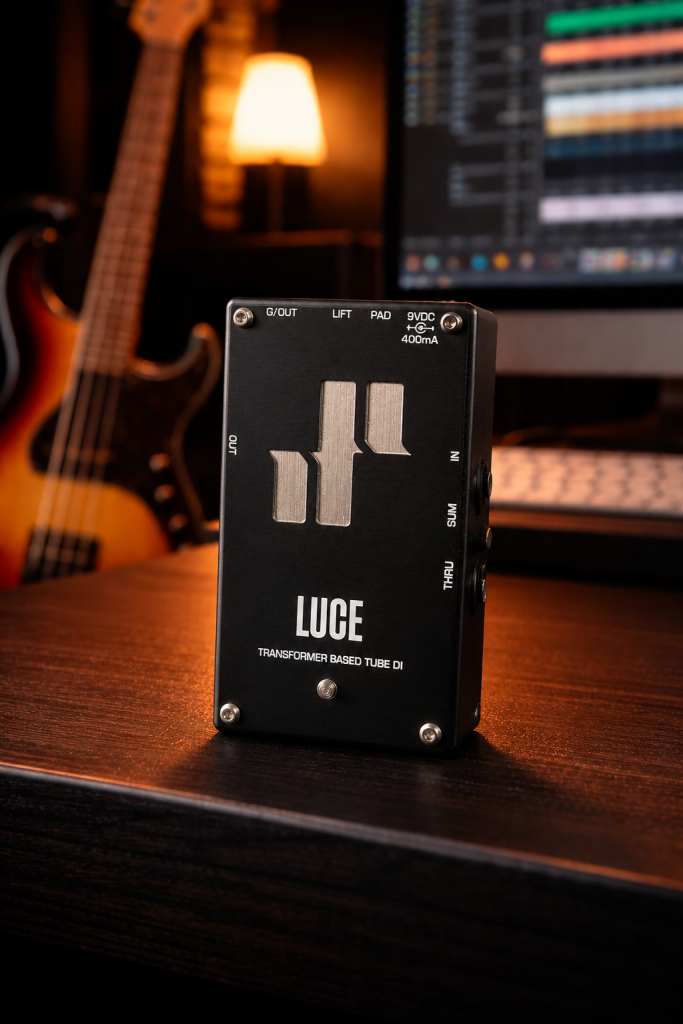
The LUCE is the latest release from Jad Freer Audio, but it takes a very different philosophical approach.
Unlike the Capo, the LUCE is not trying to be an all-in-one solution. It doesn’t offer EQ sections, drive circuits, or complex routing options. Instead, it focuses on one specific job—and does it exceptionally well. You could think of it less as a multi-tool and more as a precision studio instrument: minimal in concept, but deeply refined in execution.
And that distinction is important, because everything about the LUCE is built around restraint. It doesn’t try to reshape your sound—it tries to elevate what’s already there.
“Luce — light in Italian — is a studio-quality, transformer-based tube DI (Direct Injection) box: a unity gain (1:1) tube preamplifier and active summing unit.”
First of all, let’s clear out what all these things actually mean—because this one sentence pretty much tells you everything about what the LUCE is trying to be, even if the terminology isn’t immediately obvious.
What is a transformer-based tube DI?
Let’s break that into two parts: DI box and transformer + tube.
A DI (Direct Injection) box is what lets you send your bass signal straight to a mixing console or audio interface. Instead of relying on a mic’d amp, you’re giving the sound engineer a clean, controlled version of your tone.
Now, not all DIs are created equal.
- A basic DI is transparent but plain
- A transformer-based tube DI—like the LUCE—is designed to enhance your tone in a musical way
The transformer part
A transformer is an old-school piece of analog circuitry used in classic studio gear. In practice, for bass players, it does a few subtle but important things:
- Adds weight and solidity to the low end
- Smooths out harsh highs
- Gives the signal a slightly more “finished” feel
It’s one of those things you don’t hear as an effect—you feel it as authority in your tone.
The tube part
The LUCE uses a real vacuum tube (not a digital emulation), which introduces:
- Gentle harmonic saturation
- A bit of natural compression
- A more “3D” and responsive feel under your fingers
Importantly, this isn’t distortion—it’s the kind of enhancement you associate with high-end studio recordings.
Put together, “transformer-based tube DI” basically means:
A DI that makes your bass sound like it’s already been through expensive studio gear.
Understanding the LUCE’s Unity Gain Design
One of the most misunderstood — yet most important — aspects of the Jad Freer Audio LUCE is the fact that it operates at unity gain. On paper, that can sound almost counterintuitive. Most players see the word “preamp” and immediately assume it is there to add volume, push the front of an amp harder, or dramatically reshape the sound. The LUCE approaches the idea differently.
Rather than boosting or coloring the signal aggressively, the LUCE is designed to preserve the natural level of your bass while improving the quality and feel of the signal itself. That distinction is important because the pedal is less about imposing a new identity onto your tone and more about refining what is already there.
In practice, the effect feels subtle at first, but very noticeable once you spend time with it. Notes become clearer and more dimensional. The low end stays controlled, but feels richer and more connected. Dynamics respond more naturally under the fingers, and there is a sense of consistency across the instrument that can make the entire rig feel more polished without sounding processed.
That is ultimately what the LUCE does so well. It does not try to overwhelm your core tone with heavy EQ curves or exaggerated coloration. Instead, it enhances the integrity of the signal in a way that feels organic and musical. If your bass already sounds good, the LUCE tends to make it sound more complete rather than fundamentally different.
The Role of the Tube Preamplifier
The tube stage is a major part of why the pedal feels the way it does. At its core, a preamplifier is simply the first stage your signal encounters before reaching the rest of the chain — whether that is an amplifier, recording interface, or front-of-house console. In the LUCE, that stage is driven by a tube circuit, and that choice has a very real impact on the playing experience.
Unlike many sterile or ultra-clinical solid-state designs, the tube reacts dynamically to touch and articulation. When you dig in harder, the response softens slightly in a pleasing way, creating a subtle compression effect that feels natural rather than obvious. Harmonics become more present, but never harsh, and the attack develops a smoother, more musical character.
For bass players, that translates into an instrument that feels more alive beneath the hands. Notes carry a little more depth and dimension, while remaining articulate and controlled. Fingerstyle passages gain warmth and detail, while pick playing retains aggression without becoming brittle.
The difference is not necessarily dramatic in the way a distortion pedal or EQ sweep would be. Instead, it is the kind of enhancement that changes the overall feel of the instrument and encourages you to play differently. The signal stops feeling flat or purely functional and starts responding with a sense of movement and elasticity that many players associate with high-end studio gear or vintage tube amplifiers.
What is an active summing unit?
This is the most technical-sounding part, but it’s actually pretty straightforward.
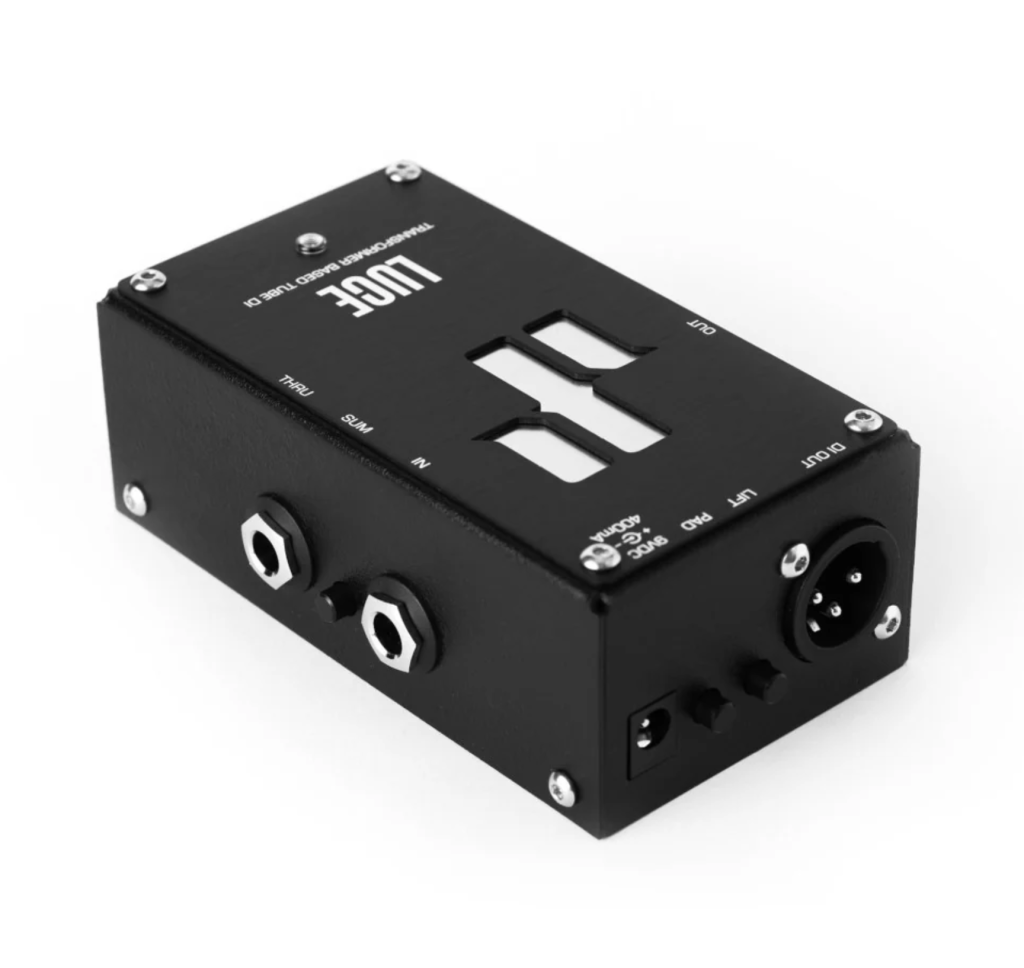
Active summing means the LUCE can take multiple input signals and combine them into one — cleanly and intentionally.
In practical terms:
- You can plug in two instruments at once
- Or combine different signal sources (for example, bass + synth)
The “active” part means:
- The signals are buffered and preserved properly
- You don’t lose tone or clarity when combining them
This isn’t something every player will use daily—but in studio or experimental setups, it’s a powerful feature.
The analog core and its heritage
To achieve all of this, the LUCE relies on a carefully chosen analog core: a high-quality, low-noise ECC88/6922 tube paired with an OEP/Carnhill audio transformer.
The ECC88/6922 is valued for its clarity, low noise floor, and musical harmonic response. It delivers the subtle tube behavior engineers actually want in a recording chain: gentle saturation, dynamic softness, and harmonic density without turning the signal into obvious distortion.
The transformer side of the equation is where things connect directly to recording history.
OEP/Carnhill transformers are closely associated with the lineage of classic British console design, the kind of circuitry found in legendary studios like Abbey Road, Olympic, and AIR Studios. These consoles defined the sound of countless recordings from the golden era of rock and pop, where the console wasn’t just a capture device—it was part of the instrument.
That sonic fingerprint—slight iron saturation, controlled low-end weight, and smooth top-end behavior—became embedded in the sound of entire generations of records.
For bass players, that heritage shows up in some of the most iconic recorded tones ever captured, whether it’s the melodic clarity of Paul McCartney, the aggressive articulation of John Entwistle, or the commanding presence of John Paul Jones in Led Zeppelin’s recordings. None of those sounds came from perfectly transparent signal chains—they came from transformer-driven analog systems that subtly shaped and enhanced the instrument in musical ways.
The LUCE isn’t attempting to replicate those consoles directly. Instead, it borrows from their design philosophy: that the signal path itself can be musical, not just functional.
And that is ultimately what defines the LUCE more than anything else—it’s not a multi-tool, and it’s not a tone sculptor. It’s a modern, pedalboard-ready expression of a very old idea:
That great tone doesn’t always come from adding more, but from refining what’s already there.
Performance, Feel, and Where the LUCE Actually Belongs
On paper, the LUCE is a pedalboard-friendly DI box. It has the footprint of something you could comfortably place at the end of a signal chain and send straight to front of house. But in practice, it behaves less like a traditional “gigging preamp” and more like a studio-grade front end that happens to live on your pedalboard.
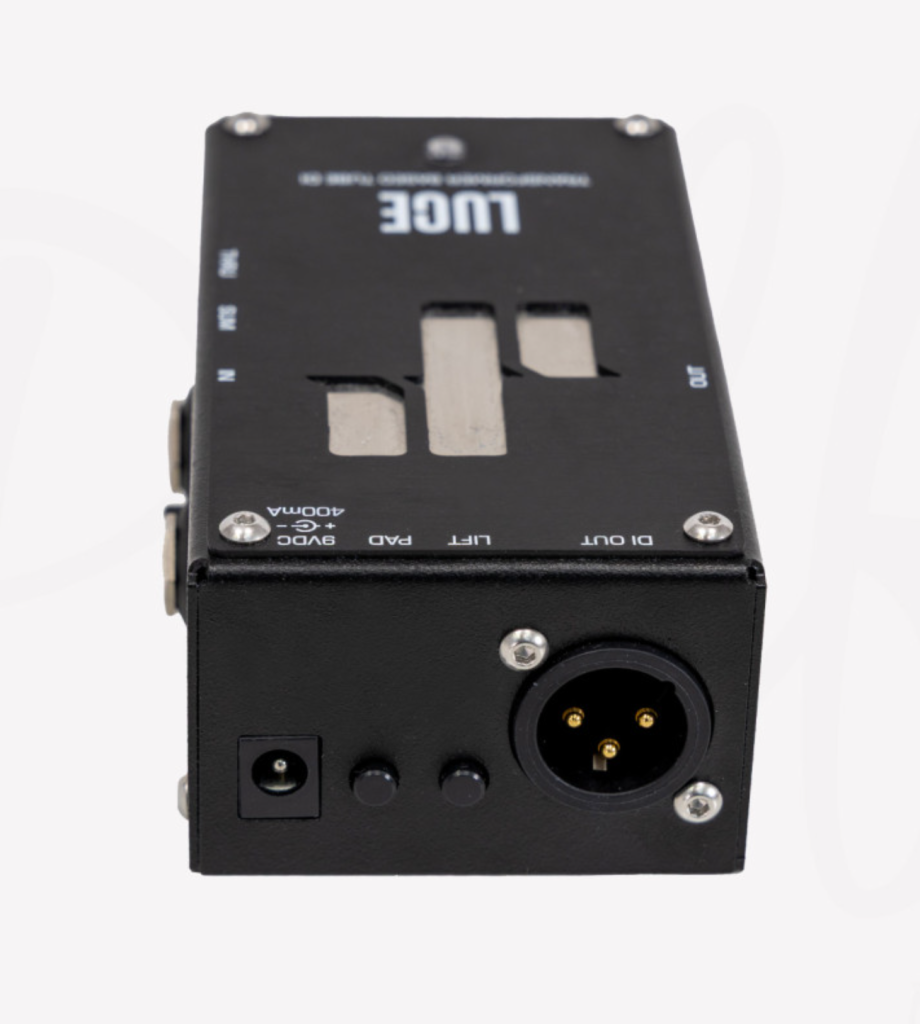
On stage: subtlety over spectacle
If you’re expecting a pedal that dramatically reshapes your live tone or gives you instant EQ curves and obvious coloration, the LUCE is not that kind of tool. In a live context, its contribution is intentionally understated.
What it does bring to a gigging rig:
- A consistently high-quality DI feed to FOH
- A slightly more polished, controlled low end
- Improved note separation and clarity under stage conditions
- A subtle sense of “finished mix” tone before the signal even hits the console
In other words, it doesn’t change what you play—it changes how present and refined it feels in the PA system.
For players used to aggressive preamps or amp-modeling pedals, this can feel almost too subtle at first. But sound engineers will immediately notice what’s happening: a bass signal that requires less corrective EQ and sits more naturally in the mix.
In a live setting, the LUCE is less about inspiring tonal experimentation and more about making your baseline tone mix-ready by default.
In the studio: where it makes the most sense
Where the LUCE really starts to justify itself is in recording environments.
In a studio context, its design philosophy becomes much clearer:
- The tube stage adds harmonic depth that translates beautifully on recorded DI tracks
- The transformer imparts a sense of low-end solidity often associated with high-end analog consoles
- The unity gain approach ensures your performance is captured without unintended coloration or gain staging issues
Most importantly, it delivers a signal that already feels like it has passed through a high-end console input stage, before any plugins or outboard processing are even involved.
This can subtly improve workflow in a meaningful way:
- Less corrective EQ later in the mix
- Faster “finished” bass tones
- More confidence tracking direct without relying on an amp
For session players, producers, or bassists recording at home, this is where the LUCE becomes less of a luxury and more of a serious front-end recording tool.
Who is it really for?
The LUCE sits in a very specific category of gear: it is not designed for beginners building their first pedalboard, nor is it a Swiss-army-knife preamp competing on versatility.
Instead, it is aimed at players who already have one of two things:
1. A tone they already love
If your sound is already dialed in—whether through your bass, amp, or pedalboard—the LUCE acts as a final refinement stage. It preserves your identity while improving how it translates to recording systems and live PA setups.
2. A recording-focused mindset
If your priority is capture quality—DI tracking, studio work, hybrid amp/DI setups—the LUCE functions as a pro-level input stage, not just another pedal in the chain.
Where it sits in the real world
The honest way to think about the LUCE is this:
- It is not a “gigging tone shaper” in the traditional sense
- It is not a multi-purpose preamp
- It is not trying to compete with drive or EQ-heavy bass pedals
Instead, it lives in a more niche but very real category:
A studio-quality DI that happens to be pedalboard-ready
So while it absolutely can be used on stage—and will perform flawlessly there—its biggest strengths are revealed when it’s treated as what it really is: a permanent, always-on recording-grade front end for your bass signal.