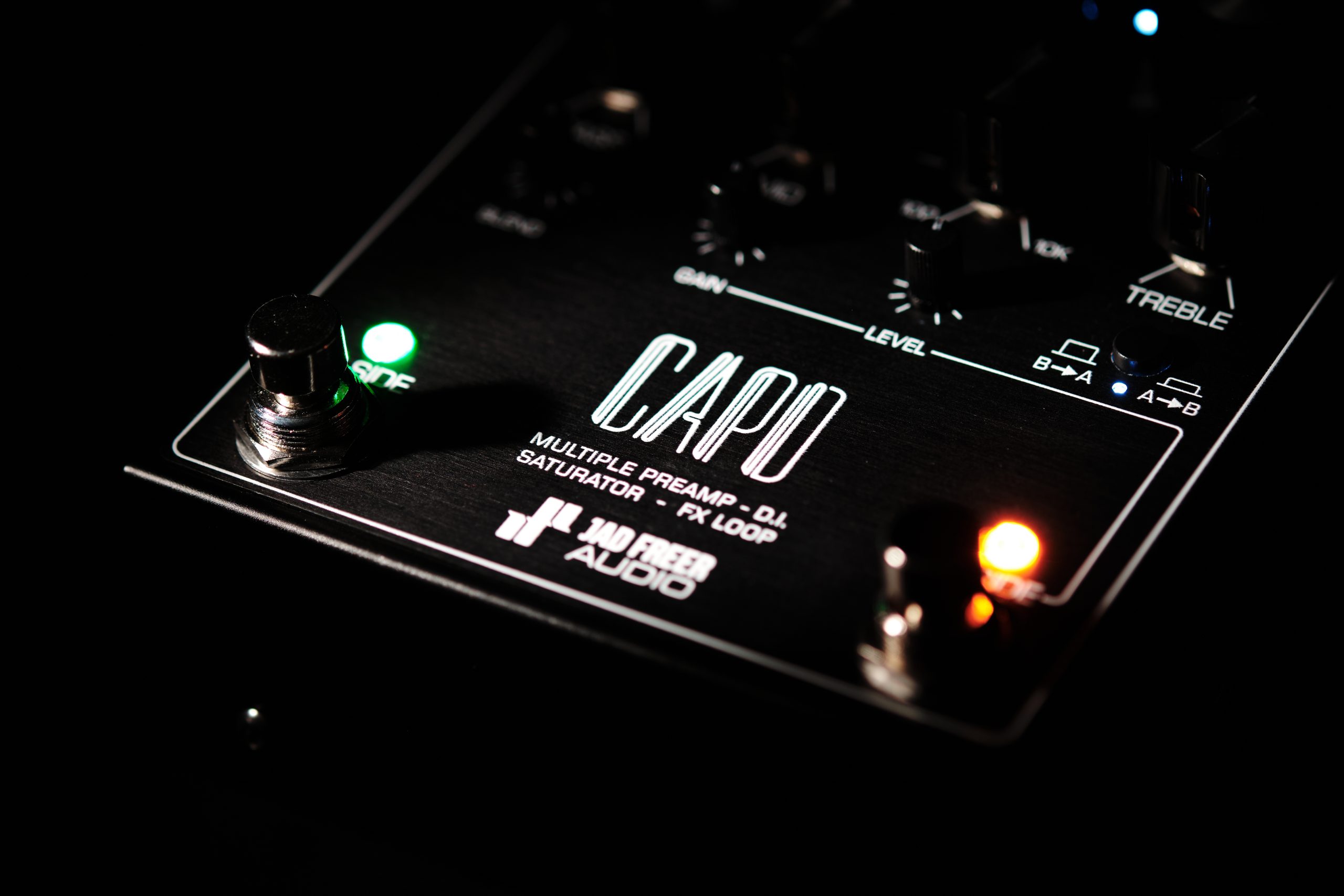
Jad Freer CAPO: Pedal Review
The Modern Bass Front End If the LUCE is Jad Freer Audio’s exercise in restraint, the CAPO is the company’s statement piece. At first glance, the two products almost seem to come from different design philosophies. The LUCE focuses on refinement, taking an already good signal and elevating it through a carefully designed tube and transformer circuit. The CAPO, on the other hand, is unapologetically ambitious. It presents the player with multiple gain stages, extensive routing possibilities, studio-grade EQ controls, saturation circuits, parallel processing options, and a level of flexibility that can initially seem almost excessive. But after spending time with it, you begin to realize that the CAPO’s complexity isn’t there for the sake of complexity. Every control exists because Jad Freer is trying to solve a very specific modern problem. For decades, bass players built their sound around amplifiers. The amp was the heart of the rig. It shaped the feel, the response, the dynamics, and the way the instrument sat in a mix. A DI box was often little more than a practical necessity—a way to get a signal to the front-of-house engineer. Today’s reality is very different. Many players perform on silent stages. Others rely on in-ear monitoring systems, record directly into interfaces, or move between different backline amplifiers every night. Consistency has become more important than ever, and the center of the bass rig has gradually shifted away from the amplifier and toward the pedalboard. The CAPO feels like a product designed specifically for that world. It isn’t simply a bass preamp. It isn’t just a DI box. It isn’t merely an overdrive pedal with some extra features attached. The easiest way to understand it is as a complete bass front end—a device designed to take responsibility for everything that happens between your instrument and the rest of the audio chain. That distinction is important because it explains almost every design decision inside the pedal. More Than a Preamp One of the first misconceptions people have about the CAPO is that it’s supposed to provide a particular sound. Many bass preamps are built around exactly that idea. You buy them because they deliver a recognizable tonal character. Whether it’s a vintage tube-inspired warmth, a modern hi-fi voice, or a particular overdriven texture, the product’s identity is tied directly to its sound. The CAPO approaches the problem differently. Instead of presenting a single tonal signature, it gives the player an enormous amount of control over how the signal behaves. That may sound like a subtle distinction, but in practice it changes everything. When musicians talk about a bass feeling “alive,” “responsive,” or “amp-like,” they’re often describing the way harmonics, dynamics, and transient response interact. These qualities don’t come from EQ alone. They emerge from the way gain stages react to the signal and how different parts of the audio chain influence one another. This is where the CAPO begins to separate itself from many other preamps on the market. Internally, it behaves less like a single preamp and more like multiple gain structures working together. Rather than simply boosting or cutting frequencies, the pedal allows the player to shape the harmonic architecture of the signal itself. That sounds like something only an engineer would care about, but the effect is immediately noticeable beneath your fingers. Notes feel denser without becoming compressed. Harmonics become richer without turning into obvious distortion. The attack remains articulate, yet the instrument develops a sense of weight and authority that can be difficult to achieve with conventional EQ alone. It’s a design philosophy rooted far more in studio engineering than traditional pedal design. Understanding the Saturation Philosophy Perhaps the best way to understand the CAPO is to stop thinking about distortion and start thinking about saturation. The two concepts are related, but they aren’t the same thing. Many overdrive pedals create their character by introducing clipping. As gain increases, the signal becomes increasingly compressed and distorted. This can be effective, but it often comes at the expense of dynamic response and low-frequency clarity. The CAPO takes a more nuanced approach. Its gain stages feel closer to what happens when a great studio preamp, a recording console, or a tube amplifier begins to work harder. Harmonics emerge gradually. Compression increases naturally. The signal thickens and develops complexity, but the instrument never loses its sense of touch sensitivity. This is one of the reasons so many players describe the CAPO as feeling “amp-like.” When you dig into the strings, the pedal responds. When you back off, it cleans up naturally. The relationship between the player’s hands and the signal remains intact. That responsiveness becomes especially apparent during long playing sessions. Rather than sounding like an effect layered on top of your bass, the saturation becomes part of the instrument’s behavior. The result is a signal that feels larger, richer, and more dimensional without sounding obviously processed. The J and F Personalities A large part of the CAPO’s flexibility comes from its different saturation voices. Rather than offering a single drive character, the pedal provides distinct personalities that allow players to emphasize different aspects of their sound. The J voicing tends to feel expansive and modern. The low end extends effortlessly, the overall presentation feels broad and open, and there is a certain smoothness through the midrange that gives the bass a sense of scale. The F voicing approaches things from a different angle. Where the J side feels wide and relaxed, the F side feels focused and assertive. Midrange information moves forward, articulation becomes more pronounced, and the bass occupies space in a mix with greater authority. Neither approach is inherently better than the other. They simply emphasize different priorities. What makes the CAPO particularly compelling is that it doesn’t force players to commit exclusively to one philosophy. The interaction between these voices allows for a remarkable range of textures, from pristine studio cleanliness to harmonically rich drive tones that remain articulate and controlled. Rather than behaving like preset EQ curves, these voices