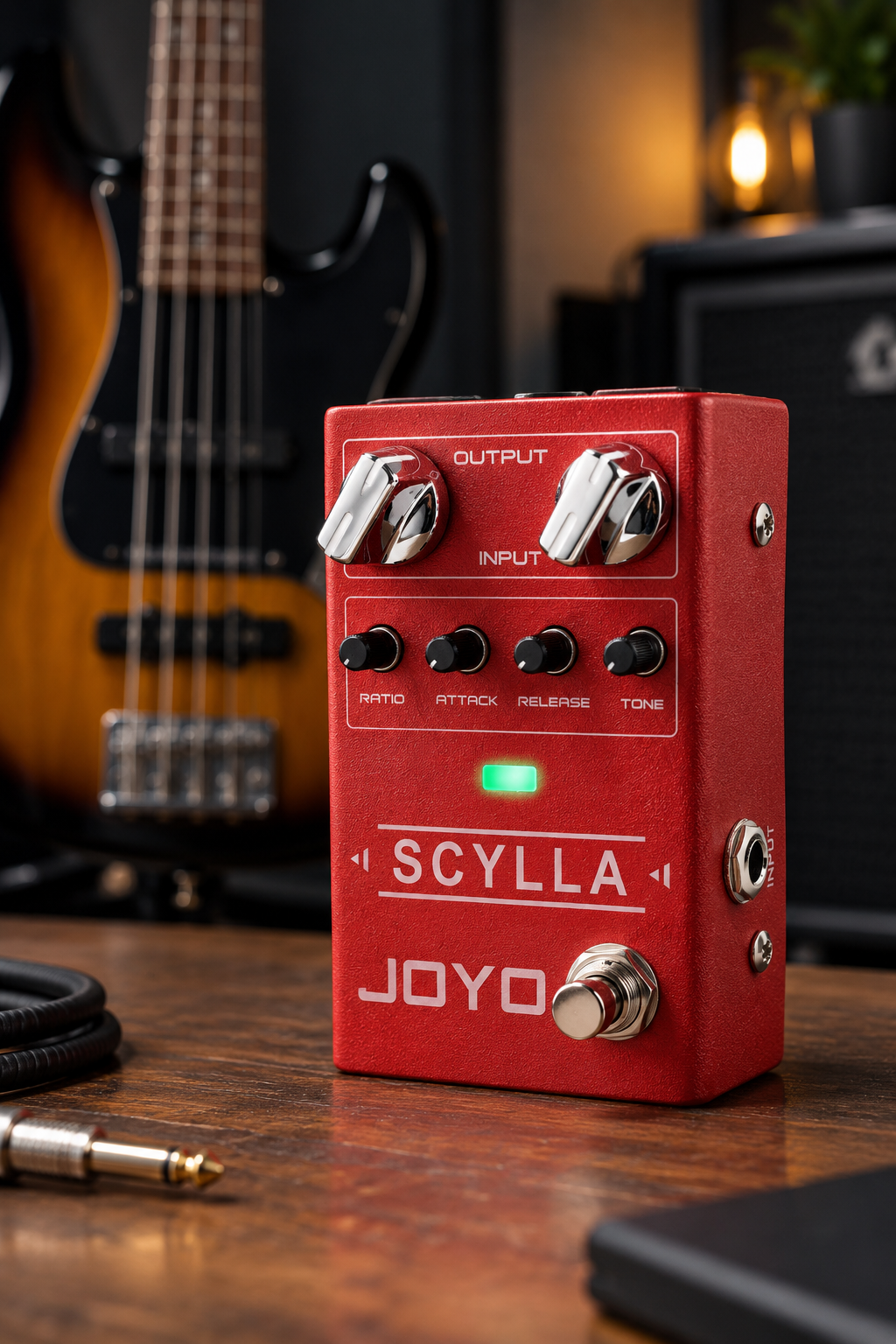
Joyo Scylla Compressor: Two Years Later
The biggest surprise in the entire year! When I reviewed the Joyo Scylla compressor in 2024, I thought I was reviewing a good, inexpensive bass compressor. I liked the pedal considerably more than I expected to, and the review reflected that. What I didn’t expect was what happened afterwards. The Scylla review eventually became the most searched and most viewed article on Bass Gear Reviews. It has also been the site’s best-converting article so far, which is something I find particularly interesting because there are considerably more expensive, more prestigious and, on paper at least, more exciting pieces of gear on the website. Two years later, the Scylla is still relevant, and people are still looking for information about it. That seemed like a good enough reason to come back to it. This isn’t intended to replace my original review, which you can still read here. That article goes into the pedal itself in much more detail. Instead, I wanted to look at what happens when you live with a piece of gear for a couple of years. Does it still get used? Have my opinions changed? Does the pedal still make sense now that there are more compressors competing for our attention? TL’DR: In the case of the Scylla, the answer to all three is yes. Two years is a useful amount of time Most gear reviews are necessarily written relatively soon after receiving a product. That’s not a criticism of the format; it’s simply how reviewing works. You have a limited amount of time with a pedal, you spend as much of that time as possible playing it, testing its controls and trying it in different situations, and eventually you have to sit down and write about what you found. The problem is that some things only become apparent after the novelty wears off. A pedal can be very impressive when it first arrives because it’s new and you’re deliberately paying attention to it. A few months later, it might have disappeared into a drawer. Something else has taken its place on the pedalboard and you have stopped thinking about it altogether. The Scylla didn’t really do that. It became one of those pedals that was simply there. I would use it without necessarily thinking about the fact that I was using it, which is actually a pretty good place for a compressor to end up. Compression isn’t normally an effect you want drawing attention to itself. When it is doing its job properly, it becomes part of the way the bass feels rather than something you are constantly listening for. That has probably been the biggest change in my opinion over the last two years. I don’t think about the Scylla as an inexpensive compressor that happens to be surprisingly good anymore. I think of it simply as a compressor that I like using. The fact that it happens to be inexpensive is still rather remarkable. The controls are still what make the Scylla interesting The Scylla gives you Input, Output, Ratio, Attack, Release and Tone, and that remains a very useful combination. The Input control is particularly important because it determines how hard you’re driving the compressor. The Output then gives you the opportunity to bring the overall level back to where you want it. Between those two controls, you can make sensible level adjustments rather than judging the pedal based on the very common perception that a louder signal somehow sounds better. Ratio determines how aggressively the compressor responds, while Attack and Release allow you to decide how quickly it reacts to your playing and how quickly it recovers afterwards. There is enough range here to move from fairly subtle dynamic control into much more obvious compression, which makes the pedal useful for considerably more than simply evening out a few inconsistent notes. Then there is the Tone control, which is one of the features I continue to appreciate, and it’s not something we expect to have on bass. Compressors are usually valued for being as transparent as they can possibly be, but in the case of the Scylla, it gives it an extra oomph that’s very effective. The Scylla doesn’t simply give you a conventional bass and treble arrangement. The Tone control changes the balance of the signal, allowing you to make the compressed sound darker or brighter. It is particularly useful when you’re trying to compensate for the way compression can change the perceived character of an instrument. That combination of controls is a large part of why the Scylla has aged well. There are no particularly exotic features here, but the things Joyo chose to include are genuinely useful. The Scylla is a very capable bass compressor There are plenty of compressors that can technically do more than the Scylla. The price range of the pedal makes that inevitable. Once you start looking at significantly more expensive compressors, you’ll find blend controls, sidechain filters, sophisticated metering, multiple compression modes and considerably more refined control over the signal. The Scylla is not competing with all of that. Its strength is that it gives you a useful amount of control over the fundamentals of compression without making the pedal prohibitively expensive. You can use it to smooth out your playing, control the peaks from a slap part, add some sustain or simply make your bass feel more consistent from note to note. And I think that is one of the reasons the pedal continues to attract attention. Compression is one of those areas where it is very easy to convince yourself that you need an expensive piece of equipment before you’ve really worked out what you want the compressor to do. The missing blend control If there is one feature I would have liked Joyo to include, it would be a blend control. Parallel compression is particularly useful on bass because it allows you to keep some of the original attack and dynamics of your playing while mixing in a heavily compressed signal