The biggest surprise in the entire year!
When I reviewed the Joyo Scylla compressor in 2024, I thought I was reviewing a good, inexpensive bass compressor. I liked the pedal considerably more than I expected to, and the review reflected that. What I didn’t expect was what happened afterwards.
The Scylla review eventually became the most searched and most viewed article on Bass Gear Reviews. It has also been the site’s best-converting article so far, which is something I find particularly interesting because there are considerably more expensive, more prestigious and, on paper at least, more exciting pieces of gear on the website.
Two years later, the Scylla is still relevant, and people are still looking for information about it.
That seemed like a good enough reason to come back to it.
This isn’t intended to replace my original review, which you can still read here. That article goes into the pedal itself in much more detail. Instead, I wanted to look at what happens when you live with a piece of gear for a couple of years. Does it still get used? Have my opinions changed? Does the pedal still make sense now that there are more compressors competing for our attention?
TL’DR: In the case of the Scylla, the answer to all three is yes.
Two years is a useful amount of time
Most gear reviews are necessarily written relatively soon after receiving a product. That’s not a criticism of the format; it’s simply how reviewing works. You have a limited amount of time with a pedal, you spend as much of that time as possible playing it, testing its controls and trying it in different situations, and eventually you have to sit down and write about what you found.
The problem is that some things only become apparent after the novelty wears off.
A pedal can be very impressive when it first arrives because it’s new and you’re deliberately paying attention to it. A few months later, it might have disappeared into a drawer. Something else has taken its place on the pedalboard and you have stopped thinking about it altogether.
The Scylla didn’t really do that.
It became one of those pedals that was simply there. I would use it without necessarily thinking about the fact that I was using it, which is actually a pretty good place for a compressor to end up. Compression isn’t normally an effect you want drawing attention to itself. When it is doing its job properly, it becomes part of the way the bass feels rather than something you are constantly listening for.
That has probably been the biggest change in my opinion over the last two years. I don’t think about the Scylla as an inexpensive compressor that happens to be surprisingly good anymore. I think of it simply as a compressor that I like using.
The fact that it happens to be inexpensive is still rather remarkable.
The controls are still what make the Scylla interesting
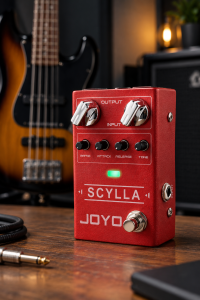
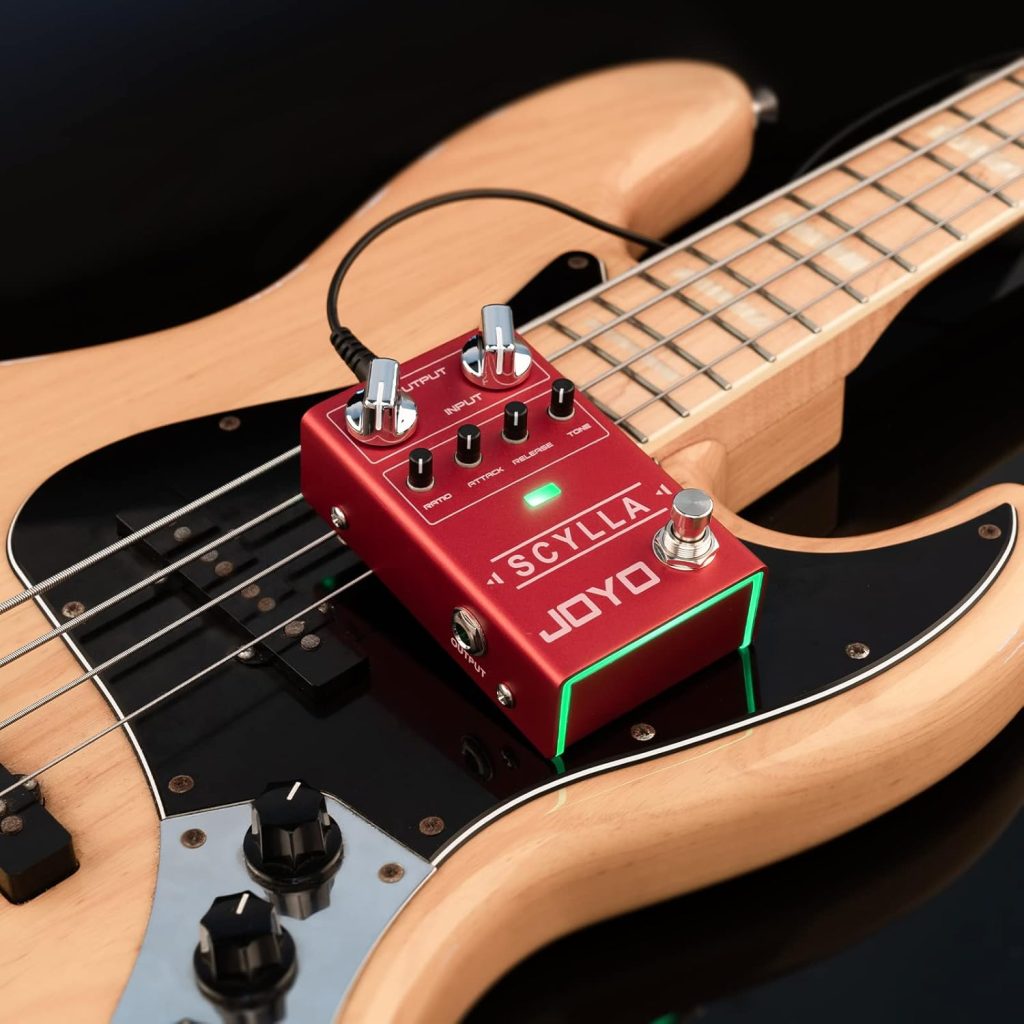
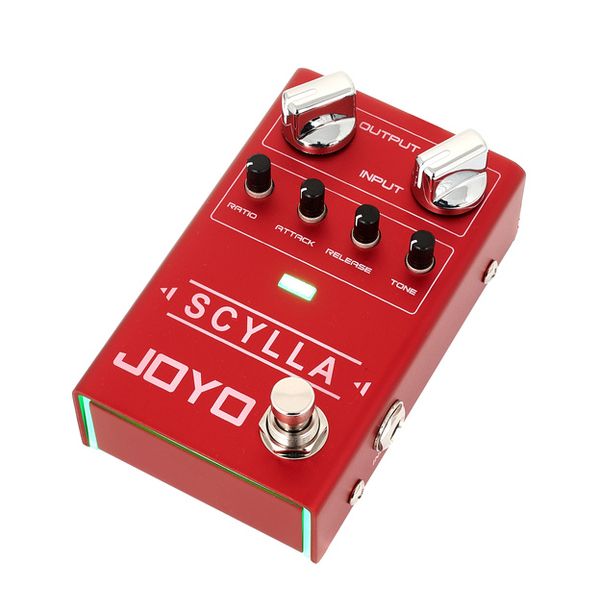
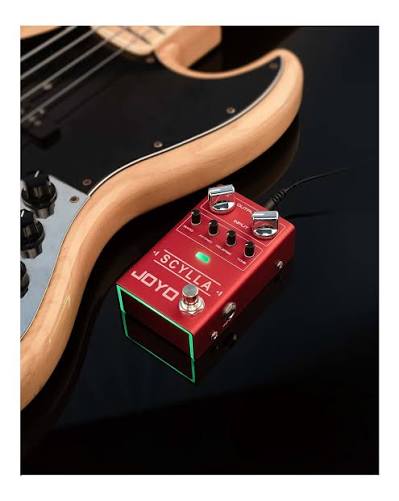
The Scylla gives you Input, Output, Ratio, Attack, Release and Tone, and that remains a very useful combination.
The Input control is particularly important because it determines how hard you’re driving the compressor. The Output then gives you the opportunity to bring the overall level back to where you want it. Between those two controls, you can make sensible level adjustments rather than judging the pedal based on the very common perception that a louder signal somehow sounds better.
Ratio determines how aggressively the compressor responds, while Attack and Release allow you to decide how quickly it reacts to your playing and how quickly it recovers afterwards. There is enough range here to move from fairly subtle dynamic control into much more obvious compression, which makes the pedal useful for considerably more than simply evening out a few inconsistent notes.
Then there is the Tone control, which is one of the features I continue to appreciate, and it’s not something we expect to have on bass. Compressors are usually valued for being as transparent as they can possibly be, but in the case of the Scylla, it gives it an extra oomph that’s very effective.
The Scylla doesn’t simply give you a conventional bass and treble arrangement. The Tone control changes the balance of the signal, allowing you to make the compressed sound darker or brighter. It is particularly useful when you’re trying to compensate for the way compression can change the perceived character of an instrument.
That combination of controls is a large part of why the Scylla has aged well. There are no particularly exotic features here, but the things Joyo chose to include are genuinely useful.
The Scylla is a very capable bass compressor
There are plenty of compressors that can technically do more than the Scylla. The price range of the pedal makes that inevitable. Once you start looking at significantly more expensive compressors, you’ll find blend controls, sidechain filters, sophisticated metering, multiple compression modes and considerably more refined control over the signal.
The Scylla is not competing with all of that.
Its strength is that it gives you a useful amount of control over the fundamentals of compression without making the pedal prohibitively expensive. You can use it to smooth out your playing, control the peaks from a slap part, add some sustain or simply make your bass feel more consistent from note to note.
And I think that is one of the reasons the pedal continues to attract attention. Compression is one of those areas where it is very easy to convince yourself that you need an expensive piece of equipment before you’ve really worked out what you want the compressor to do.
The missing blend control
If there is one feature I would have liked Joyo to include, it would be a blend control.
Parallel compression is particularly useful on bass because it allows you to keep some of the original attack and dynamics of your playing while mixing in a heavily compressed signal underneath. You can get sustain and consistency without completely flattening the character of the instrument.
Whether that matters depends entirely on how you use compression. If you’re looking for a pedal that you can set up for fairly conventional compression and leave on, the omission isn’t particularly important. If parallel compression is an essential part of your sound, you’ll need to look elsewhere.
I don’t think this is a flaw that suddenly became more obvious after two years. It was a limitation when I first reviewed the pedal, and it remains one now.
The same is true of the metering. The Scylla has a LED system that gives you some indication of what the compressor is doing, but it isn’t anything like the proper gain-reduction meters found on more expensive compressors. There have even been discussions among users about modifying the LEDs to make the indication easier to see.
It’s an interesting little quirk of the pedal, although I wouldn’t consider the metering one of the reasons to buy a Scylla.
Attack and Release take a little getting used to
One detail that can catch people out when they first use the Scylla is the way the Attack and Release controls behave.
They work as speed controls, so turning them clockwise makes the response faster. That’s not necessarily how someone coming from another compressor will expect the controls to behave, and it can lead to some confusion when you’re first setting the pedal up.
Once you understand what the controls are actually doing, it becomes much less of an issue.
In fact, I think this is a good example of why compressors are worth spending some time with. There is a temptation to put every control in the middle, play a few notes and decide whether a compressor sounds good or bad. With the Scylla, as with most useful compressors, you get considerably more from it once you start paying attention to how the settings interact with your playing.
A slower attack can allow more of the initial transient through, preserving some of the punch of the note, while a faster setting can bring the compressor in more quickly. Release has an equally important effect on how natural the compression feels.
There isn’t one correct setting. It depends on your bass, your playing and what you’re trying to achieve.
Has the Scylla become outdated?
I don’t think so. The pedal was never built around some fashionable feature that has since been replaced by something better. Its appeal is based on a fairly straightforward set of fundamentals: it compresses a bass signal, gives you useful control over how it does so, includes a Tone control, and doesn’t cost very much. And those things haven’t become obsolete.
If anything, the current pedal market makes the Scylla’s proposition easier to understand. There are now an enormous number of compressors available, from very simple pedals to extremely sophisticated digital and analogue designs. You can spend several hundred euros on a compressor if you want to.
You can also spend considerably less. The question is whether the more expensive option will make enough difference to your particular setup to justify the additional cost.
The Scylla doesn’t pretend to be the last compressor you’ll ever need, but it gives you enough control to produce a genuinely useful result without requiring a significant investment.
Joyo also continues to sell the pedal, which is worth mentioning. This isn’t an old design that has quietly disappeared while the remaining examples sit in warehouses. The Scylla is still part of Joyo’s current range, and it remains readily available.
Why has this become the biggest article on Bass Gear Reviews?
This is the part I find most interesting.
When I published the original Scylla review, Bass Gear Reviews was still relatively young. I wasn’t expecting a budget compressor from Joyo to become the article that would bring more people to the website than anything else I’d written.
But it did.
The review has continued to attract people searching for information about the pedal, and a significant number of those readers have gone on to buy it.
I think the reasons are fairly straightforward. The Scylla sits in an interesting price range, it is aimed directly at bass players, and there are enough controls to make it feel like a serious compressor rather than a stripped-down beginner’s pedal.
More importantly, I suspect there are a lot of bass players in exactly the position I was in when I first reviewed it: interested in compression, aware that it can be useful, but not necessarily convinced that they need to spend hundreds of euros finding out.
The Scylla makes that decision considerably easier.
And, as the site’s owner, I obviously can’t complain about the fact that it has also become its most successful affiliate article.
The funny thing is that none of that was planned.
I reviewed the pedal because I thought it would be useful to readers. The readers then decided to make it the most successful article on the site.
Two years later, I’m rather glad they did.
Would I still recommend the Joyo Scylla?
Yes.
That answer is probably less exciting than telling you that my opinion has completely changed after two years, but the reality is that it hasn’t.
If I were buying a compressor today and wanted something affordable with enough controls to explore proper compression, the Scylla would still be on my list. It gives you Input, Output, Ratio, Attack, Release and Tone, and those controls cover most of what you are likely to want from a straightforward bass compressor.
It isn’t perfect. The lack of a blend control is still unfortunate, the metering could be better and there are certainly more sophisticated compressors available.
But none of those things have stopped me from using it.
And that’s ultimately what I was interested in finding out when I came back to this pedal after two years. A review can tell you what a product does. Longer-term use tells you whether you actually want to keep using it.
Final thoughts
The Joyo Scylla is an unusual success story for Bass Gear Reviews because it has ended up being much more important to the site than I ever expected when I first plugged it in.
The original review brought the pedal to the attention of a lot of bass players, but two years of continued use have also given me a better understanding of why it worked for me in the first place. It is a straightforward, capable compressor with a useful set of controls, and its shortcomings are fairly easy to understand before you buy it.
For me, the fact that I’m still happy to use it after two years is probably a more meaningful recommendation than anything I could have written in the original review. And the fact that thousands of bass players have continued searching for that review, reading it and buying the pedal through it has made the Scylla a rather special part of the story of Bass Gear Reviews.
So this is less a second review than a celebration of a pedal that has quietly become one of the most important pieces of gear I’ve covered.
The little red Joyo surprised me in 2024.
Two years later, it still hasn’t given me a reason to change my mind.
Joyo Scylla Compressor on Amazon →
This is an affiliate link. If you purchase through it, Bass Gear Reviews may earn a small commission at no additional cost to you.
Other Joyo Gear You Might Like
If you enjoyed checking out this Joyo pedal, here are more Joyo products worth exploring — all tested and reviewed here on BassGearReviews:
- Joyo Gloam – Dark and Gritty sub-octave bass fuzz.
- Joyo Tidal Wave – Vintage preamp based on the Sansamp circuit.
- Joyo Monomyth Bass Preamp – Versatile preamp with EQ shaping and DI output.
- Joyo Double Thruster – Dual-drive section for layered grit and boost.