A versatile dual-modulation pedal
Modulation effects are an interesting category for bass players and we’ve reviewed quite a bit of them here on BassGearReviews. While chorus, phaser and flanger pedals have been around for decades, they aren’t necessarily effects that everyone uses regularly. Some players rely on a subtle chorus to add a little movement to their sound, while others use modulation more creatively, particularly when exploring fretless bass, ambient textures or synthesiser-inspired tones.
The problem is that building a versatile modulation section can quickly become an expensive exercise. A decent chorus, phaser, flanger and filter can easily occupy a considerable amount of pedalboard space, even before you start thinking about tremolo or rotary effects.
Rather than offering six separate effects that you can select individually, the VDS-2D takes a slightly different approach. It features two independent digital modulation engines, each with three effect options, allowing you to combine two different modulation effects simultaneously.
You get Chorus, Flanger and Phaser on the first engine, while the second offers Rotary, Filter and Tremolo. You can then run the two engines in series or parallel, giving you quite a bit of flexibility when building more complex sounds.
Let’s take a closer look.
Two modulation engines, six effects
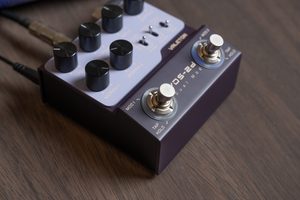
The first thing you’ll notice about the VDS-2D is that Valeton has managed to fit quite a lot of functionality into a relatively compact enclosure.
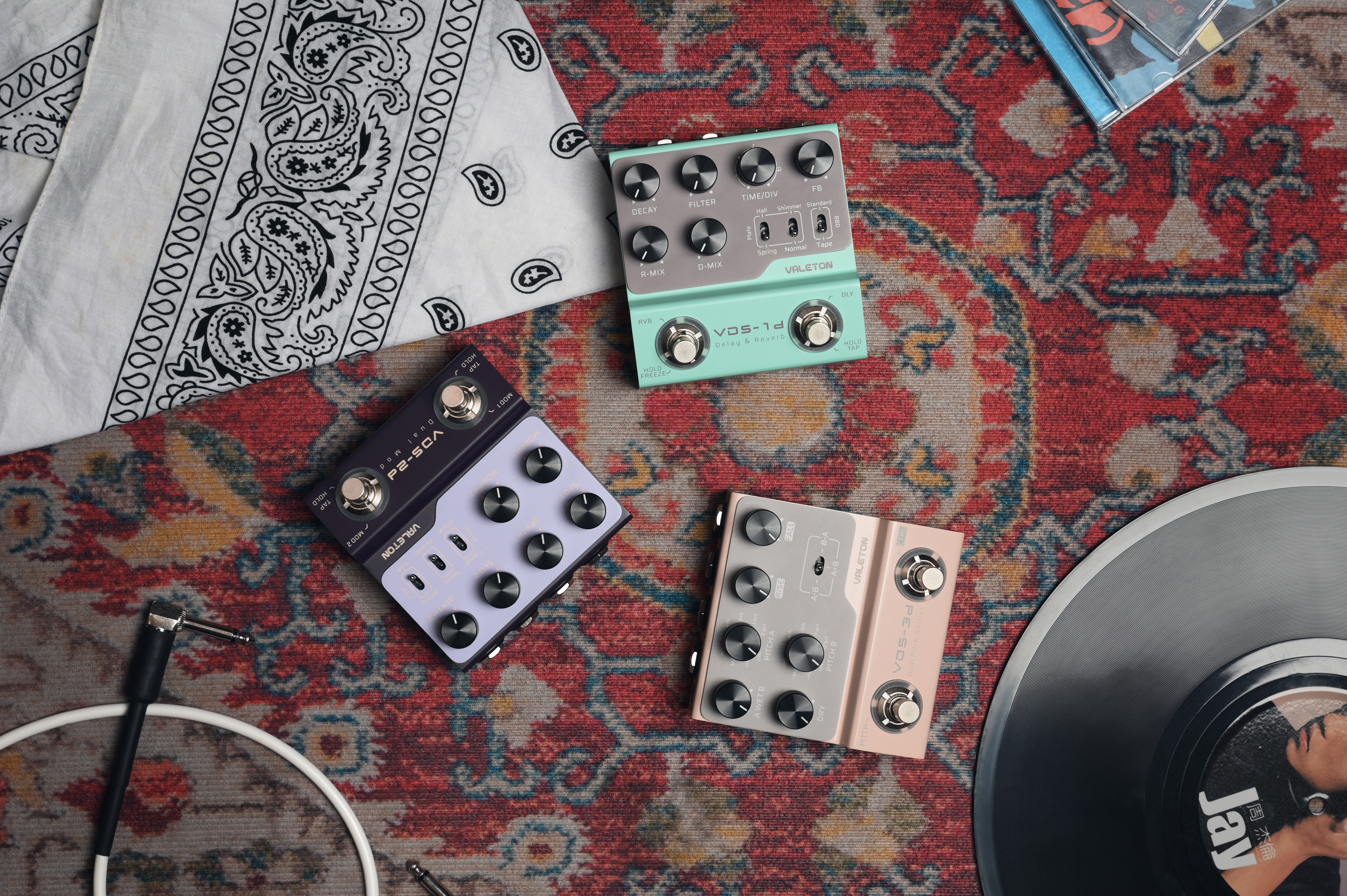
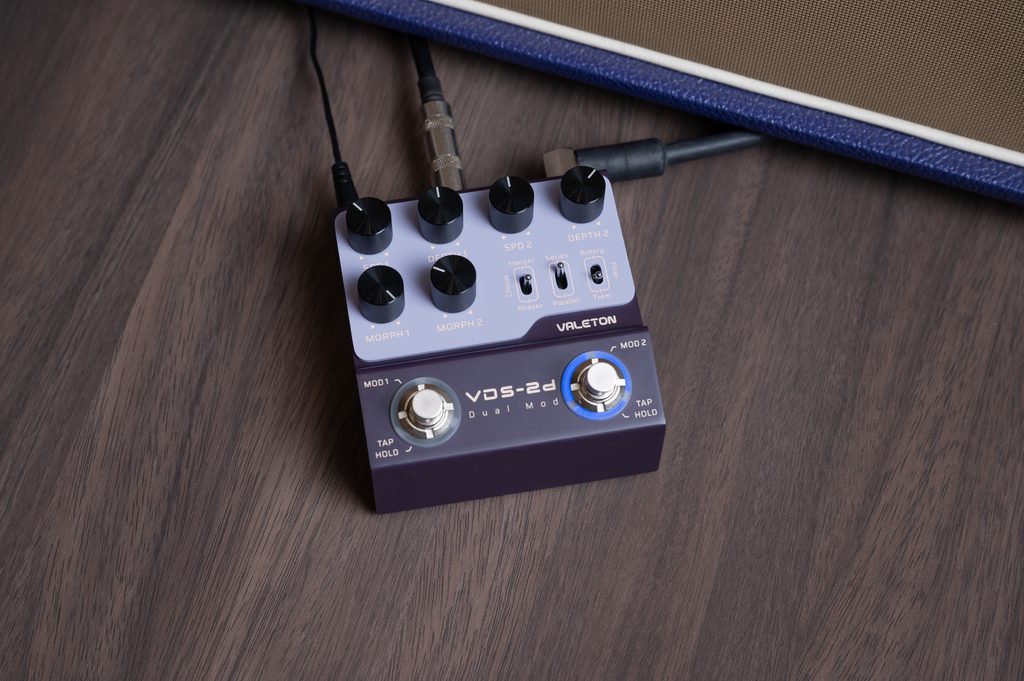
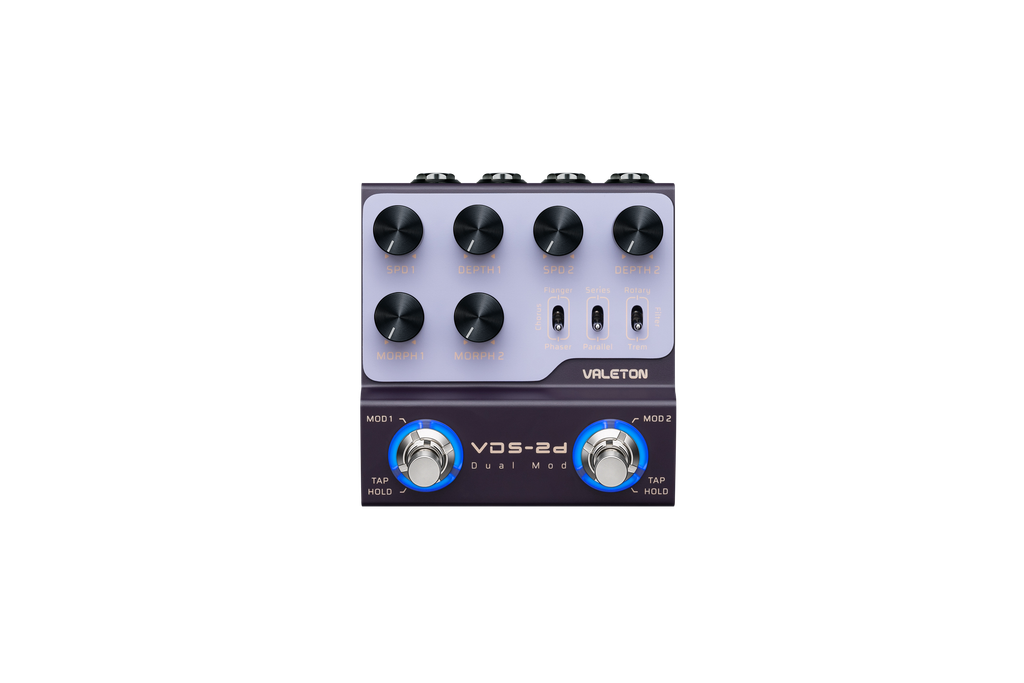
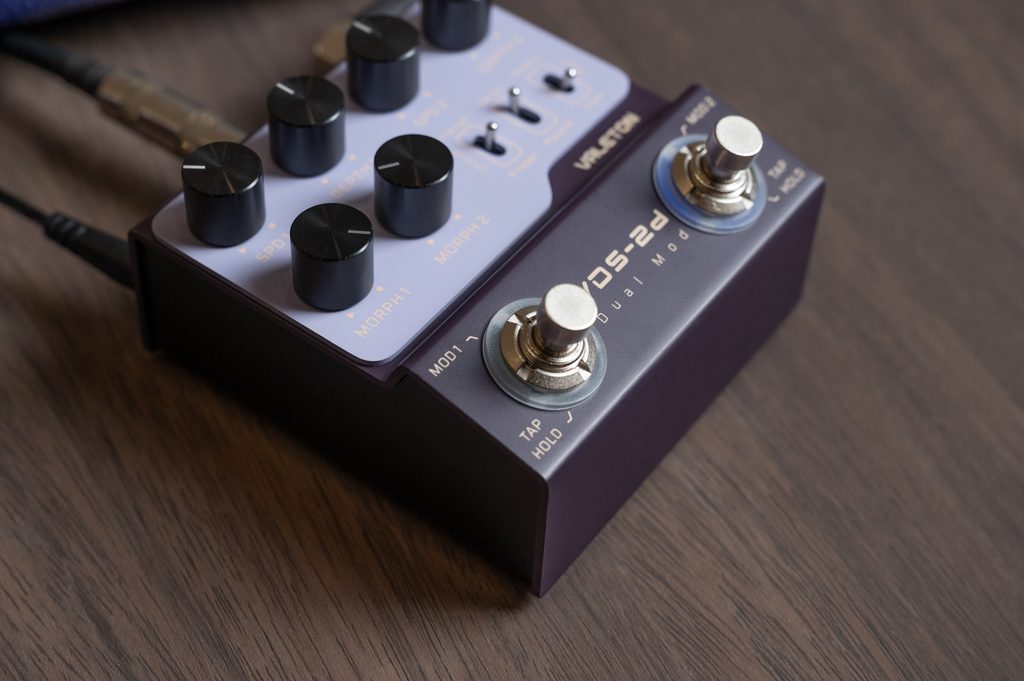
The layout is straightforward. There are six rotary controls, two effect-selection switches and a Series/Parallel switch, with two footswitches at the bottom controlling the individual modulation engines.
The first engine offers three familiar modulation effects:
- Chorus
- Flanger
- Phaser
The second engine provides:
- Rotary
- Filter
- Tremolo
Each engine has independent Speed and Depth controls, allowing you to adjust the modulation rate and intensity without affecting the other effect.
There’s also a Morph control for each engine. Morph 1 adjusts the mix of MOD 1 when using Series mode, while in Parallel mode it controls the final blend between the two modulation engines. Morph 2 changes its function depending on the selected MOD 2 effect, controlling the filter frequency or the tremolo waveform, for example.
This is a fairly clever approach to the controls. You don’t have to navigate menus or deal with complicated parameter assignments. Everything is accessible directly from the pedal.
The only thing worth remembering is that you can combine one effect from each engine, not any two of the six available effects. You can run Chorus and Tremolo together, for example, but you cannot combine Chorus and Phaser.
It’s a reasonable limitation, particularly considering how much functionality Valeton has managed to fit into the pedal.
Check the price of the Valeton VDS-2 on Amazon –>
How does the VDS-2D sound with bass?
One of the things I always look for when testing modulation pedals with bass is how much they affect the fundamental frequency. It’s relatively easy to make a chorus sound impressive when playing guitar, but bass introduces a different set of challenges. You want the movement and character of the modulation without losing the weight that makes the instrument work.
Fortunately, the VDS-2D handles bass particularly well. The effects retain enough low-frequency information to keep the instrument sounding like a bass rather than a thin, heavily processed version of one.
That’s important because modulation effects can sometimes create the impression that you’re losing low end even when the fundamental is still present. Changes in phase relationships, frequency emphasis and the balance between wet and dry signals can all affect how substantial the instrument feels.
The VDS-2D manages to keep things under control, making it possible to use the effects more enthusiastically without constantly having to compensate for a disappearing bottom end.
It’s also worth mentioning that the pedal offers true and buffered bypass options, so you can choose whichever approach works best with your existing signal chain.
Chorus: a familiar effect with plenty of room to experiment
Chorus is probably the first effect most bass players will want to try, and for good reason.
A good bass chorus can add width and movement without making the instrument sound excessively processed. It’s particularly useful for fretless bass, melodic passages and situations where you want the bass to occupy a little more space in the mix.
At lower depth settings, the chorus adds a subtle sense of movement that works particularly well with sustained notes. Increase the depth and the effect becomes considerably more noticeable, opening the door to those more pronounced, almost synthesiser-like textures.
I particularly like having independent control over speed and depth. It means you can experiment with slower, deeper modulation without being forced into the more obvious, rapidly moving chorus sounds that some pedals tend to favour.
For everyday bass playing, I’d probably spend most of my time with relatively conservative settings. There’s enough character here to make a difference without overwhelming the original instrument.
Flanger: for something a little more adventurous
Flanger is one of those effects that can sound fantastic in the right context, but it’s not necessarily something you’ll leave switched on throughout an entire performance.
The VDS-2D offers the familiar sweeping, metallic character you’d expect from a flanger, making it particularly useful for more experimental passages and moments where you want the bass to stand out.
On bass, I tend to prefer flanger settings that retain some of the original instrument’s body. There’s a fine line between adding an interesting movement to a bass line and turning it into a rather hollow, indistinct sound.
The VDS-2D gives you enough control to explore both ends of that spectrum.
It’s also worth experimenting with the flanger in combination with the second modulation engine. Adding a little tremolo, for example, creates a considerably more animated sound that can work surprisingly well for atmospheric passages and transitions.
Phaser: subtle movement or something much more obvious
Phaser is another effect that I think deserves more attention from bass players. Unlike chorus, which tends to create a more obvious sense of movement, a phaser can add character without necessarily making the instrument sound dramatically different.
The VDS-2D offers a useful range of possibilities here, from relatively restrained movement to more pronounced sweeps.
For fretless bass in particular, I find phaser effects particularly interesting. The combination of sustained notes, natural articulation and the movement introduced by the effect can create some very expressive sounds.
It’s also one of the more interesting effects to combine with the second engine. A phaser running alongside tremolo can produce rhythmic movement that’s quite different from what you’d get using either effect independently.
Rotary: an interesting addition to a bass modulation pedal
Rotary effects attempt to recreate the sound of a rotating speaker cabinet, traditionally associated with Hammond organs and Leslie speaker systems. It’s not necessarily the first effect that comes to mind when thinking about bass, but that doesn’t mean it isn’t useful.
The VDS-2D’s rotary option introduces a swirling, moving character that can work particularly well with sustained notes and melodic bass parts.
I wouldn’t necessarily consider this an essential effect for every bass player, but it’s a welcome addition to a pedal that already covers the more conventional modulation sounds.
It also gives you another option when experimenting with the dual-engine architecture. Combining rotary with chorus or phaser can produce some rather interesting textures that would otherwise require multiple pedals.
Filter: some interesting possibilities for bass
The filter is potentially one of the most interesting effects on the VDS-2D from a bass player’s perspective. Filter effects have a long history in bass music, particularly funk and electronic music, where they can transform an otherwise conventional bass line into something much more expressive.
It’s important to clarify that the VDS-2D’s filter isn’t a conventional envelope filter that automatically responds to how hard you’re playing. Instead, it offers a manually adjustable filter frequency, with the modulation controls determining how the effect moves. This means you can create rhythmic filter sweeps and more synthesiser-inspired textures without needing to rely on an envelope follower.
The Morph 2 control is particularly useful here, allowing you to adjust the filter frequency directly.
It’s a different approach from a dedicated envelope filter, but one that opens up some interesting possibilities, especially when combined with chorus or flanger.
For bass players looking to experiment with more electronic sounds, this is definitely one of the more appealing features of the pedal.
Tremolo: simple, effective and surprisingly versatile
Tremolo is perhaps the simplest effect in the VDS-2D’s collection, but it’s also one of the most useful when you start experimenting with different combinations.
Rather than changing the pitch or frequency content of the signal, tremolo periodically changes its volume, creating a pulsing effect.
At slower speeds, this can add a gentle rhythmic movement to sustained notes. Increase the rate and it becomes considerably more pronounced, opening the door to more rhythmic and experimental sounds.
The Morph 2 control also allows you to change the waveform between triangle and square, giving you a choice between smoother volume changes and more abrupt transitions.
For bass, this is particularly interesting because the two approaches can produce very different results.
A softer waveform can add movement without drawing too much attention to itself, while the square waveform creates a much more obvious rhythmic gating effect.
It’s also an excellent candidate for combining with chorus, phaser or flanger.
Series or Parallel: where things get interesting
Having two modulation engines is already useful, but the ability to change how they interact is what makes the VDS-2D particularly interesting. Valeton gives you two routing options: Series and Parallel.
In Series mode, the signal passes through the first modulation engine and then the second. This means that the second effect processes the already-modulated signal, creating a more layered result.
For example, you could run Chorus into Tremolo, allowing the chorus to add movement to the signal before the tremolo introduces its rhythmic volume changes.
In Parallel mode, the two modulation engines operate alongside each other, with Morph 1 controlling the final blend between them. I think this flexibility is one of the strongest arguments for choosing the VDS-2D over a conventional single-modulation pedal.
You aren’t simply getting two effects in one enclosure. You’re getting two effects that can interact in different ways, creating sounds that would otherwise require a more complicated pedalboard.
There are nine possible effect combinations in total, and having both routing options gives you plenty of room to experiment.
Tap tempo and stereo connectivity
There are a few additional features worth mentioning.
Both modulation engines have their own footswitch, allowing you to activate or deactivate them independently.
Holding either footswitch activates Tap Tempo, with the indicator rings providing visual feedback. When both engines are using Tap Tempo, tapping one side also synchronises the other engine’s rate.
This is particularly useful when combining effects such as tremolo and chorus, where having the modulation rates working together can make a considerable difference to the resulting sound.
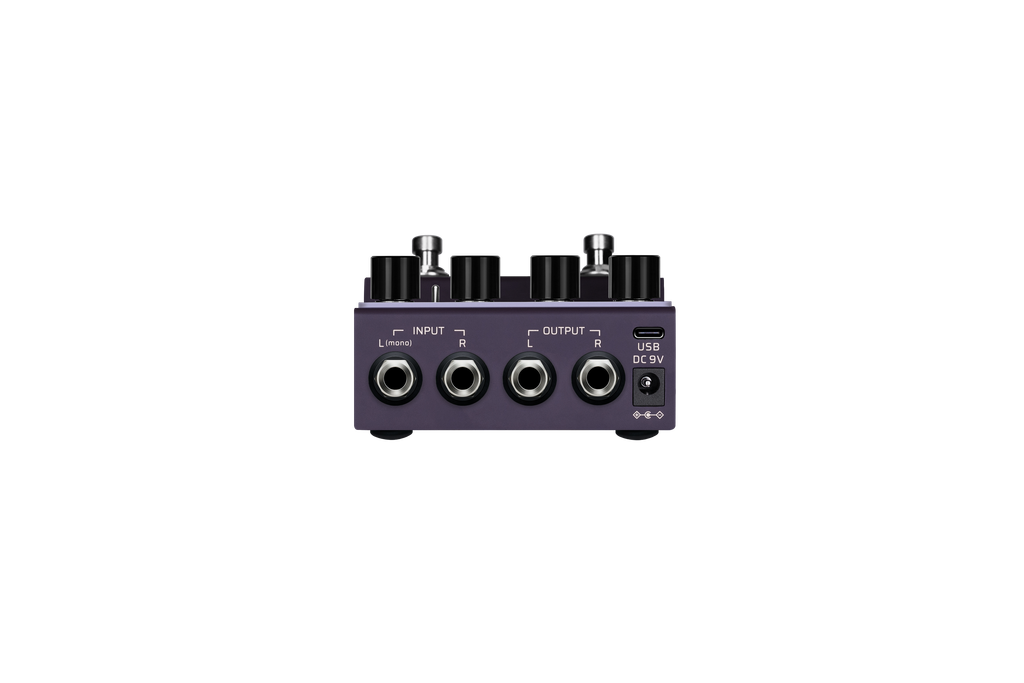
The VDS-2D also offers true stereo input and output connections.
For bass players running a stereo rig, this opens up some interesting possibilities, particularly when using two amplifiers or a stereo effects chain.
Of course, you can also use the pedal in a conventional mono configuration through the left input and output.
The remaining connections include a USB-C port for firmware updates and a standard 9V DC power input. The pedal requires 300mA, so make sure your power supply can accommodate that.
What the VDS-2D doesn’t have
There are a few things worth considering before deciding whether the VDS-2D is the right modulation pedal for your setup.
The most obvious omission is the lack of presets. You can configure the two modulation engines exactly as you want, but there’s no way to save multiple configurations and recall them later.
For players who like to change their modulation settings between songs, this could become inconvenient.
There’s also no MIDI connectivity or expression pedal input, which limits the possibilities for integrating the pedal into more elaborate, MIDI-controlled rigs.
Another consideration is that you’re limited to one effect from each modulation group. If you were hoping to combine Chorus and Phaser, for example, you’ll need another pedal.
None of these limitations is particularly surprising for a pedal in this category, but they’re worth considering if you’re building a more sophisticated effects setup.
Who is the Valeton VDS-2D for?
I think the VDS-2D makes the most sense for bass players who want access to a broad range of modulation effects without having to dedicate several individual pedals to the task.
The combination of Chorus, Flanger, Phaser, Rotary, Filter and Tremolo covers most of the modulation sounds that many bass players are likely to need.
More importantly, the dual-engine architecture makes it possible to combine two effects simultaneously, which considerably expands the creative possibilities.
For someone who primarily wants a straightforward chorus pedal, there are probably simpler and more specialised options available.
However, if you’re interested in experimenting with modulation, building more complex sounds or simply having a wider range of effects available when you need them, the VDS-2D is a much more compelling proposition.
I can particularly see it appealing to fretless players, musicians working with ambient or progressive music, and bassists who enjoy exploring the more synthesiser-inspired side of the instrument.
Final thoughts
The Valeton VDS-2D is a surprisingly versatile modulation pedal.
Its biggest strength isn’t necessarily any individual effect, but rather the way Valeton has brought six modulation options together with two independent processing engines and flexible signal routing.
The chorus, phaser and flanger cover the familiar territory, while the rotary, filter and tremolo options add some welcome variety.
For bass players, the ability to retain the weight and character of the instrument while introducing these effects is particularly important, and the VDS-2D does a good job of getting that balance right.
I also appreciate the straightforward control layout. There are no complicated menus or unnecessary distractions, and most of the adjustments you need are available directly from the top panel.
The lack of presets, MIDI and expression control might be disappointing for some players, but I don’t think those omissions undermine what the pedal is trying to achieve.
Ultimately, the VDS-2D is a good option for anyone looking to expand their modulation possibilities without filling their pedalboard with individual effects.