An Inspiring Chorus and Vibrato Pedal for Bass
Disclaimer: This pedal was kindly provided by Walrus Audio for the purpose of this review. However, this does not influence our opinions or the content of our reviews. We strive to provide honest, unbiased, and accurate assessments to ensure that our readers receive truthful and helpful information.
Chorus and vibrato pedals can be a mixed bag for bass players. Many sound fantastic on guitar but quickly become unusable once low frequencies enter the picture, either thinning out the fundamental, smearing note definition, or creating a wash of modulation that gets lost in a band mix.
My interest in vibrato on bass goes back years. As a huge fan of bassist Juan Alderete, I was exposed early on to the creative possibilities of vibrato effects, particularly when paired with fretless bass. There’s something about subtle pitch movement on a fretless that can add an almost vocal quality to a bass line, transforming a simple phrase into something far more expressive. Since then, I’ve always had a soft spot for pedals that explore that territory.
That’s what immediately caught my attention about the Walrus Audio Julia. On paper, it offers two of my favorite modulation effects in a single enclosure: chorus and vibrato. Having two sounds for the price of one is always appealing, but what really intrigued me was the ability to blend seamlessly between them rather than treating them as separate modes. For bass players looking to add movement, texture, and atmosphere without sacrificing musicality, that flexibility makes Julia a particularly interesting proposition.
Overview
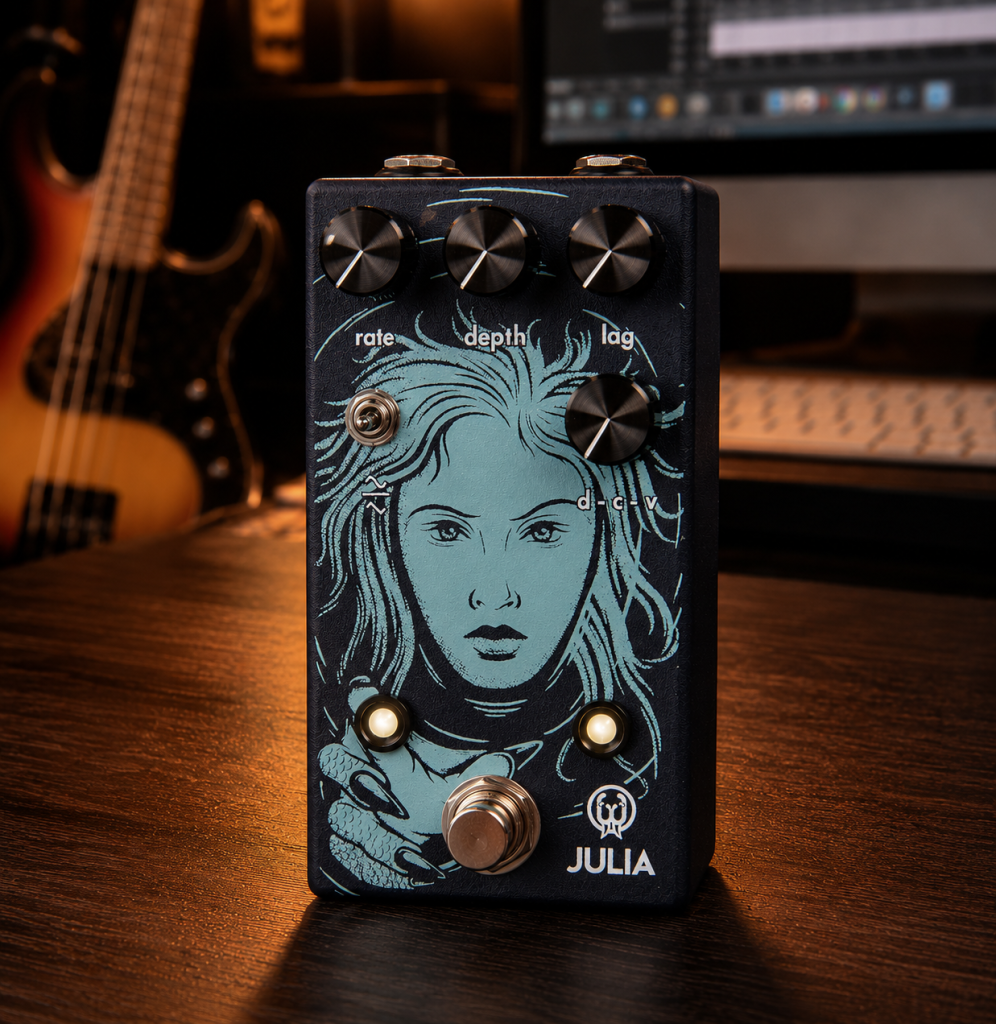
At its core, the Julia is an analog chorus and vibrato pedal built around a bucket brigade delay (BBD) circuit. Rather than locking players into a single chorus voice, Julia allows continuous blending between dry and modulated signals through its D-C-V control. This control is the heart of the pedal. Fully counterclockwise, the signal remains dry. As the knob moves clockwise, increasing amounts of modulation are introduced, progressing from subtle chorus to fully wet vibrato.
For bass players, this flexibility is especially useful. Traditional chorus pedals often provide a fixed blend that can overwhelm the low end, but Julia allows the effect to be dialed in with precision.
Design and Aesthetics
Let’s be honest: most effects pedals are designed with function as the primary objective and aesthetics as an afterthought. There’s nothing wrong with that, but it often results in pedalboards filled with little more than colored metal boxes distinguished only by their logos and knob layouts.
The Julia takes a different approach.
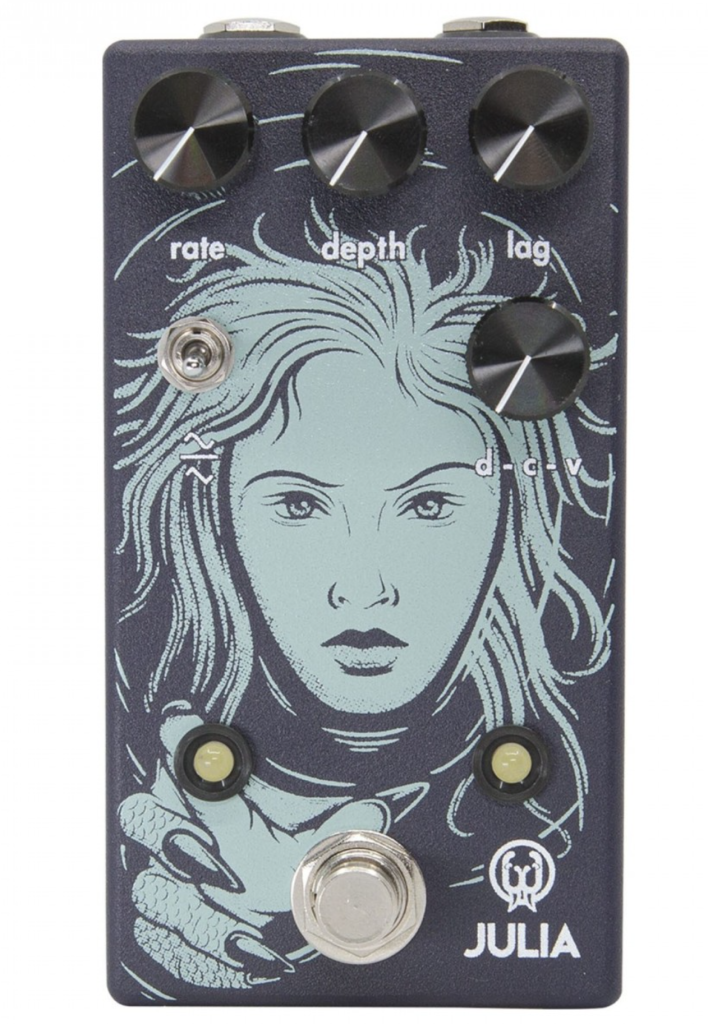
Like many of Walrus Audio’s pedals, the Julia features distinctive artwork that gives it a personality of its own. The illustration has become almost as recognizable as the pedal’s sound, helping it stand out in an increasingly crowded effects market. More importantly, the design isn’t just decorative—it makes the pedal instantly identifiable on a busy pedalboard or stage. Even from a distance, it’s difficult to mistake a Julia for anything else.
While visual design won’t make a pedal sound better, there’s something to be said for gear that inspires you every time you look down at your board. The Julia manages to combine practical usability with a unique artistic identity, adding a touch of character to a pedalboard without feeling gimmicky. In a world where many pedals blend together visually, the Julia stands out for all the right reasons.
Controls and Features
D-C-V Blend Control
The D-C-V control is what separates Julia from many other modulation pedals. Instead of forcing players to choose between chorus and vibrato, it offers a continuous spectrum between the two.
For bassists, this means you can dial in just enough modulation to add movement while preserving note definition and low-end presence. Subtle settings create width and dimension, while more aggressive settings move into lush chorus territory before eventually reaching pure vibrato.
Rate and Depth
The Rate and Depth controls shape the character of the modulation.
Lower Rate settings create slow, spacious movement that complements sustained notes and melodic playing. Increasing the Rate introduces more obvious modulation that can range from classic chorus textures to experimental sounds.
The Depth control determines how dramatic the pitch movement becomes. Low settings provide a gentle shimmer, while higher settings produce deep, swirling modulation capable of transforming the character of your bass entirely.
Lag Control
One of Julia’s most unique features is the Lag control.
Rather than functioning as a traditional tone control, Lag alters the shape and feel of the modulation waveform. Lower settings provide smoother and more rounded movement, while higher settings create a more pronounced and textured modulation response.
For bass players, this control becomes a powerful tool for tailoring the pedal to different instruments, playing styles, and musical situations.
Waveform Selector
Another subtle but useful feature is the two-position Wave switch, which lets you choose between sine and triangle LFO waveforms. While it may seem like a minor addition, changing the waveform noticeably alters the feel of the modulation.
The triangle wave produces a more defined and articulate modulation, making it particularly well suited to chorus sounds. On bass, it helps create a lush, animated texture while maintaining note separation, making it a great choice for players looking to add width without losing clarity.
Switching to the sine wave smooths out the modulation considerably. The rounder waveform creates a more fluid and natural pitch movement that complements vibrato especially well. On fretless bass, this can produce an expressive, almost vocal quality that feels organic rather than exaggerated.
It’s the kind of control that’s easy to overlook, but after spending time with the pedal it becomes clear how useful it is. Instead of simply making the effect faster or deeper, the Wave switch changes the character of the modulation itself. Combined with the D-C-V, Rate, Depth, and Lag controls, it gives Julia an impressive amount of flexibility, allowing bass players to fine-tune not just how much modulation they hear, but how that modulation feels under the fingers.
Chorus and vibrato on Bass
Many bass players approach chorus with caution, and for good reason. Poorly implemented chorus effects can rob a bass signal of its focus and authority.
With moderate settings, the pedal adds width, movement, and dimension without dramatically altering the instrument’s fundamental role in the mix. Clean passages gain a sense of space, while melodic lines become more engaging and expressive.
Players who enjoy fretless bass, chordal work, or atmospheric textures will find plenty to appreciate here.
While chorus is common in bass rigs, vibrato remains somewhat overlooked.
Julia’s fully wet vibrato settings open up a completely different set of creative possibilities. Without the dry signal present, the modulation becomes more dramatic and expressive, creating movement that feels almost vocal at times.
This is where my interest in the pedal began. Vibrato can be particularly effective on fretless bass, where the natural singing quality of the instrument combines beautifully with subtle pitch modulation.
While pure vibrato may not be an always-on effect, it shines during intros, ambient passages, solos, and experimental sections where character and expression are the goal.
In Practical Use
In real-world bass applications, Julia succeeds because it rarely feels like it’s fighting the instrument.
The analog modulation remains musical across a wide range of settings, allowing players to move from subtle enhancement to immersive textures without losing the organic character of their bass.
The pedal also pairs exceptionally well with other effects. Combined with octave pedals, reverb, delay, or filters, Julia can create rich and inspiring soundscapes while remaining easy to control.
Low-End Performance
Perhaps the most important question for bassists is whether the pedal preserves low-end clarity.
While Julia does not include dedicated bass controls or crossover processing, its flexible blend architecture helps retain the fundamental more effectively than many traditional chorus pedals. By controlling exactly how much modulation enters the signal path, players can find a sweet spot that adds movement without sacrificing punch.
As always, results will vary depending on instrument, amplifier, and playing style, but Julia generally behaves far better on bass than its guitar-focused reputation might suggest.
Final Thoughts
The Walrus Audio Julia succeeds because it offers more than a standard chorus pedal. Its ability to move seamlessly between chorus and vibrato gives bass players access to a broad palette of modulation textures in a single, intuitive package.
Whether you’re looking for subtle enhancement, spacious chorus sounds, expressive vibrato, or ambient experimentation, Julia delivers with a musicality that feels particularly well suited to bass.
It may not have been designed specifically for bass players, but its flexibility, organic analog character, and unique control set make it an excellent option for anyone looking to expand their modulation toolkit.
Get your Walrus Audio Julia on Amazon now!
If you’re a bass player looking for more information on Walrus Audio gear, check some of the other reviews we’ve done here on BassGearReviews.com:
– Walrus Audio Mantle – Studio Grade Bass Preamp in Pedal Form