A studio-grade bass preamp in pedal form
Disclaimer: This pedal was kindly provided by Walrus Audio for the purpose of this review. However, this does not influence our opinions or the content of our reviews. We strive to provide honest, unbiased, and accurate assessments to ensure that our readers receive truthful and helpful information.
Nowadays, we have gear for every player, in every shape, form, and price point. Some of it turns out to be little more than hype, while other pieces quietly prove themselves to be genuinely exceptional. There is budget gear capable of producing incredible sounds, and there are ultra-boutique, expensive products that struggle to justify their price. It is in this landscape that the Mantle appears—highly visible, heavily discussed, and undeniably controversial.
When Walrus Audio gave us the opportunity to review this pedal, it was an easy decision. This is exactly the kind of product we aim to explore: ambitious, polarizing, and designed with a very clear purpose.
Designed from a studio mindset
The Mantle was developed by Ian Martin Allison in collaboration with Walrus Audio, and its design philosophy reflects that partnership clearly. Instead of chasing versatility or feature count, the pedal focuses on capturing the character and behavior of high-end studio preamps.
At the heart of the Mantle is a signal path inspired by classic recording equipment. The input stage draws from Neve-style designs, known for their weight and warmth, while the output stage takes cues from API circuits, prized for their clarity and punch. This combination is not accidental. In studio environments, engineers rely on these types of preamps to shape bass tone before it even reaches EQ or compression, and the Mantle brings that philosophy directly to the pedalboard.
One of the defining elements of this design is the use of custom transformers. Unlike most pedals, which rely entirely on solid-state circuitry, the Mantle incorporates transformer-based stages to add harmonic richness, depth, and low-end authority. This is part of what gives the pedal its sense of weight and helps it feel closer to studio outboard gear than to a traditional stompbox.
Another important aspect of the design is headroom. Although the pedal runs on a standard 9-volt power supply, it internally operates at a much higher voltage. This allows it to handle strong signals—especially from active basses—without distorting or compressing unintentionally. In practice, this means the Mantle remains clean, open, and highly dynamic, even when pushed.
A different approach to control
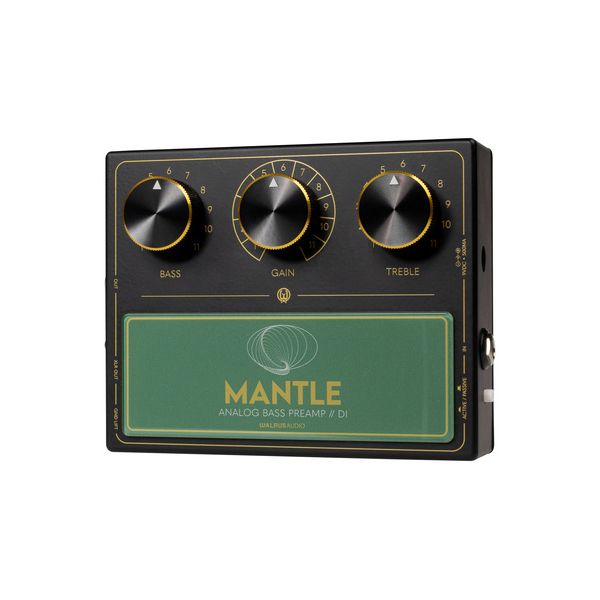
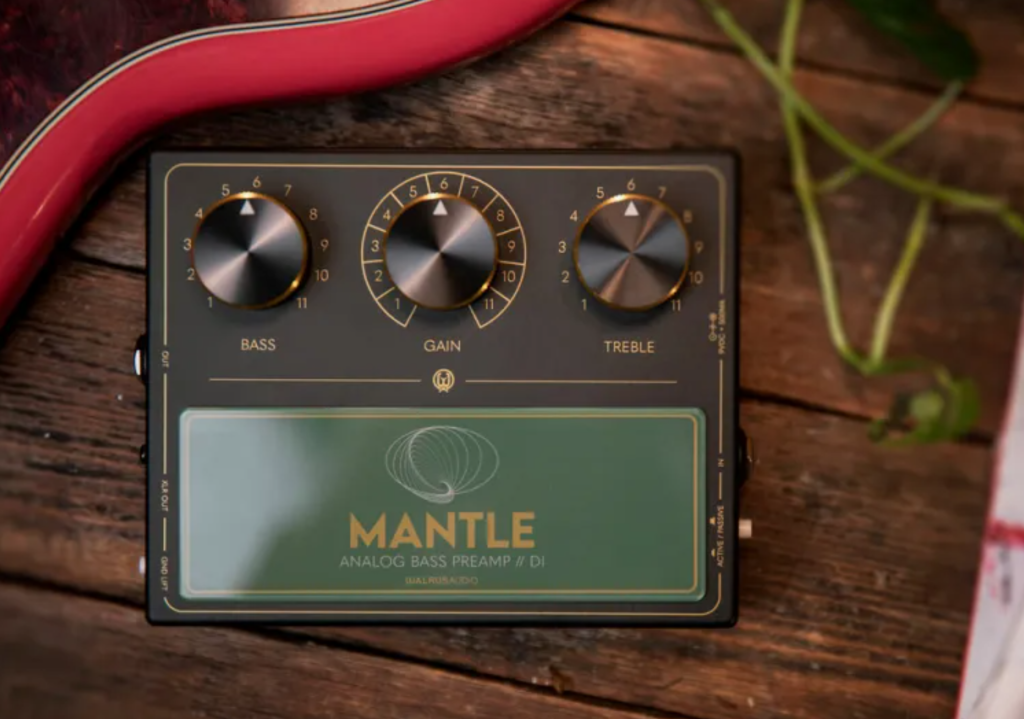
At first glance, the Mantle appears almost too simple for a pedal in its price range. It does not offer multiple EQ bands, onboard compression, or drive circuits. Instead, it provides a focused set of controls that behave more like studio gear than like traditional pedals.
The gain control is a perfect example. Rather than acting as a distortion or overdrive knob, it adjusts how hard the signal hits the internal circuitry. Increasing the gain does not create obvious breakup; instead, it enhances harmonic content, density, and presence. The result is subtle but meaningful—notes feel thicker, more solid, and more forward in a mix, without losing clarity.
The EQ section consists of bass and treble controls, but these are not standard knobs. They are implemented as stepped rotary switches, each with fixed positions. The center position is flat, and each step introduces a precise amount of boost or cut. This makes the pedal highly repeatable and predictable, which is particularly valuable in studio environments.
More importantly, the EQ is musical in its behavior. Boosting the low end adds weight without immediately introducing muddiness, while cutting it tightens the sound without making it feel thin. The treble control allows players to add clarity and articulation or to smooth out aggressive highs. Rather than dramatically reshaping the tone, the EQ works to refine and enhance what is already there.
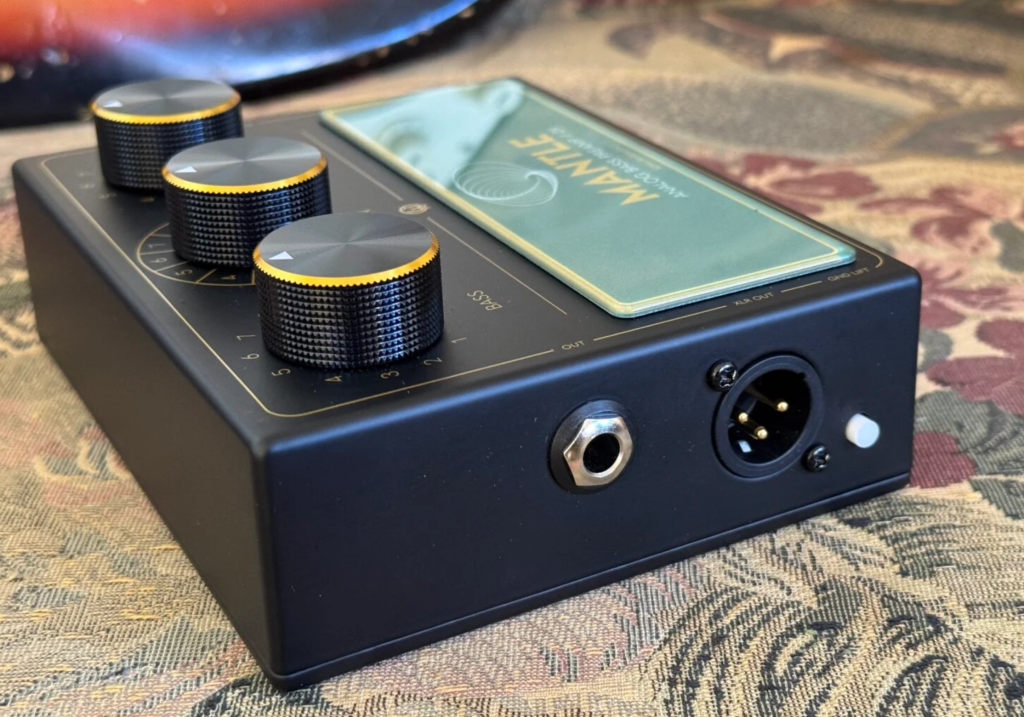
The pedal also includes an active/passive switch, ensuring proper input sensitivity for different instruments, and a ground lift for the DI output, making it reliable in both live and studio environments.
Understanding what the Mantle actually does
To fully understand the Mantle, it helps to look at how bass tone is usually handled. In many setups, the instrument goes straight into an amp or DI, and tone shaping happens later—either on the amplifier or at the mixing desk. While this works, it often means the core tone is not optimized at the source.
The Mantle changes that approach completely. By placing a high-quality preamp at the very beginning of the signal chain, it allows players to define their tone before it reaches anything else. The result is a signal that already sounds finished, balanced, and intentional.
This becomes especially clear when using the XLR output. Many DI signals can sound flat or sterile, particularly in recording situations. The Mantle’s transformer-based output adds depth, warmth, and harmonic complexity, making the signal feel closer to a miked amplifier. In practice, this can significantly reduce the need for processing during mixing.
How it fits into a bass rig
In real-world use, the Mantle can take on several roles. For many players, it becomes an always-on foundation, shaping the core tone before it hits the rest of the pedalboard. In this role, it acts almost like an extension of the instrument itself.
In live settings, the built-in DI output is a major advantage. It allows bassists to send a consistent, high-quality signal directly to front-of-house, regardless of the backline. This is particularly useful in unpredictable environments where amp quality or setup may vary.
For recording, the Mantle can effectively replace a traditional DI box and preamp chain, delivering a clean, detailed signal with a natural sense of weight and presence. It is also well suited to modern setups such as silent stages and in-ear monitoring, where the entire bass tone depends on the direct signal.
Strengths, limitations, and expectations
The Mantle’s strengths lie in its clarity, depth, and refinement. It delivers a level of tonal quality that is rare in pedal form, with an emphasis on musicality rather than complexity. Its simplicity encourages players to focus on their playing and their sound, rather than on constant tweaking.
That same simplicity, however, means it is not for everyone. Players looking for versatility, onboard effects, or aggressive tone shaping will not find those features here. The Mantle does not include distortion, compression, or extensive EQ options. It is a specialized tool, designed to excel at one specific task.
The price is also a significant consideration. Positioned firmly in the premium category, it competes more with boutique preamps and studio gear than with typical pedals. For some, this will be a barrier. For others, it reflects exactly what the pedal is trying to achieve.
A studio front end for bass players
In use, the Mantle feels less like a pedal and more like a piece of studio equipment adapted for the pedalboard. It does not radically transform your tone or impose a strong character. Instead, it makes your bass sound more like itself—only bigger, clearer, and more controlled.
For players used to relying on amplifiers or engineers to shape their sound, this represents a shift in approach. The Mantle places that control directly in the hands of the bass player, allowing them to define their tone at the source.
Summing Up
Ultimately, while it may seem expensive or limited when viewed as a traditional stompbox, the Mantle reveals its true value when approached as a high-end preamp and DI solution. In that context, it stands out as a genuinely impressive and purposeful piece of gear—one that, for the right player, can become the foundation of their entire sound.
If you liked this gear, make sure to also check:
- Joyo Scylla Compressor – Smooth compression for consistent, punchy bass tone.
- Origin Effects Cali76 Bass Compressor – Classic studio compression meets modern innovation.
- SushiBox Effects Grand Slampegg – A different taste on the classic B15.
- JHS Colour Box V2 – Neve Style Preamp Pedal