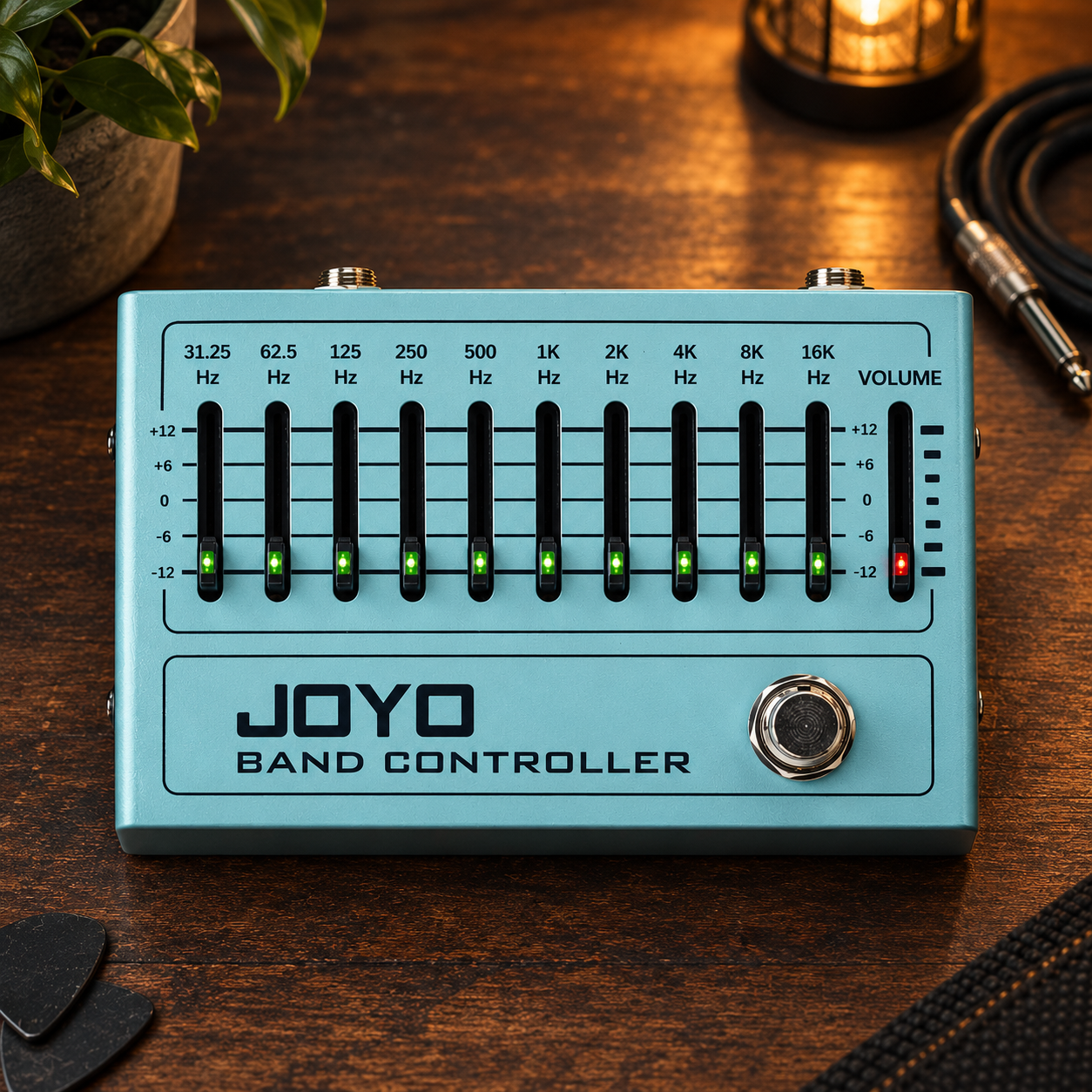
Joyo R-12 Band Controller: Pedal Review
A practical guide to shaping your bass tone, cutting through the mix, and understanding what EQ with the Joyo R-12 Disclaimer: This pedal was kindly provided by Joyo for the purpose of this review. However, this does not influence our opinions or the content of our reviews. We strive to provide honest, unbiased, and accurate assessments to ensure that our readers receive truthful and helpful information. I’ve always considered EQ pedals among the most useful pieces of equipment a bass player can own, although they’re also among the least understood. Most of us can pick up a distortion pedal and work out fairly quickly how it affects our sound, even if we don’t know much about the electronics behind it. Equalisation is a different story. Moving a slider can make a bass sound fuller, clearer or more aggressive, but understanding why a particular adjustment works is what allows you to get consistent results rather than relying on trial and error. That’s one of the reasons I was particularly interested when Joyo sent me the R-12 Band Controller. Over the years, Joyo has become a friend of Bass Gear Reviews, partly thanks to the success of my original review of the Scylla compressor, which eventually became the most successful article on the website. That led to further collaborations, including the Avallon compressor, and now the R-12. Before discussing what this pedal can do for your sound, though, it’s worth understanding what those ten sliders actually control. The R-12 is a ten-band graphic equaliser covering frequencies from 31.25 Hz to 16 kHz, with up to 12 dB of boost or cut available on each band. Those numbers might look rather abstract at first, but once you understand how different frequency ranges contribute to the sound of a bass guitar, the layout becomes considerably more intuitive. Joyo R-12 Band Controller on Amazon → What exactly is an EQ pedal doing? An equaliser changes the balance of frequencies within an audio signal, allowing you to emphasise certain parts of the sound while reducing others. This matters because the character of a bass depends on considerably more than the low frequencies that give it its weight. Every note contains a fundamental frequency alongside a series of harmonics that contribute to its overall timbre. A low E on a standard four-string bass has a fundamental of approximately 41 Hz, while the low B on a five-string sits around 31 Hz. However, the sound of those notes extends much higher into the spectrum, with the upper harmonics contributing to the attack, articulation and character that help the bass remain audible in a mix. This is why the R-12’s range is useful even though the bass is traditionally associated with low frequencies. Its ten sliders let you shape everything from the deepest lows to the upper harmonics, giving you considerably more control than the basic bass, middle and treble knobs found on many amplifiers. Understanding the R-12’s frequency bands The ten bands are centred at 31.25 Hz, 62.5 Hz, 125 Hz, 250 Hz, 500 Hz, 1 kHz, 2 kHz, 4 kHz, 8 kHz and 16 kHz. Each slider affects a region around its centre frequency rather than one isolated point, so the results will depend on the surrounding bands, your instrument and the rest of your signal chain. You don’t need to memorise the frequency spectrum to use the pedal effectively, but knowing what each region generally contributes makes it easier to identify the adjustments worth trying. 31.25 Hz: the very bottom This is particularly relevant to five-string players because the frequency sits close to the fundamental of a low B string. Boosting it can add deep low-end weight, provided your amplifier and speakers can reproduce those frequencies effectively. Too much sub-bass, however, can consume headroom without making the instrument any clearer, so I’d approach this slider conservatively. 62.5 Hz: weight and fundamental This region contributes to the solid, powerful low end that gives a bass line its foundation. A modest boost can help a thin-sounding instrument feel fuller, but excessive energy here can quickly make the sound boomy, particularly in rooms that already emphasise low frequencies. The aim is to give the bass weight without overwhelming the rest of the mix. 125 Hz: warmth and fullness At 125 Hz, the emphasis is on warmth and body. Boosting this band can help a lean-sounding bass feel fuller, while cutting it slightly can tame an instrument that already has a thick low end. It’s also a useful frequency to experiment with when switching between basses with noticeably different tonal characteristics. 250 Hz: warmth versus muddiness The 250 Hz region contributes to body, but too much energy here can make a bass sound woolly or indistinct. If your instrument sounds huge when practising alone but disappears into a muddy mix with the full band, try reducing this area before reaching for the treble control. A small cut can often improve definition without sacrificing the low end. 500 Hz: body and definition This part of the midrange helps preserve the character of the bass in a mix. Too much can produce a boxy or congested sound, while cutting it excessively can leave the instrument feeling hollow. Adjusting 500 Hz independently is one of the advantages of a ten-band graphic EQ over the broader controls found on most amplifiers. 1 kHz: presence Around 1 kHz, the midrange becomes particularly important to the perceived presence of the bass. A small boost can help notes remain audible among guitars, keyboards and vocals without adding more low end. Too much, however, can make the instrument sound nasal or honky, so the best setting depends on the arrangement and the character you’re after. 2 kHz: articulation This band contributes to the definition of individual notes, making it useful for players who want their bass lines to cut through a dense mix. Pick players may appreciate the extra attack, while fingerstyle players can use it to bring out more articulation. Be careful with excessive boosts, though, as