A Deep Dive from the Perspective of a Bass Player
Bass synth pedals sit in an awkward space between effects and instruments. Too shallow, and they sound like novelty filters strapped onto a bass signal. Too complex, and they demand a keyboardist’s mindset that many bass players don’t want to adopt mid-set. The MXR Bass Synth lives squarely in the middle of that tension. It is not a “synth-flavored” bass pedal, nor is it a full replacement for a dedicated synthesizer. Instead, it is a compact, monophonic synth engine designed to be controlled entirely by a bassist’s hands, dynamics, and note choice.
This pedal rewards curiosity and punishes impatience. A quick glance at the control layout might suggest familiar territory—mix knobs, filters, modulation—but the MXR Bass Synth behaves more like a traditional subtractive synthesizer than a typical stompbox. Understanding how its controls interact is essential if you want to move beyond presets and into sounds that feel intentional, musical, and reliable in real-world playing situations.
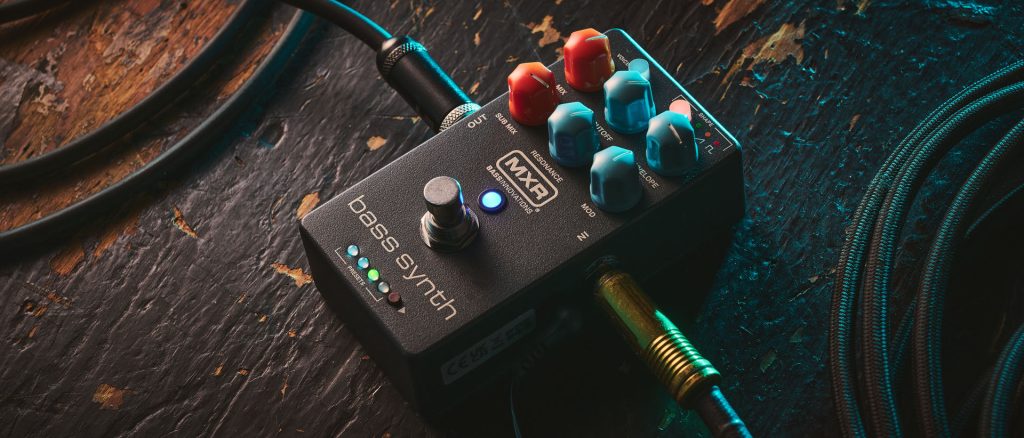
What follows is a true deep dive: not just what each control does in isolation, but how the pedal behaves as a system, how it reacts to bass technique, and how to program it so it serves the role of a bass player rather than fighting against it.
Understanding the Signal Flow
At its core, the MXR Bass Synth converts your bass into a control signal. Your note is analyzed for pitch and dynamics, which then drives internal oscillators. Those oscillators pass through a filter section, are shaped by envelope and modulation controls, and are finally blended with your clean bass signal before reaching the output.
This is important because it explains why the pedal feels sensitive. Your bass is not merely being processed; it is actively controlling a synthesizer. Clean playing, consistent dynamics, and good muting are not optional—they directly affect how the synth behaves.
Oscillator Architecture: Voice and Shape
The Voice control determines the internal oscillator configuration. Each voice changes how many oscillators are active, which octaves they occupy, and how harmonically dense the sound is. Some voices are lean and focused, ideal for classic synth bass lines. Others layer multiple oscillators or emphasize sub-octave content for massive, modern low-end.
From a bassist’s perspective, Voice selection is the first and most important decision. If the pedal feels unstable, too thick, or hard to control, the problem is often the voice choice rather than the knob settings that follow.
The Shape control defines the oscillator waveform. Triangle waves are smooth and rounded, emphasizing fundamental and low frequencies. Sawtooth waves are aggressive and harmonically rich, cutting through dense mixes. Square waves offer a hollow, vintage character associated with classic funk and early synth bass lines.
Waveform choice dramatically affects how the filter behaves later. Brighter waveforms exaggerate filter sweeps and resonance peaks, while smoother waves produce subtler movement.
Mixing the Synth with Your Bass
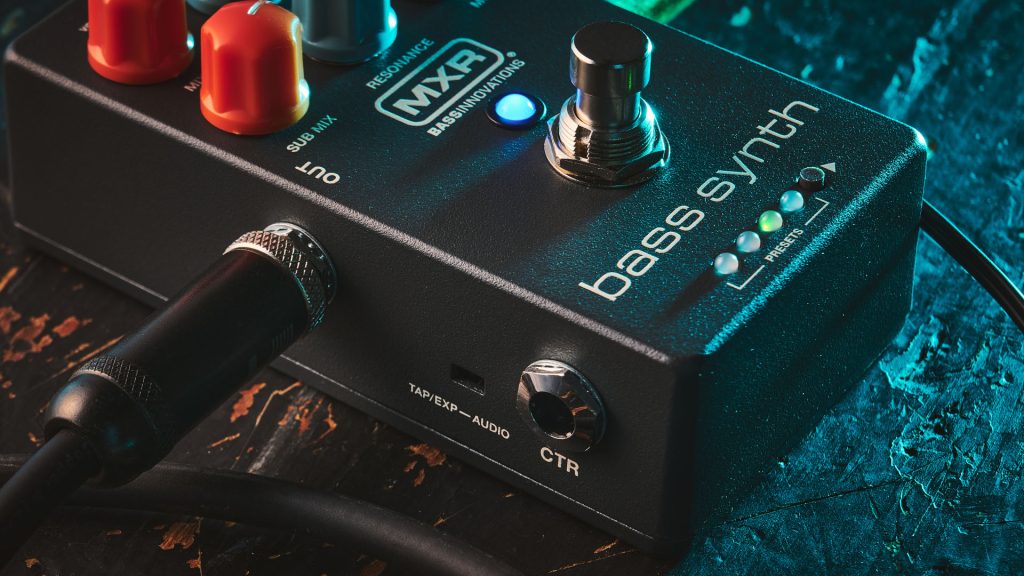
The Dry control blends your unaffected bass signal back in after the synth engine. This is not an afterthought; it is a crucial part of making the pedal usable in a band context. Leaving some dry signal preserves attack, note definition, and low-frequency consistency.
The Synth control sets the level of the main oscillator output. It determines how dominant the synth voice is relative to your clean bass, but it does not increase distortion or saturation.
The Sub control adds a dedicated synthesized sub-octave voice. This is not a standard octave pedal—it is a low-frequency oscillator designed to reinforce the fundamental. Used sparingly, it adds authority and weight. Used carelessly, it can overwhelm a mix or cause low-end chaos, especially in live settings.
For most practical applications, the sweet spot is a balanced relationship between Dry, Synth, and Sub, rather than maxing out any one of them.
Filter Section: Cutoff, Resonance, and Envelope
The filter is where the MXR Bass Synth truly earns its name.
Cutoff sets the frequency threshold for the low-pass filter. Lower settings produce dark, muted tones; higher settings allow brightness and harmonic content through. On its own, Cutoff feels static. Its musical value comes from how it interacts with Envelope and Resonance.
Resonance emphasizes frequencies around the cutoff point. Low resonance produces smooth, understated movement. Higher resonance introduces vocal-like peaks and classic acid-style squelch. While tempting, high resonance can make levels unpredictable and can be difficult to manage in a full mix.
The Envelope control determines how strongly your playing dynamics affect the filter sweep. This is not an attack or decay time control; it defines the depth of the dynamic response. Harder playing opens the filter more, softer playing keeps it closed.
Envelope response is influenced by your technique, your bass’s output, compression before the pedal, waveform choice, and resonance settings. This interconnectedness is why the pedal can feel inconsistent until it is dialed in around the player.
Modulation and Movement
The Mod control introduces low-frequency modulation to the synth, adding motion to pitch or filter behavior depending on the selected voice. At low settings, modulation adds subtle animation that keeps the sound from feeling static. At higher settings, it ventures into vibrato, pulsing, and sci-fi territory.
Most bassists will use modulation sparingly, but it becomes invaluable for electronic, ambient, or experimental styles.
Expression Pedal Integration
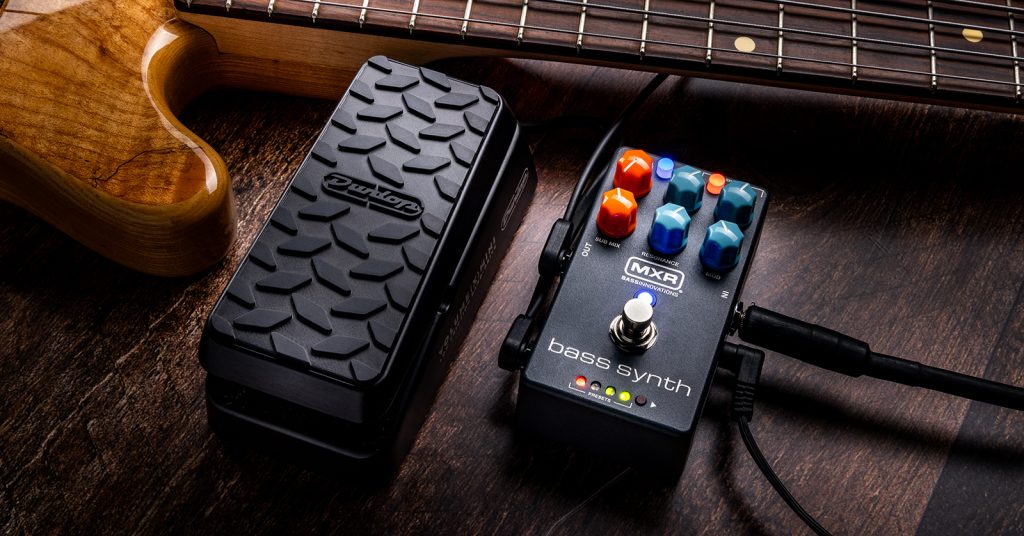
The MXR Bass Synth includes an expression pedal input, and this is one of its most powerful yet overlooked features.
Depending on the mode and internal assignment, expression can be used to control parameters such as filter cutoff or modulation depth. In practice, filter cutoff is the most musically useful assignment. With an expression pedal, the Bass Synth becomes a foot-controlled filter instrument, enabling manual sweeps, build-ups, drops, and dub-style movements that feel intentional rather than automated.
This transforms the pedal from a set-and-forget effect into a performance tool.
Tracking, Technique, and Limitations
The pedal is strictly monophonic. It tracks one note at a time and expects clean note separation. Sloppy muting, chords, double stops, and inconsistent attack can confuse the pitch detection.
Good tracking is helped by playing higher up the neck, maintaining consistent dynamics, using a compressor before the pedal, and muting unused strings. These requirements are not flaws; they are inherent to synth pitch detection and apply to nearly all monophonic bass synths.
How to Program It Without Fighting It
A practical programming approach looks like this:
First choose the Voice, then the Shape. Next balance Dry, Synth, and Sub so the sound sits correctly before touching the filter. After that, set Cutoff, add Envelope until the sound moves, introduce Resonance carefully, and finally add Modulation only if needed.
Most frustration comes from trying to fix architectural problems with fine controls.
Conclusion: A Synth for Bassists Willing to Learn It
The MXR Bass Synth is not a plug-and-play effect, and it is not designed to be. It is a compact synthesizer that happens to be controlled by a bass guitar. In the hands of a player willing to understand its structure and adapt their technique, it delivers expressive, musical synth bass tones that go far beyond octave-and-fuzz approximations.
Its strength lies in interaction: between oscillators and filters, between dynamics and envelope response, and between player and machine. The expression pedal input elevates it further, turning it into a performance instrument rather than a static effect.
For bass players who want instant gratification, this pedal may feel demanding. For those willing to treat it as a synth and learn its language, the MXR Bass Synth becomes a powerful extension of the instrument—capable of classic analog warmth, modern electronic weight, and everything in between.
Other MXR Jim Dunlop Gear You Might Like
If you enjoyed checking out this MXR pedal, here are more MXR products worth exploring — all tested and reviewed here on BassGearReviews:
– MXR Bass Synth MB301 – Game Changer Synth Pedal for Bass
– MXR M87 Bass Compressor – No Non-sense Compression for Bass