A Deep Dive into Modern B-15 Tone
Disclaimer: This pedal was kindly provided by Sushi Box for the purpose of this review. However, this does not influence our opinions or the content of our reviews. We strive to provide honest, unbiased, and accurate assessments to ensure that our readers receive truthful and helpful information.
Why B-15 Tone Is Everywhere Again
Interest in B-15–style bass tone has surged once more, driven by players looking for warmth, authority, and a sound that sits effortlessly in a mix. From high-end analog pedals to increasingly accurate digital models, the appeal is clear: the B-15 represents a foundational bass sound rather than a stylistic extreme.
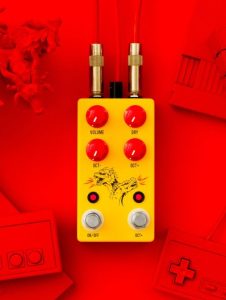
Within this landscape, the Sushi Box FX Grand Slampegg stands out not by offering the most features, but by committing fully to the circuit philosophy that made early Ampeg designs special.
After being sent the pedal directly by Sushi Box FX founder Nathan Slade, I had the chance to test it extensively and use it on gigs. What became immediately clear is that this is not a nostalgic novelty — it’s a carefully thought-out, modern implementation of classic tube design.
If you want to check our first impressions of the Grand Slampegg, check the article we wrote last year about it.

TL;DR
- What it is: A boutique, tube-driven bass preamp inspired by classic Ampeg B-15 design philosophy
- Tube: High-voltage 6SL7 for soft compression and vintage feel
- EQ: Musical Baxandall bass/treble EQ — broad, natural shaping
- Extras that matter: HPF switch, pre/dry routing, buffered 1/4″ out
- Connectivity: Independent XLR DI and 1/4″ volume controls
- Best use: Always-on foundation tone for live and studio
- Not for: Aggressive modern distortion or heavy tone-shaping
Circuit Philosophy: Old Ideas, Applied Properly
At the core of the Grand Slampegg is a 6SL7 tube, a key component of early Ampeg preamp designs and an important departure from the more common 12AX7 found in many modern tube pedals. The 6SL7 offers a softer, rounder response with a different gain structure, contributing heavily to the pedal’s smooth dynamics and natural compression.
The tube operates at proper high voltage, allowing it to behave like a real amplifier preamp rather than a tube-flavored effect. This is paired with a Baxandall EQ, which provides broad, symmetrical bass and treble shaping. Instead of carving frequencies aggressively, the EQ gently reshapes the overall balance, maintaining phase coherence and musicality.
This design approach explains why the Grand Slampegg feels more like an amp front end than a typical pedal.

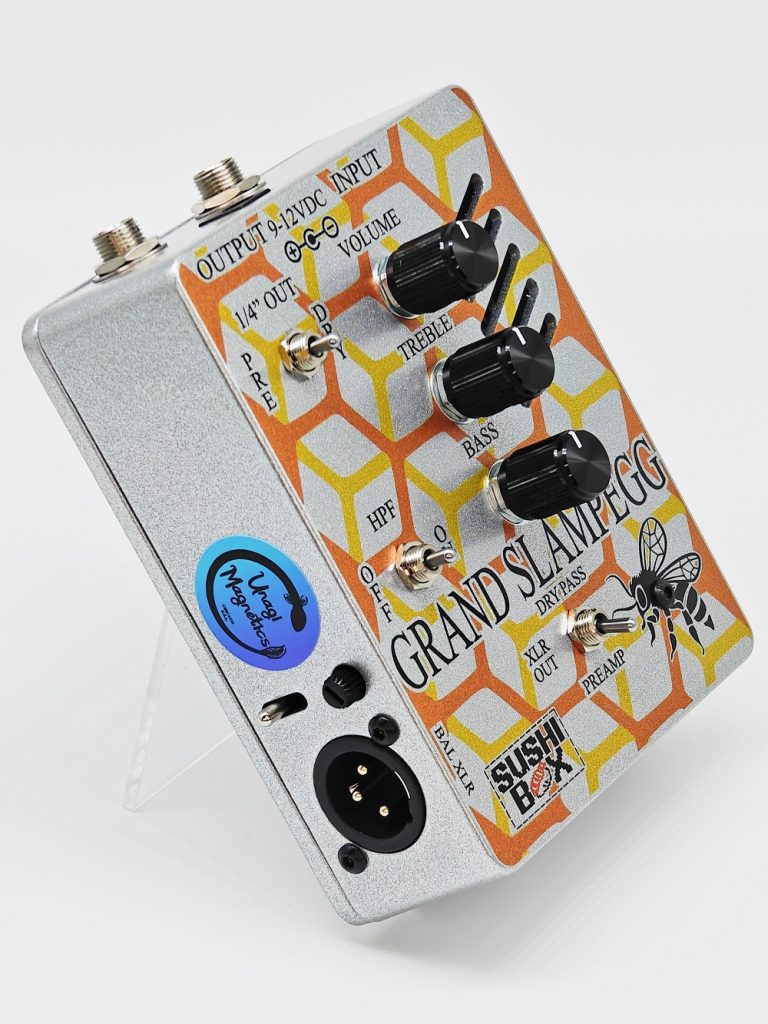
Controls and Signal Routing
The Grand Slampegg’s control set is minimal but deliberately chosen:
- Volume – Controls output level for the 1/4″ signal path
- Bass / Treble – Baxandall EQ controls offering wide, musical adjustment
- HPF switch – Engages a high-pass filter to tighten the low end and manage excessive sub frequencies
- 1/4″ Pre/Dry switch – Selects between the processed preamp signal and a buffered dry signal at the 1/4″ output
On the output side, the pedal offers professional-grade flexibility:
- XLR DI Out with its own independent volume control
- Buffered 1/4″ Out with independent volume control
This independent level control allows players to send a strong, consistent signal to front of house while independently managing stage volume — a small detail that makes a big difference in real-world use.
Notably absent is a footswitch. This reinforces the Grand Slampegg’s role as an always-on preamp rather than an effect designed for on-the-fly engagement.
Tone: Weight, Space, and Authority
The Grand Slampegg’s tonal character is defined by density rather than brightness. Low frequencies are full and supportive, yet controlled — especially with the HPF engaged when needed. The midrange sits naturally in a mix, and the highs are smooth and unforced, retaining clarity without edge.
The 6SL7 tube imparts a subtle, musical compression that responds directly to playing dynamics. Digging in adds harmonic richness and thickness rather than sharp attack, while lighter touch remains even and present. When pushed, breakup is soft and rounded, more reminiscent of a driven studio preamp than a distortion device.
Integration in Real Rigs
In live use, the Grand Slampegg excels as a set-and-forget foundation. Into a clean amp or power section, it provides a convincing vintage-flavored front end. Using the XLR DI straight to FOH yields a finished, mix-ready bass sound that requires minimal corrective EQ.
In the studio, it functions as a high-quality DI preamp. The combination of the 6SL7 tube, Baxandall EQ, and controlled low end produces tracks that already feel shaped, reducing reliance on plug-ins or corrective processing.
The pre/dry switching and buffered output also make it easy to integrate into complex pedalboards or parallel signal paths.
Q&A: Common Questions Answered
Is this a B-15 clone?
No. The Grand Slampegg isn’t a component-for-component clone, but it clearly draws from early Ampeg design choices — particularly the 6SL7 tube and Baxandall EQ — to recreate the behavior and feel of a B-15-style preamp.
Why use a 6SL7 instead of a 12AX7?
The 6SL7 has lower gain and a rounder response, contributing to smoother compression and a more relaxed dynamic feel — closer to early Ampeg circuits.
Can I use it as my main DI?
Yes. The XLR DI is designed for professional use and includes its own volume control, making it easy to feed FOH or an interface directly.
What does the HPF switch actually do?
It filters out excessive sub-bass content, tightening the low end. This is especially useful on boomy stages, with modern cabinets, or when running direct.
Is the lack of a footswitch a downside?
Only if you expect it to function like an effect. The pedal is designed to stay on as your core tone — similar to leaving an amp dialed in all night.
Does it do overdrive?
It can be pushed into soft, vintage-style saturation, but it’s not intended for aggressive distortion or modern grit.
Strengths and Limitations
Strengths
- Authentic high-voltage 6SL7 tube design
- Musical Baxandall EQ that preserves feel and balance
- Independent XLR and 1/4″ volume controls
- HPF switch for real-world low-end control
- Excellent dynamic response and touch sensitivity
Limitations
- No footswitch limits switching options
- Limited EQ flexibility by design
- Not intended for aggressive or modern distortion tones
Final Thoughts
The Sushi Box FX Grand Slampegg succeeds because it understands what made the B-15 special — not just its frequency response, but its behavior. By using a 6SL7 tube, a Baxandall EQ, and a thoughtfully designed output section, Sushi Box has created a pedal that behaves like a real amplifier front end in a modern, practical format.
For bassists seeking an always-on preamp that delivers warmth, weight, and musical authority without unnecessary complexity, the Grand Slampegg is a compelling and convincing option.
If you enjoyed checking out this SushiBox Effects pedal, here are more products worth exploring — all tested and reviewed here on BassGearReviews:
– JHS Colour Box V2 – Neve Style Preamp Pedal
– JHS 424 Gain Stage – A Tascam PortaStudio on your pedalboard.