A First Look Into EQD One Stop Solution For Bass Players
An all-analog bass preamp that aims to replace an entire rig in a single pedal!
EarthQuaker Devices has a long history of building unconventional, forward-thinking effects, but the Scrolls Bass Odyssey pushes into more ambitious territory than most of its previous releases. Rather than focusing on a single effect type, it presents itself as a complete bass signal hub—combining preamp tone shaping, overdrive, routing flexibility, and DI functionality in one compact unit.
At its core, Scrolls is designed around a simple but demanding idea: a bassist should be able to plug into any system and immediately sound consistent, regardless of venue, backline, or recording environment.
A collaboration driven by real-world touring needs
The Scrolls Bass Odyssey was developed in collaboration with Japanese bassist Kentaro Nakao (Number Girl, Crypt City), whose experience performing in varied live environments helped shape the pedal’s focus on adaptability and reliability.
Rather than chasing a single “signature tone,” the design emphasizes portability and consistency, making it especially attractive to touring musicians who frequently encounter unpredictable stage setups.
Dual-channel design: EQ and drive working together
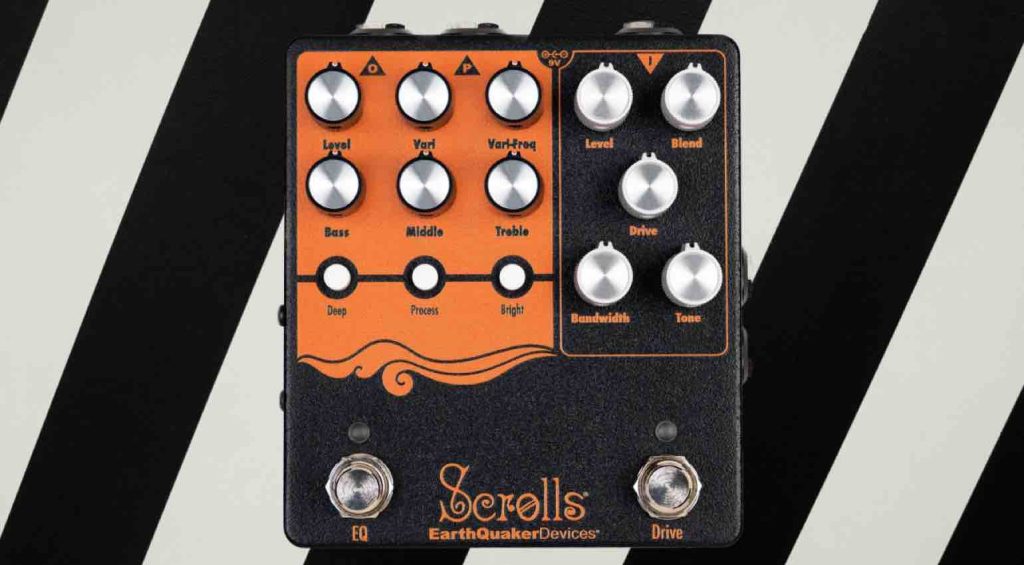
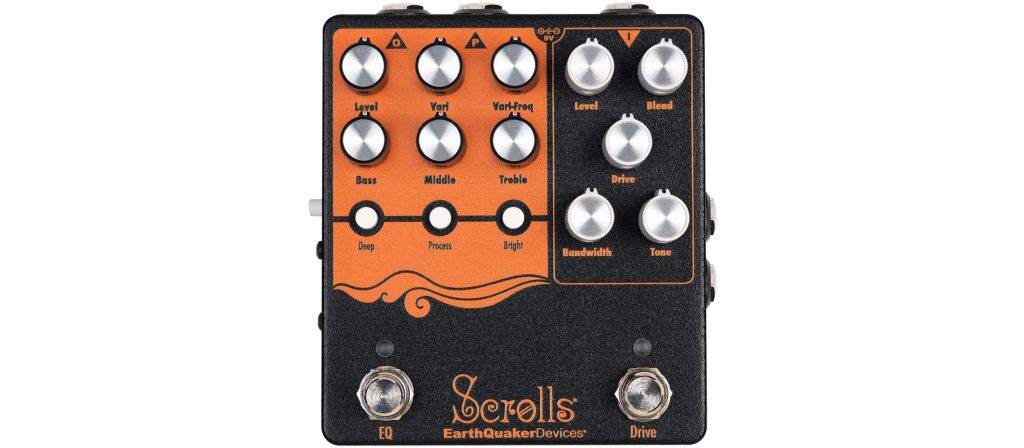
The Scrolls is built around two fully independent but interactive sections: a comprehensive EQ/preamp stage and a flexible drive circuit.
– EQ / Preamp Section
The EQ side functions more like a studio-grade tone-shaping tool than a traditional pedal tone stack. It includes:
- Bass, mid, and treble controls
- A variable frequency control spanning roughly 20 Hz to 10 kHz
- Voicing switches for instant tonal shifts (including deep low emphasis, mid scoop, and bright presence options)
This section is designed not just for enhancement, but for complete tonal reconstruction when needed—from subtle refinement to dramatic reshaping.
– Drive Section
The distortion side of the Scrolls is tailored specifically for bass, focusing on maintaining low-end clarity even at higher gain levels. It features:
- Drive control for gain intensity
- Blend control for mixing clean and distorted signals
- Bandwidth control for targeting specific frequency ranges
- Tone shaping filter for final EQ adjustment of the distorted signal
The standout feature here is the bandwidth control, which allows the drive circuit to behave differently depending on frequency focus—ranging from subtle harmonic enhancement to aggressive mid-focused distortion.
Flexible routing and DI integration
One of the most powerful aspects of the Scrolls Bass Odyssey is its routing architecture. It is designed to function not just as an effect, but as a central signal distribution tool.
Key features include:
- Buffered parallel output for clean signal splitting
- Balanced XLR DI output with cabinet-style filtering
- An effects loop positioned between EQ and drive stages
- Simultaneous multi-output capability for hybrid live and studio setups
This flexibility allows players to split clean and processed signals, integrate external pedals at different stages of the chain, or run direct-to-PA setups without additional hardware.
Tone philosophy: from vintage warmth to modern aggression
EarthQuaker describes the Scrolls Bass Odyssey as a tonal journey that spans multiple eras of bass sound, from classic foundational tones to modern high-gain textures.
In practice, the design supports a wide range of styles, including:
- Warm, rounded vintage bass tones
- Mid-forward rock presence
- Scooped modern metal voicing
- Saturated, harmonically rich DI textures
Rather than locking players into a single aesthetic, the pedal is built to move quickly between tonal identities, making it suitable for multi-genre performers.
First impressions: more than just a pedal
Early impressions suggest that the Scrolls Bass Odyssey behaves less like a traditional stompbox and more like a compact bass front-end system. Its combination of EQ flexibility, drive shaping, and routing options places it closer to rack-style preamp workflows than typical pedalboard effects.
This makes it particularly relevant for:
- Touring bassists needing consistent tone across venues
- Studio players looking for a flexible DI and preamp solution
- Pedalboard users aiming to simplify complex signal chains
Conclusion
The EarthQuaker Devices Scrolls Bass Odyssey is not a subtle addition to the bass effects world. It is designed as a central command unit for bass tone, combining multiple roles into a single, highly configurable platform.
Rather than replacing one pedal category, it effectively merges several: preamp, EQ, drive, DI, and routing hub. For players looking to consolidate their setup without sacrificing control, it represents one of EarthQuaker’s most ambitious bass-focused designs to date.