Blog

News

IK Multimedia Unveils TONEX ONE+

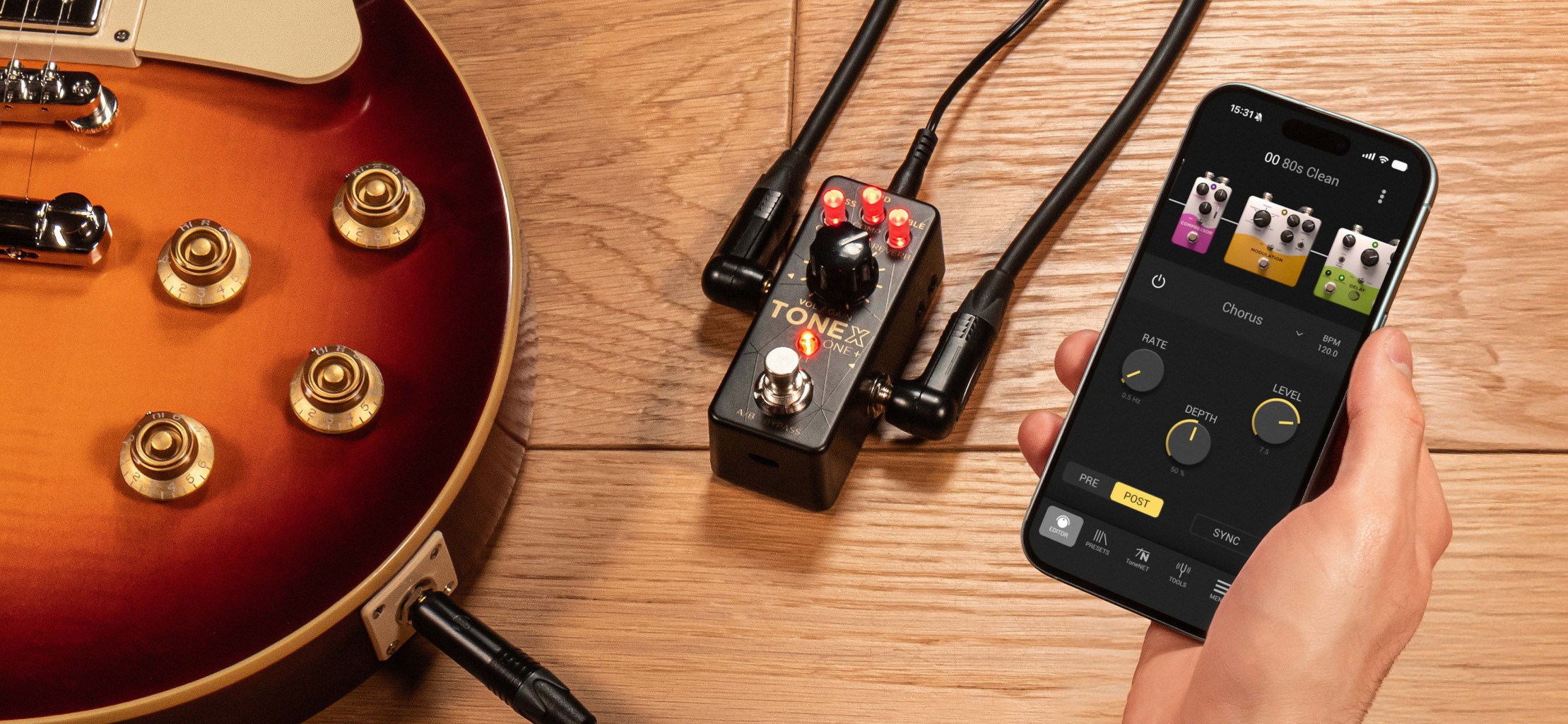
Wireless Control and MIDI Expand the Power of Its Compact Amp Modeler May 7, 2026 — IK Multimedia has officially announced the TONEX ONE+, an evolution of its ultra-compact TONEX ONE pedal that brings wireless mobile control and full MIDI integration into a streamlined, gig-ready format. Designed for players who want maximum tonal flexibility without adding complexity to their rigs, TONEX ONE+ introduces a major workflow upgrade: complete wireless editing via the new TONEX Control app (iOS and Android). This eliminates the need for a computer, allowing musicians to tweak, load, and manage tones directly from their mobile devices—whether on stage, in the studio, or on the go. At its core, TONEX ONE+ continues to leverage IK’s AI Machine Modeling™ technology, delivering highly realistic amp, cabinet, and stompbox tones with the dynamic response players expect from real gear. The pedal integrates seamlessly into the broader TONEX ecosystem, giving users access to an ever-growing library of sounds and tools. Wireless Freedom Meets Deep Control The addition of the TONEX Control app marks a significant step forward in usability. Players can now access ToneNET, browse thousands of Tone Models, and make adjustments in real time—all without interrupting their playing flow. This mobile-first approach streamlines tone management and keeps the focus where it belongs: on performance. Full MIDI Integration for Modern Rigs TONEX ONE+ also adds comprehensive MIDI support via both TRS and USB connections. This opens the door to deeper integration with pedalboards and switching systems, enabling users to: Advanced users can even run dual-pedal setups for stereo or dual-amp configurations, expanding tonal possibilities while maintaining a compact footprint. Expanded Tone Library and Included Software Out of the box, TONEX ONE+ comes loaded with the new Signature+ Collection, a premium set of 100 Tone Models (20 preloaded), covering everything from pristine clean tones to high-gain leads. These models are built using TONEX V2 AI Machine Modeling™ and are based on a curated selection of iconic amps and pedals. Also included: Studio-Grade Processing in a Compact Form Despite its small size, TONEX ONE+ packs a full suite of studio-quality effects and tools, including: It also features USB connectivity for recording and preset management, making it equally at home in studio and live environments. Small Format, Big Flexibility Maintaining the same compact design as its predecessor, TONEX ONE+ is built to fit any setup—from travel rigs to fully integrated pedalboards. It can be used as a standalone solution or combined with additional units to create powerful multi-amp or stereo rigs without sacrificing portability. Pricing and Availability TONEX ONE+ is available starting May 7, 2026, through IK Multimedia’s online store and authorized dealers worldwide for $/€249.99. The package includes the Signature+ Collection (valued at $/€99.99), TONEX SE, and AmpliTube 5 SE. More IK Multimedia gear you might enjoy: – IK Multimedia Tonex Pedal – Amp Modeler + Interface – IK Multimedia Tonex One – Compact Amp Modeler + Interface – IK Multimedia Axe I/O One – Portable Interface – IK Multimedia Axe I/O – Feature Rich Interface
News

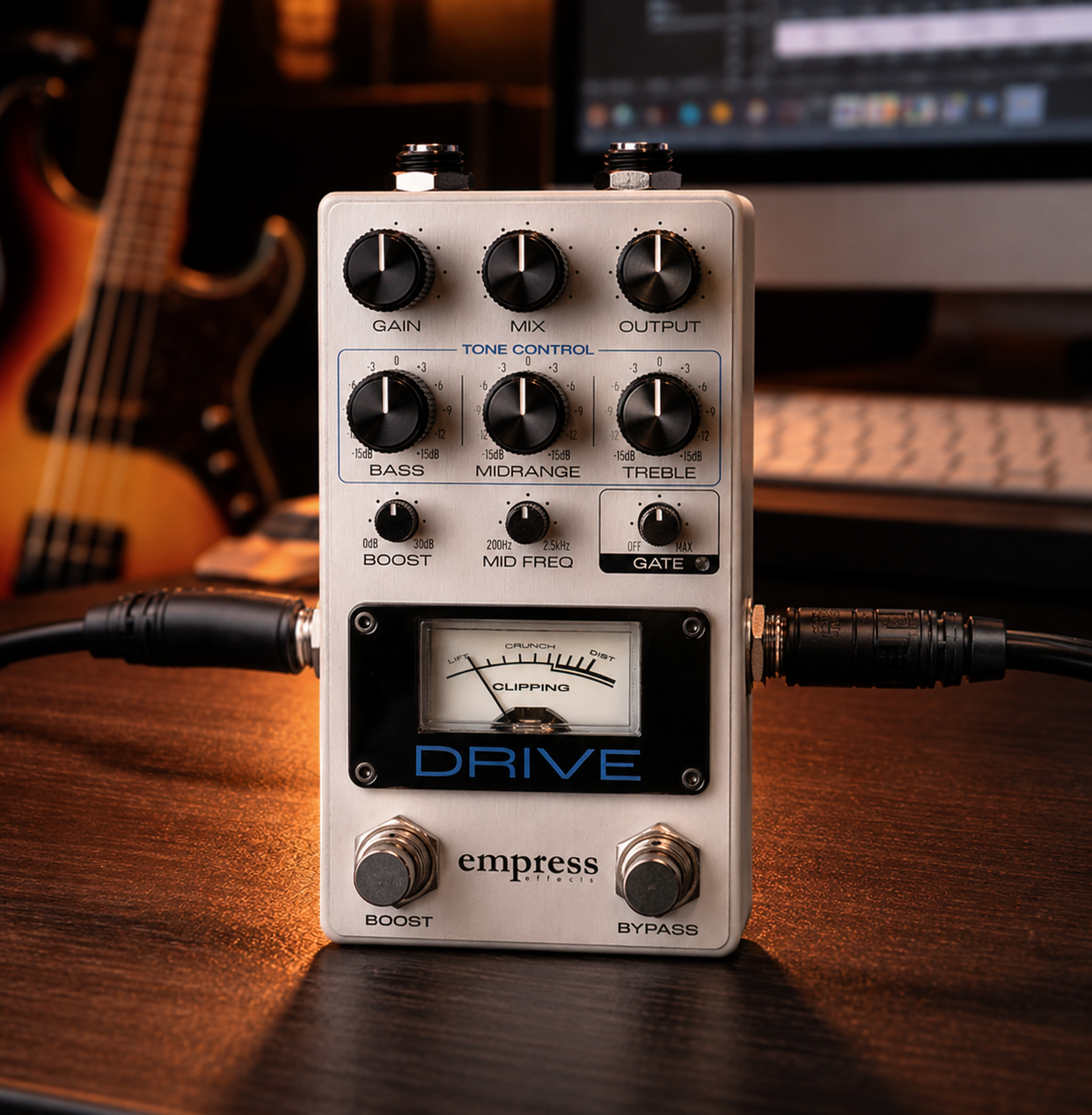
Empress Effects Unveils the New Drive Pedal

A Flexible Take on Tube-Like Overdrive Empress Effects has officially released the new Empress Drive, a highly configurable overdrive pedal designed to give players deeper control over how gain behaves—not just how much of it is applied. While the overdrive market is crowded with pedals built around fixed tonal identities, the Empress Drive takes a different approach, offering bassists and guitarists a platform for shaping harmonic character at its core. At the heart of the Empress Drive is a concept that will resonate with tone-conscious players: pre-overdrive tone shaping. Instead of applying EQ after distortion, the pedal allows users to sculpt the midrange before the signal hits the clipping stage. This fundamentally changes how the circuit responds, letting players emphasize low mids for thicker breakup, push upper mids for articulation, or dial them back for tighter, more controlled drive. The result is a more responsive and intentional overdrive that reacts dynamically to playing style and instrument volume. For bass players in particular, the inclusion of a clean blend (mix control) is a key feature. It preserves low-end integrity and natural amp character while layering in varying levels of drive—a crucial element for maintaining clarity in a band mix. Combined with active bass and treble shelving filters, the pedal offers precise post-mix tone shaping to keep everything balanced and defined. Another standout feature is the integrated boost circuit, capable of delivering up to 30 dB of gain. This boost can be assigned either before or after the overdrive stage and is footswitchable, making it useful for pushing the circuit into heavier saturation or simply increasing output level for solos or dynamic transitions. By integrating boost and drive into a single unit, the Empress Drive reduces the need for stacking multiple pedals, helping players save space and minimize noise. Speaking of noise, the pedal also incorporates an adaptive noise gate that responds to playing dynamics. It intelligently reduces unwanted hum at higher gain settings without compromising sustain—an especially welcome addition for high-output bass setups. The Empress Drive remains fully analog throughout its signal path, delivering what the company describes as “organic breakup and natural compression.” Adding a visual twist, the pedal includes a built-in analog clipping meter (VU-style) with selectable LED colors, giving players real-time feedback on how hard they’re driving the circuit. It’s a functional feature, but also one that adds a bit of tactile satisfaction to the playing experience. Tonally, the Empress Drive isn’t tied to a single amp-inspired voice. Instead, it’s designed to cover a wide spectrum—from warm, mid-forward breakup reminiscent of vintage tweed circuits to tighter, more aggressive British-style crunch, and even cleaner, punchy edge-of-breakup tones. This versatility makes it equally suited as a foundation tone shaper or as a flexible second gain stage on a pedalboard. With its emphasis on gain structure, harmonic control, and integrated functionality, the Empress Drive positions itself as more than just another overdrive pedal. For bass players looking to retain clarity while exploring richer textures—or those wanting to simplify complex gain-staging setups—it’s a compelling new option worth a closer look. The Empress Drive is available now through Empress Effects dealers worldwide.

News

Sushi Box FX Launches Mayday

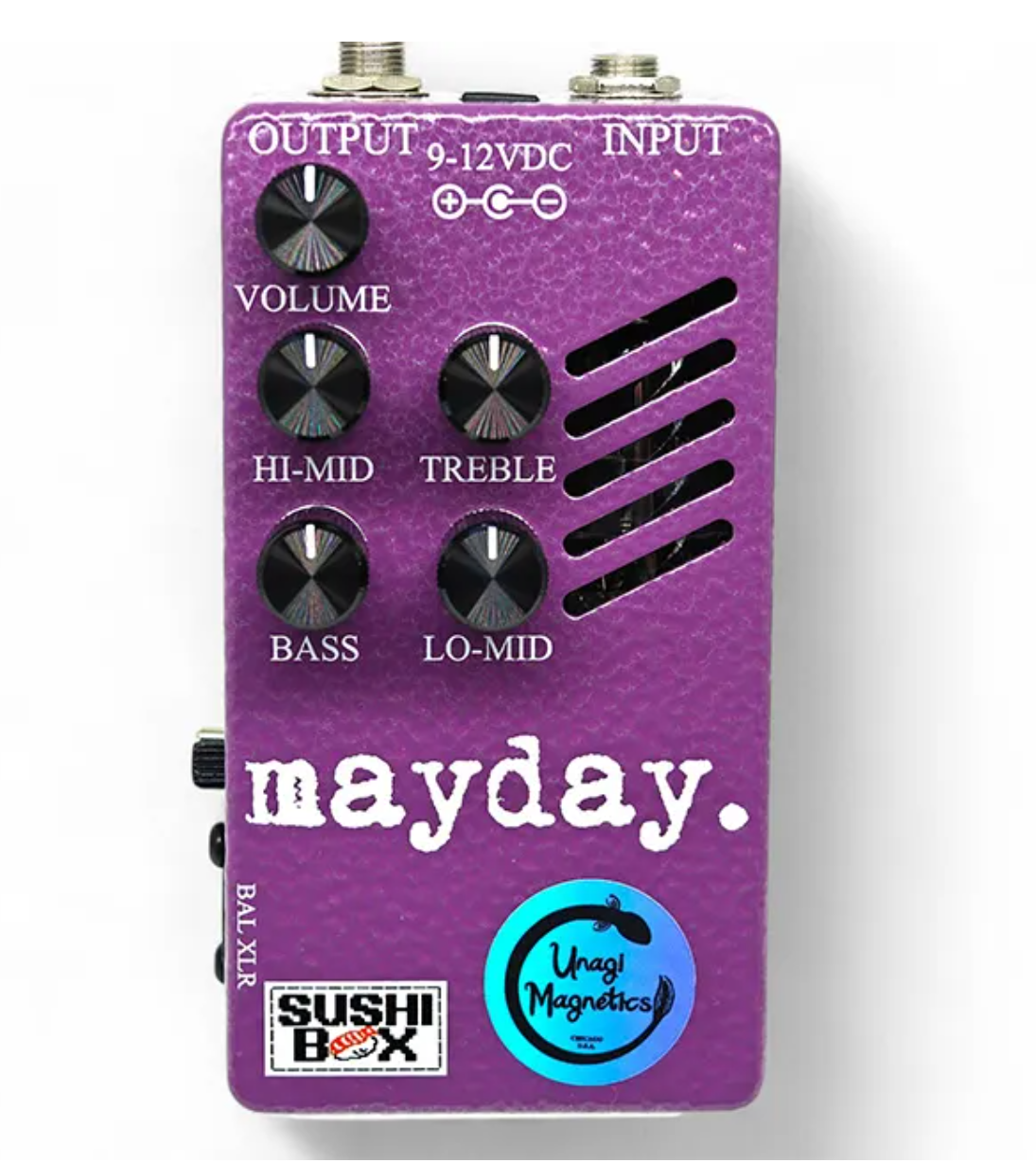
Tube Preamp Pedal with High-Voltage Warmth and Flexible EQ May 2026 — Sushi Box FX has unveiled the Mayday, a compact clean tube preamp pedal designed to deliver rich harmonic warmth and precise tone shaping for bassists and guitarists alike. At the heart of the Mayday is a high-voltage 12AU7 tube, engineered to provide a responsive, amp-like feel with enhanced depth and clarity. Paired with a custom Unagi Magnetics E4305 DI transformer, the pedal offers studio-grade signal integrity and a full-range response tailored especially for low-frequency instruments. High-Voltage Tube Tone Meets Flexible EQ Sushi Box FX positions the Mayday as a clean, tone-enhancing preamp rather than a drive pedal, focusing on preserving the natural character of the instrument while adding warmth and dimension. The onboard four-band active EQ features carefully selected center frequencies at 60Hz, 250Hz, 1kHz, and 7kHz, allowing players to shape everything from deep, supportive lows to clear, articulate highs. “The 12AU7 running at high plate voltage brings unparalleled warmth and depth to your tone, while the four-band active EQ helps you dial in whatever sound you need for any style of music,” the company explains. Built for Stage and Studio Flexibility The Mayday is designed with versatility in mind, offering multiple output options for different performance and recording scenarios. Players can route their signal via a preamp-affected 1/4″ output or use the transformer-coupled balanced XLR DI output, making it equally suited for live rigs and direct recording setups. The custom DI transformer provides excellent sensitivity and an extended frequency response, ensuring full-bodied low-end reproduction without sacrificing clarity. Compact Design, Professional Performance Housed in a compact enclosure, the Mayday fits easily into pedalboards of any size while maintaining the power requirements typical of tube-driven designs. Sushi Box recommends a 9–12V DC power supply capable of delivering sufficient current to ensure optimal performance. Despite its small footprint, the Mayday is built as a full-featured preamp solution—ideal as a standalone tone shaper, a direct box replacement, or the foundation of a modern ampless rig. The Sushi Box FX Mayday is available now, with pricing starting at approximately $300 depending on configuration.

Walrus Mantle
Reviews

Walrus Mantle: The Long Awaited Pedal Review

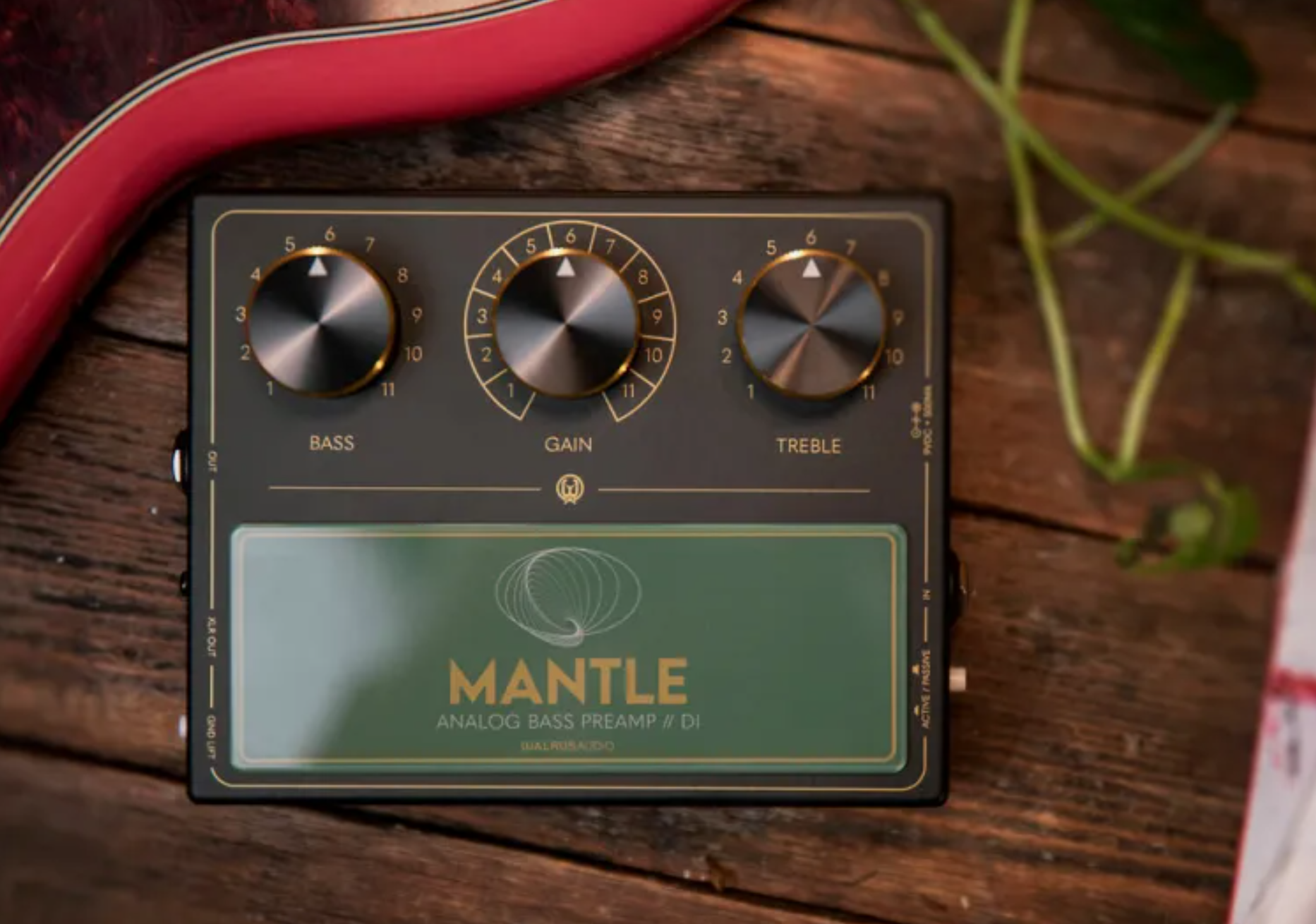
A studio-grade bass preamp in pedal form Disclaimer: This pedal was kindly provided by Walrus Audio for the purpose of this review. However, this does not influence our opinions or the content of our reviews. We strive to provide honest, unbiased, and accurate assessments to ensure that our readers receive truthful and helpful information. Nowadays, we have gear for every player, in every shape, form, and price point. Some of it turns out to be little more than hype, while other pieces quietly prove themselves to be genuinely exceptional. There is budget gear capable of producing incredible sounds, and there are ultra-boutique, expensive products that struggle to justify their price. It is in this landscape that the Mantle appears—highly visible, heavily discussed, and undeniably controversial. When Walrus Audio gave us the opportunity to review this pedal, it was an easy decision. This is exactly the kind of product we aim to explore: ambitious, polarizing, and designed with a very clear purpose. Check the price on Amazon –> Designed from a studio mindset The Mantle was developed by Ian Martin Allison in collaboration with Walrus Audio, and its design philosophy reflects that partnership clearly. Instead of chasing versatility or feature count, the pedal focuses on capturing the character and behavior of high-end studio preamps. At the heart of the Mantle is a signal path inspired by classic recording equipment. The input stage draws from Neve-style designs, known for their weight and warmth, while the output stage takes cues from API circuits, prized for their clarity and punch. This combination is not accidental. In studio environments, engineers rely on these types of preamps to shape bass tone before it even reaches EQ or compression, and the Mantle brings that philosophy directly to the pedalboard. One of the defining elements of this design is the use of custom transformers. Unlike most pedals, which rely entirely on solid-state circuitry, the Mantle incorporates transformer-based stages to add harmonic richness, depth, and low-end authority. This is part of what gives the pedal its sense of weight and helps it feel closer to studio outboard gear than to a traditional stompbox. Another important aspect of the design is headroom. Although the pedal runs on a standard 9-volt power supply, it internally operates at a much higher voltage. This allows it to handle strong signals—especially from active basses—without distorting or compressing unintentionally. In practice, this means the Mantle remains clean, open, and highly dynamic, even when pushed. A different approach to control At first glance, the Mantle appears almost too simple for a pedal in its price range. It does not offer multiple EQ bands, onboard compression, or drive circuits. Instead, it provides a focused set of controls that behave more like studio gear than like traditional pedals. The gain control is a perfect example. Rather than acting as a distortion or overdrive knob, it adjusts how hard the signal hits the internal circuitry. Increasing the gain does not create obvious breakup; instead, it enhances harmonic content, density, and presence. The result is subtle but meaningful—notes feel thicker, more solid, and more forward in a mix, without losing clarity. The EQ section consists of bass and treble controls, but these are not standard knobs. They are implemented as stepped rotary switches, each with fixed positions. The center position is flat, and each step introduces a precise amount of boost or cut. This makes the pedal highly repeatable and predictable, which is particularly valuable in studio environments. More importantly, the EQ is musical in its behavior. Boosting the low end adds weight without immediately introducing muddiness, while cutting it tightens the sound without making it feel thin. The treble control allows players to add clarity and articulation or to smooth out aggressive highs. Rather than dramatically reshaping the tone, the EQ works to refine and enhance what is already there. The pedal also includes an active/passive switch, ensuring proper input sensitivity for different instruments, and a ground lift for the DI output, making it reliable in both live and studio environments. Understanding what the Mantle actually does To fully understand the Mantle, it helps to look at how bass tone is usually handled. In many setups, the instrument goes straight into an amp or DI, and tone shaping happens later—either on the amplifier or at the mixing desk. While this works, it often means the core tone is not optimized at the source. The Mantle changes that approach completely. By placing a high-quality preamp at the very beginning of the signal chain, it allows players to define their tone before it reaches anything else. The result is a signal that already sounds finished, balanced, and intentional. This becomes especially clear when using the XLR output. Many DI signals can sound flat or sterile, particularly in recording situations. The Mantle’s transformer-based output adds depth, warmth, and harmonic complexity, making the signal feel closer to a miked amplifier. In practice, this can significantly reduce the need for processing during mixing. How it fits into a bass rig In real-world use, the Mantle can take on several roles. For many players, it becomes an always-on foundation, shaping the core tone before it hits the rest of the pedalboard. In this role, it acts almost like an extension of the instrument itself. In live settings, the built-in DI output is a major advantage. It allows bassists to send a consistent, high-quality signal directly to front-of-house, regardless of the backline. This is particularly useful in unpredictable environments where amp quality or setup may vary. For recording, the Mantle can effectively replace a traditional DI box and preamp chain, delivering a clean, detailed signal with a natural sense of weight and presence. It is also well suited to modern setups such as silent stages and in-ear monitoring, where the entire bass tone depends on the direct signal. Strengths, limitations, and expectations The Mantle’s strengths lie in its clarity, depth, and refinement. It delivers a level of tonal quality that is rare in pedal form, with

Reviews

Neural DSP Darkglass Ultimate: Plugin Review

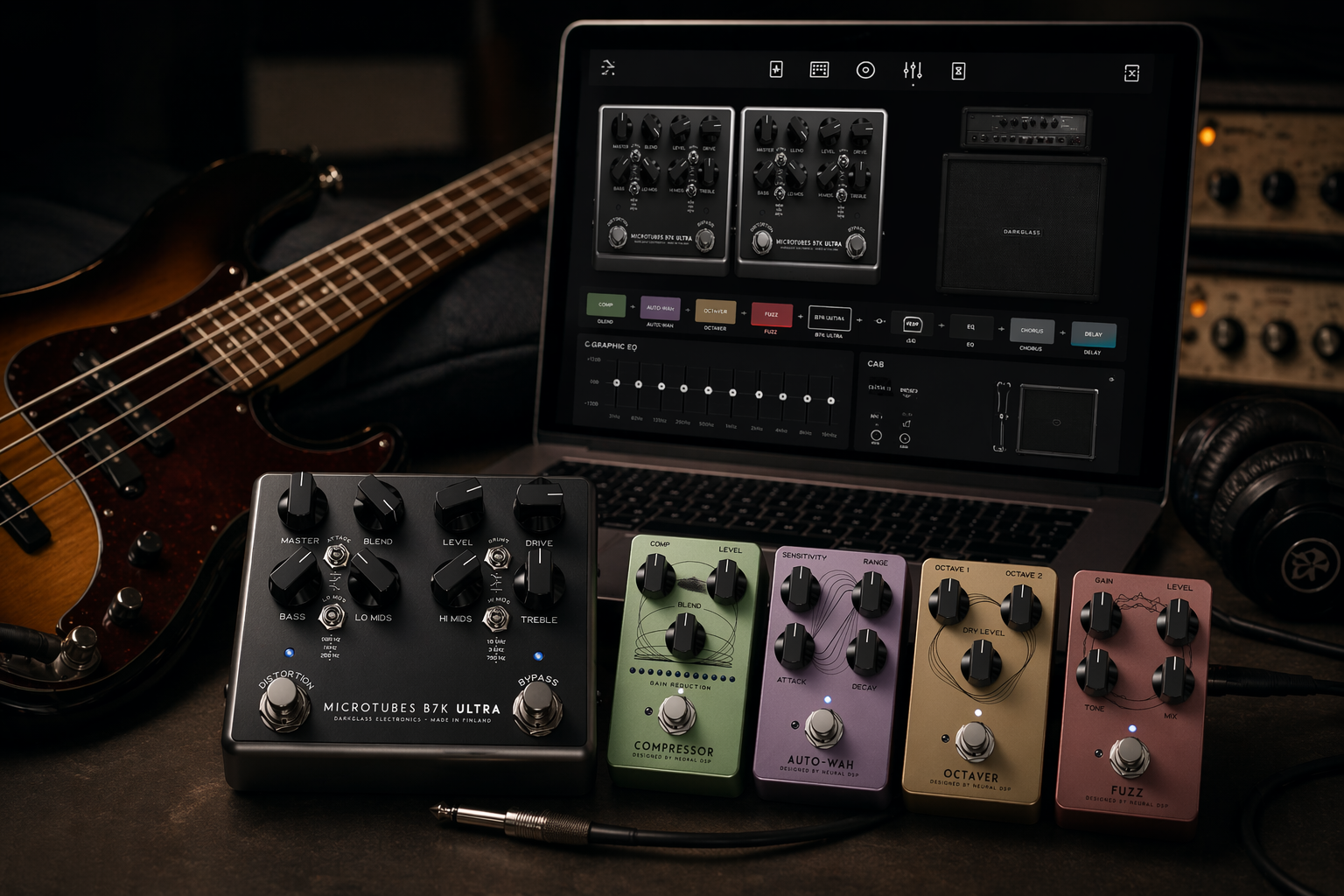
A Complete Bass Rig Evolved Neural DSP has just announced the release of Darkglass Ultimate, a new plugin that expands some of the most recognizable bass tones of the past decade into a complete, studio-ready environment. Rather than simply recreating the Darkglass sound in plugin form, Ultimate builds on the foundation of earlier releases (the Darkglass Ultra) by combining its core character with a full signal chain and creative tools, designed to take you from initial idea to a finished, mix-ready track—all within a single plugin. Neural DSP first brought the Darkglass sound into the digital domain back in 2018, capturing the essence of the B7K Ultra and Vintage Ultra in plugin form, and with Darkglass Ultimate that original concept grows into something far more comprehensive. The Darkglass sound has played a major role in shaping modern bass tone over the past decade, particularly in heavier and more progressive genres, and Darkglass Ultimate builds on that legacy while pushing it into a more complete workflow. At its core are the familiar B7K Ultra, known for its tight, aggressive drive with controlled low end and clear articulation, and the Vintage Ultra, which offers a warmer, rounder character inspired by classic tube amps. While I didn’t have a Vintage Microtubes unit on hand for a direct comparison, the B7K side feels very close to the original pedal in both response and character, which speaks to how faithfully these tones have been translated into the plugin. More importantly, the core tone still feels like a solid starting point—something you build around rather than fight against—which makes the whole process intuitive from the start. Where Darkglass Ultimate really differentiates itself is in scope, moving beyond amp simulation into a complete signal chain designed to take you from initial idea to a finished, mix-ready track without leaving the plugin. The pre-effects section includes a compressor, auto-wah, octaver, and fuzz, while post-effects cover chorus and delay, all of which feel tightly integrated into the tone-shaping process rather than added as afterthoughts. Building on this foundation of preamps and effects, the plugin also includes a wide range of presets created by both artists and the Neural DSP team, with contributions from players like Adam “Nolly” Getgood and Alex Webster highlighting its more aggressive and mix-ready capabilities. At the same time, Neural DSP’s in-house presets expand the palette further, introducing synth-like textures, ambient soundscapes, dub-inspired tones, funk-driven patches, and outright destructive fuzz sounds, making the plugin feel less like a genre-specific tool and more like a creative playground for bass. The included Darkglass cabinets—DG210C (2×10) and DG810ES (8×10)—combined with flexible mic positioning add another layer of control and realism. Between the cab section, the 9-band graphic EQ, and the onboard EQ controls inherited from the pedal designs, there’s a huge amount of flexibility when it comes to sculpting your sound, whether you’re making subtle mix adjustments or pushing things into more extreme territory. I also spent some time properly testing the effects, and this is an area where the plugin genuinely impressed me. The overall quality is very high across the board, but the delay in particular stood out. I’m not usually a big fan of delay on bass, but this one ended up being surprisingly inspiring—I lost track of time and spent a good 30 minutes just playing into it, tweaking settings and getting completely absorbed in the sound. That kind of response says more than any feature list. Darkglass Ultimate also leans into being an all-in-one environment through built-in tools like transpose, tuner, metronome, and curated presets, all of which help streamline the workflow and reduce the need to rely on external plugins. In real-world use, the plugin performs smoothly and reliably; I was able to record multiple bass examples in Ableton Live without any issues, and the tones translated well into a mix with minimal additional processing. That immediacy—being able to dial in polished, usable sounds quickly—is one of its strongest qualities. Another aspect worth highlighting is its potential beyond the studio. For those willing to bring a laptop into a live setting, integrating Darkglass Ultimate with a MIDI controller adds a powerful layer of real-time control, effectively turning the plugin into a highly flexible multi-effects unit. This opens up interesting possibilities for live performance, especially for players who want access to complex signal chains without carrying extensive hardware rigs. Ultimately, Darkglass Ultimate feels like a natural evolution of the Ultra, taking an already strong tonal foundation and expanding it into a complete production tool that simplifies the path from idea to finished sound, while also offering enough depth to reward experimentation. Darkglass Ultimate launches on April 24, 2026, alongside Neural DSP’s Birthday Sale, which includes 50% off all plugins and 30% off Archetype: John Mayer X. Darkglass Ultimate will be a free upgrade for Darkglass Ultra customers.