Can Swiff Audio Do It Again?
Disclaimer: This wireless equipment was kindly provided by Swiff Audio for the purpose of this review. However, this does not influence our opinions or the content of our reviews. We strive to provide honest, unbiased, and accurate assessments to ensure that our readers receive truthful and helpful information.
A couple of months ago, I reviewed the Swiff Audio WT09A, a compact 2.4GHz wireless system that surprised me with how well it handled the demands of bass. The WT09A wasn’t perfect, particularly with the slight smoothing of the upper mids and the way particularly hot active basses could push its input stage, but overall it made a very convincing case for affordable wireless.
Now Swiff has followed it up with the WT09B.
At first glance, very little has changed. The WT09B keeps the same compact plug-and-play concept, magnetic charging case and instrument-friendly 1MΩ input impedance. The big difference is hiding in the wireless technology: while the WT09A operates on 2.4GHz, the WT09B moves to 5.8GHz and upgrades the audio transmission to 24-bit/48kHz. Swiff also claims latency below 5.5ms and a range of up to 200 feet line-of-sight.
So, is the WT09B simply a WT09A on a different frequency, or is it a meaningful upgrade?
Check the price on Amazon now!
First Impressions
If you’ve seen my WT09A review, there’s very little new to say about the physical side of things.
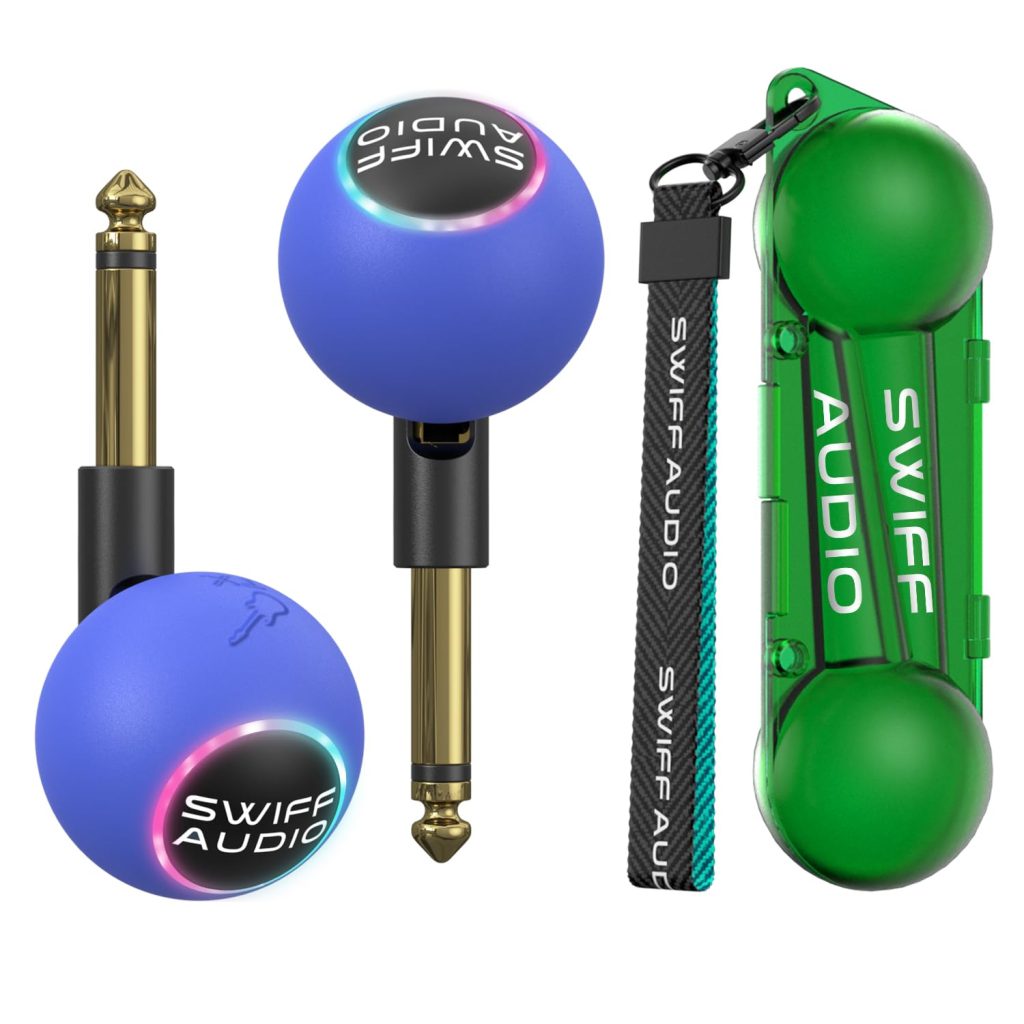
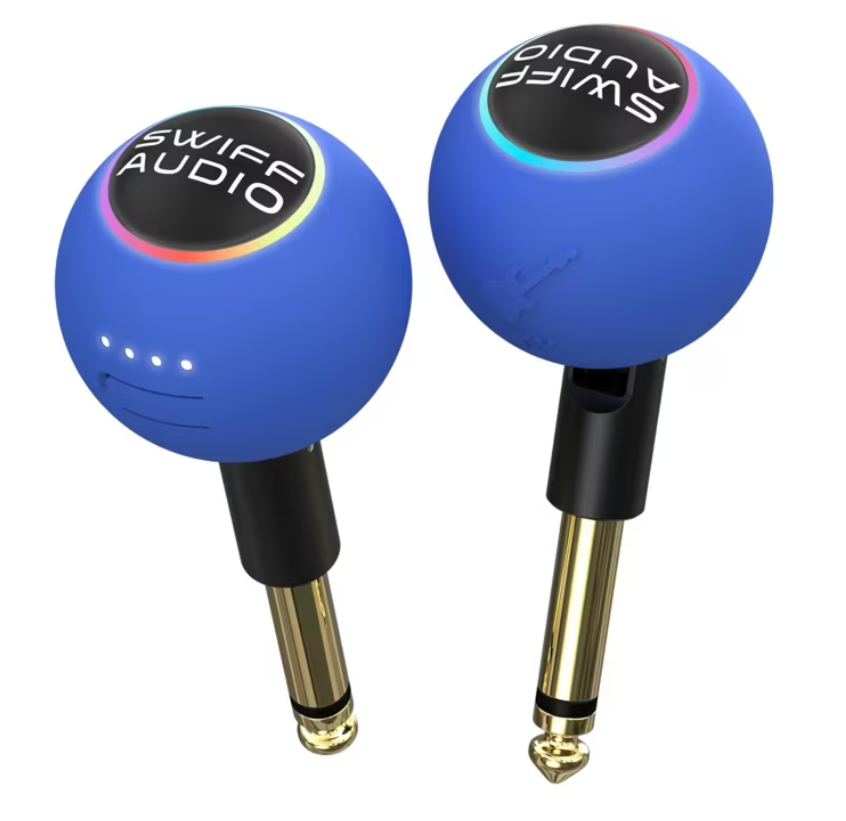
The WT09B is still impressively small and lightweight, with the transmitter plugging directly into your bass and the receiver connecting to your amp or pedalboard. The magnetic charging case remains one of my favourite details of the Swiff system. It keeps both units together and protected instead of allowing them to disappear somewhere inside your gig bag.
The whole package feels much more substantial than its price would suggest.
And that’s something Swiff seems to understand well. Packaging and feel. The packaging is premium and these products don’t feel like cheap wireless gadgets. They’re designed as pieces of gear that you can actually throw into a working rig.
5.8GHz: What’s the Difference?
The WT09A uses the familiar 2.4GHz wireless band, while the WT09B moves to 5.8GHz. Swiff’s reasoning is straightforward: the higher-frequency band is considerably less crowded than the 2.4GHz space, which is shared with an enormous number of Wi-Fi and Bluetooth devices.
The WT09B also provides six channels with automatic pairing and can support up to four systems simultaneously.
In practical terms, this is intended to make the WT09B a better choice for environments where wireless traffic is already heavy.
And this is where I think the WT09B makes the most sense as an upgrade rather than simply another version of the same product.
How Does It Sound?
One of the things I liked about the WT09A was that it didn’t immediately scream “wireless” when used with bass. The WT09B continues that trend.
The low end remains full and authoritative, and the instrument retains the dynamics and attack that made the WT09A such a pleasant surprise. The WT09B is specified for 20Hz–20kHz response and 24-bit/48kHz transmission, so there is certainly no shortage of bandwidth on paper.
Compared directly with the WT09A, the biggest difference isn’t something I’d describe as a dramatic change in tone. Instead, the WT09B feels extremely clean and immediate.
That’s exactly what I want from a wireless system. I don’t want a wireless sound, I want my bass sound.
Playing Feel
Swiff specifies latency below 5.5ms for the WT09B.
That’s slightly higher than the sub-4ms figure quoted for the WT09A, which might look strange on paper. In actual use, however, latency isn’t something I found myself thinking about.
Fingerstyle playing feels natural, ghost notes remain responsive, and slap doesn’t develop that disconnected sensation that can make some wireless systems unpleasant to use.
Once you’re playing, the WT09B simply gets out of the way, and honestly, that’s the highest compliment I can give a wireless system.
The Real Advantage
For me, the biggest reason to choose the WT09B over the WT09A isn’t that it suddenly sounds dramatically better.
It’s the RF environment.
2.4GHz is everywhere. Phones, Wi-Fi networks, Bluetooth devices and countless other pieces of equipment are competing for space in that spectrum.
5.8GHz doesn’t eliminate interference, but it gives the WT09B a less congested environment to work in.
That becomes increasingly relevant when you’re playing in rehearsal spaces, venues or stages where you’re surrounded by wireless equipment.
The ability to run up to four WT09B systems simultaneously also makes it considerably more interesting for bands than a basic single-system wireless solution.
Battery Life
The transmitter uses a 425mAh rechargeable battery and charges via USB-C, with the charging case keeping the system topped up between uses.
Battery life isn’t going to make me abandon a good wireless system, but it’s something worth keeping an eye on if you’re using wireless for long rehearsals or multiple-set gigs.
The good news is that the charging case makes keeping the system charged considerably easier. Put the units back in the case after playing and you’re ready for the next session.
WT09A vs WT09B
So, should you buy the WT09B if you already own the WT09A?
Probably not.
The WT09A is still a perfectly capable wireless system, and if you’ve already got one and it’s working reliably in your environment, there’s no reason to replace it simply because Swiff released a newer model.
But if you’re buying your first Swiff wireless system, I’d choose the WT09B.
The 5.8GHz transmission, 24-bit/48kHz audio, six-channel system and four-unit capability make it the more future-proof option.
Final Verdict
The WT09B is an interesting follow-up to the WT09A because Swiff hasn’t tried to reinvent the product.
Instead, they’ve taken a compact wireless system that already worked surprisingly well for bass and addressed one of its biggest potential limitations: the increasingly crowded 2.4GHz spectrum.
The result is a wireless system that remains small, simple and affordable while moving into a more interesting class of wireless technology.
For bass players, that’s a very good combination.
If you already read my WT09A review, you already know I was impressed with what Swiff managed to achieve with the first generation.
The WT09B doesn’t make the WT09A obsolete.
It simply makes the concept better.